




 |
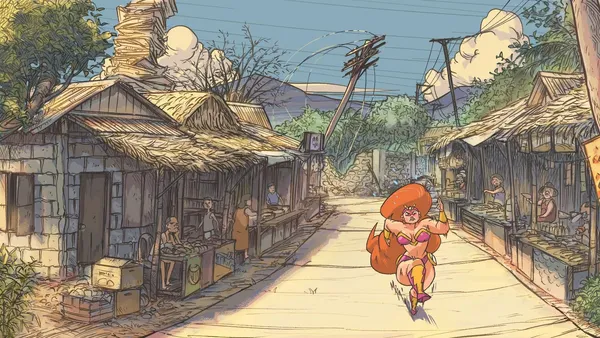
| Zsazsa Zaturnnah Photo: Fantasia International Film Festival |
“There was a live action version back in 2005, 2006. It was a graphic novel originally, then adapted into a musical, then a live action film. The live action film in 2005 adapted the musical. So this, our version, is the one that's more directly an adaptation of the graphic novel.”
Avid Liongoren and I are discussing Zsazsa Zaturnnah, a cult Filipino work which he has recently adapted into a film and screened at the Fantasia International Film Festival. The wild tale of a shy gay hairdresser who swallows a meteorite (don’t ask) and subsequently discovers that he can turn into a superheroine, saving his town from monsters, it’s an entertaining watch, but it also has a different kind of value, as it marks a milestone for the Filipino film industry. This time around, Avid explains, it was always going to be animation.
“When we began production, there was a choice to make it live action. Then me and the original creator, the author of the graphic novel, talked about it and he said ‘If we pursue live action, we get to put more creative fight scenes into it and go more all out in the ridiculousness.’ So that's why we can make it more ridiculous than it already is. That's why we chose the animation.”
In its home country it’s an iconic thing, which many different forms and many fans. Was he ever nervous about taking it on?
“No, not at all,” he says firmly. “One, because we were doing animation, so we knew that it was going to be in a different medium, a different format. So we knew we were good. We were going to give it something different from all the past versions of it. And two, because the original creator is also a screenplay writer. I knew I was going to give it justice because the creator is right there. Carlo Vergara, the creator of the original comic, is the one writing the screenplay, so every step of the way he knew what we were doing, and I would consult with him. ‘Is this true to the character? Is it true to the IP?’ And he would give it his blessing.”
He was a fan of the comic from the outset, he says.
“It was such a great time, the first time I read it in 2002. It was black and white, the original graphic novel. So your brain is like, ‘Oh, this would look great in colour and moving.’ But of course, it took me 20 years to gather the resources to make this possible from the very first time I read it.”
By the time he came to direct it, he says, he was looking at a very different animation style.
“The first graphic novel was drawn in a very Western style in black and white. We pretty much had a free rein to interpret it for animation. So we designed from scratch. Of course we took designs from the comic book, but we could [make changes]. First of all, in the comics, Zsazsa is drawn like your typical Marvel superheroine. She's like a Ms. Marvel or a Supergirl type figure. So when we began designing for animation, we're like, ‘Oh, let's make her thicker. More Rubenesque.”
I tell him that I like it because she looks more muscular like that as well. More convincingly powerful. I like the fact that when the hero transforms into a woman, he gets stronger.
“We wanted to really create a strong look. Ada, the lead character, is all straight lines, you know? He’s very conflicted because he's very timid and very shy. And then when he becomes Zsazsa, it's all round shapes, big hair. So it's like freedom, you know? That's what we wanted to do. We just really wanted to have a huge difference between the two characters.”
Why did he choose the particular monsters that we see her fight?
“In the original graphic novel, the only monsters she actually fights are the giant frog and the zombie,” he says. “We wanted to create this Hercules type montage – remember in Hercules, the Disney film, the training montage where he gets better at what he does? That's what we wanted to mirror. We needed to show her getting used to her powers, and we also needed to show that the Amazonistas were sending all sorts of monsters. It was our opportunity to just be really ridiculous and have like a giant phallic eggplant, a giant cock and roaches and all sorts of monsters. It was just to really show her getting better with using her powers.”
When it comes to the main fight sequence that we see almost at the end of the film, it's really dense, it's really fast. There's lots of moving around to different locations. How long did it take to put that together compared to the rest of the film?
“Well, the entire film took six years to make. And we are not a big studio. We practically had to sell our internal organs just to keep the lights on, you know? We wouldn't be around if it weren't for grants from our government and what we were doing to keep the film alive. I mean, we managed to get some investors, but the bulk of the money came from my studio doing paid jobs, and everything we made from work for hire, we put into the film. It’s a shitty business model. Not really much of a business, in that we take everything we earn and put it into the film.
“That was six years total of our lives. This wasn't white when I started this,” he says, tugging at his hair. “And now it's all white.”
The final fight took up a big part of that time, he says.
“We spent a good two years just working on those fight scenes. Those are the hardest to put together because, like you said, there's a lot of movement. But I guess the nice thing about when you're doing fight scenes is you don't need to pay attention as much to the model because there's so much movement. On the flip side, it's equally hard to do quiet scenes because that means you have to be more laborious with your consistency because they're just talking, so you have to keep making sure that the eyes are right, the noses are right, and that there are more nuances to the smaller scenes.
“You can't pull off a talking scene with just people talking. You need to create little gestures so that it's not boring to watch, so it's equally as hard. It doesn't take as long but it's harder to keep consistency when you're doing small talking scenes over fight scenes. Fight scenes are laborious because you have to do so much, but your consistency is in the movement. You make sure the movements flow into each other, but not so much the nose should be exactly shaped like that, or the eyebrow, because they're moving anyway.”
The flashback sequences when we're looking at Ada's childhood are quite different in tone.
“Yeah. That's actually a very Filipino thing to do. We tend to take tragedy and laugh at it very quickly. In the Philippines, somebody would die or you'd be in a funeral and there would be karaoke during the funeral, you know? That's a cultural thing in that we quickly shift from remembering trauma to making silly jokes right after, because we don't sit with it, I guess. I mean, I guess the deeper reason behind that is we don't really have access to mental health care professionals to help us process trauma, so the easiest way to process trauma is to laugh at it. I don't think it's the healthiest, but that's how we do it. Just push it back with jokes.”
As well as making it more entertaining, the humour strengthens the local character of the film.
“One of the things that we really wanted to do was to be unapologetically Filipino. If you work in the graphic arts, if you're working in cartoon and comics, oddly enough, we don't know how to draw the Philippines, because we grew up on Marvel and DC anime. We close our eyes and we can easily draw cities in the ‘States or cyberpunk cities or Tokyo or New York because we grew up reading Spider-man or watching Disney. We can draw castles but not houses outside our windows, you know? It's not part of our visual library, because we don't have media – there's no industry for us.
“A young art student is looking forward to working in either anime or Disney, so you get ready for that kind of work. There is no original animation scene in the Philippines. Our animation industry is tilted towards outsource work. The big studios around the world, they send their grunt work to us. So we have thousands of animators working like a call centre for a foreign company. Our training is towards outsourcing, so we don't really know how to draw Filipino-looking cartoons, which is what we tried to do in this film.
“You know, like when you look at anime, they don't actually look ethnically Japanese. They actually look like cats. They don't look like Japanese people. But it's tied to their identity, you know – it's Japanese. We don't have the equivalent of that yet.”
Did the effort to be more Filipino apply to the characters as well? They have more rounded, more naturally Filipino-looking bodies.
“Yes, we really were very conscious about that. Let's not be Marvel. Let's not be anime. Let's just try to represent ourselves in this medium as well. Because you know, in live action film, it's easy to represent your country because you're literally just putting the camera on what exists. But in animation – it sounds ridiculous, but we had to learn how to draw ourselves, because we don't do that. We all close our eyes and when we think cartoons, we see Disney, we see anime.”
By being at Fantasia, on the international stage, can this film can help to change that a little bit and maybe create fresh opportunities for animators in the Philippines?
“It won't be this film,” he says. “We need a lot of us making films to create something that could be identified as distinctly Filipino. It's not just one film. We need to keep at it to somehow, someday arrive there. And we know we are just at the very beginning of this journey of creating Filipino animation.”
If you’d like to check out some of Avid's previous week for free, he points out that Saving Sally is now available on YouTube.