





Eye For Film >> Movies >> Godhead (2026) Film Review


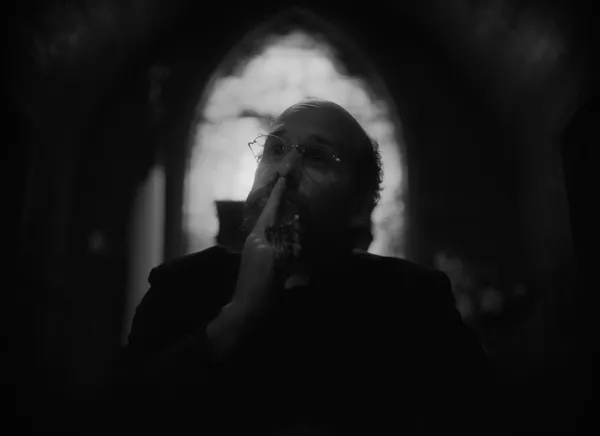

The two twins, identically dressed in white tracksuits, both with the same very direct gaze, have a quality about them from the moment they walk into the church that the Father (Al Warren) knows means trouble. He ensures that they’re alone and explains to them that if they need money they are welcome to take whatever they like; he won’t put up a fight. Unfortunately for him, what they want is of an altogether different order. “We are looking for a resolution by an unbiased third party,” says the one who calls herself Firstborn (Sarah Coffey). One of them, she insists, is possessed by the Holy Spirit. The other he must kill.
Those familiar with Mark H Rapaport’s films – which must have included quite a few people watching this at Fantasia - will instantly have recognised this as his work. It’s not just the particular luminosity of the black and white photography, nor tthe angled observation of characters who regard one another straight on, but the religious context, the hints of incest, and the insular nature of the world in which it is set. The church is evidently the centre of a small, isolated rural community. The Father himself lives in an even smaller world part of the time. Somewhere in the adjoining property is a boy (Luke Speakman) who was left in a basket on his doorstep as a baby. The Father has raised him, cared for him, evidently loves him, and yet something there is very, very wrong.

“Did I ever tell you about the eighth day?” he asks the boy after they read a book about the Biblical Creation. “On the eighth day, God went away...That’s why we stay inside, where it’s safe, ‘coz it’s crazy out there.”
It is evidently not crazy out there, or at least not to that degree; if it were, the Father would not need to do the other things that he does. That he knows he is in error, or fears what else he might do, we know from thescars on his back. But the kind of craziness Firstborn brings with her is not something that he has anticipated. Secondborn, by contrast, is quiet, mild-mannered. Played by established Rapaport collaborator Kimball Farley, he has a sort of innocence about him. Does he truly believe in what he’s doing, or is he simply swept along by his much more forceful sister? The Father suspects that he needs help – and yet in the film’s srcond half, when Secondborn finds his way to the boy, viewers may wonder if one or both of them is in danger.
Measured performances help to keep this precarious, unsteady film on balance as its various pieces come together. Firstborn is a near-constant provocative presence, and can be wearing, but this perhaps speaks to the pre-existing, ongoing strain inherent in the Father’s struggle with his faith. It is a film about choices on multiple levels, but perhaps the most important of these is the least obvious one: the choice to keep on going, for better of worse, even when there seems to be no room for change. Fixed ideas more comprehensive than religious beliefs themselves keep the Father and Seconborn trapped even as the two more naive characters find room for growth.
With little movement between locations, it’s easy to imagine this working as a stage play, and yet the framing choices matter a good deal, especially towards the end. What might initially seem absurd for the sake of it reveals unexpected depths both structurally and philosophically as it moves towards an ending which flips everything on its head. In a cynical age, Rapaport makes bold choices. It feels like the beginning of something, and one hopes to see other filmmakers get on board.
Reviewed on: 26 Jul 2026


Director: Mark H Rapaport
Writer: Mark H Rapaport
Starring: Luke Speakman, Al Warren, Kimball Farley, Sarah Coffey, Sidney Baxley, Mila Middleswarth
Year: 2026
Country: US
Search database:
