





Eye For Film >> Movies >> No Rest For The Wicked (2026) Film Review


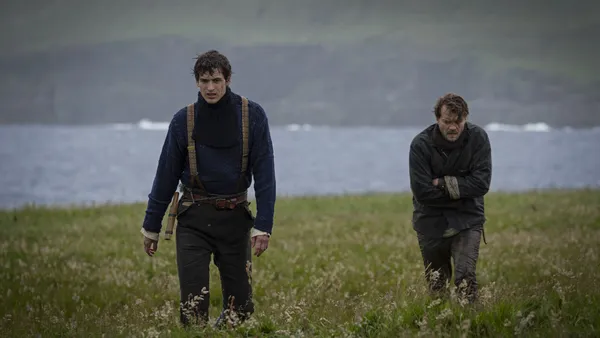

It’s not true that there are no trees on the Faroe Islands, but they are few in number and they do not grow tall. The North Atlantic wind scours this land mercilessly, so that even buildings huddle close to the rock. Great lumps of basalt reared up by ancient volcanism, these isles are a hard place to make a living, and all the more so back in the 1860s, before they were linked by tunnels and bridges. Although he goes out in a boat to catch fish, young Baldur (Egor Venned) has never strayed far from the shore. When the fog comes down, even that can be dangerous.
It is in such a fog that Baldur meets, and rescues, stranded seaman Helge (Pilou Asbæk), who has come to the islands aboard a whaling vessel and plans to depart when the next such opportunity comes around. In the meantime, he spends time with his young saviour, helping with various tasks and grateful for the meals made by his mother, Ásla (Sofia Nolsøe). Helge is an adventurer who has embraced his high risk form of work as an opportunity to see the world, and delights Baldur with stories about it. In a place where visitors are few, even the simplest things, like a new rope trick, can thrill and amaze. There’s a kind of youthful hero-worship going on here, and yet over the brief time that they have together, it becomes apparent that there’s also something else. Something so intense that even death cannot stop it.
This film has been billed as an unusual vampire tale, but it has more in common with tales of dreygur (known elsewhere in the north as draugr), and this would seem to be crucial to the central metaphor. The innocent. almost instinctive ritual upon which the film turns involves calling out to a god – but which god? When blood falls into water, a more ancient deity might be invoked. Later, water running along the ground will behave in unnatural ways, speaking to a lore which preceded the Christianisation of the north. That older way of being did not place itself at odds with homosexuality. There is a sense here of two different moral systems operating in close proximity, so that to be ‘wicked’ is, in its essence, simply to be connected to a different way of thinking, one which becomes dangerous to the islanders only when they threaten it.
Interwoven with both traditions is a still more persistent element of lore: the idea that a spontaneous love, emerging outwith social constraints, is connected with the withering if the body in this life and the growth of the spirit in the other. In laying claim to this element for a story about two male lovers, writer/director Kasper Kalle gives it a natural folkloric foundation and creates the sensation that this could be a story told, in different forms, across centuries. The bond between the lovers emerges as a sacred thing which must be respected, lest its rejection bring destruction upon everyone. This is one of the areas in which Christianity has found it hardest to establish moral authority, and the film suggests that a religion unable to bend will break.
None of this would be worth a damn if the romance at the centre of the story did not convince. Its success is all about the casting and performances. Asbæk begins with the same kind of bravado we saw from his Euron in Game Of Thrones – Helge has all the obvious power in the situation, and likely has a boy or a girl in every port – but this makes his sudden shift of gears when he recognises the strength of Baldur’s feelings all the more affecting. Venned, meanwhile, has no acting experience at all – he’s a model by trade –and in context this is an advantage, as he gives a completely open, guileless performance which is apt for the young islander.
The third player in this situation is Nolsøe, who carries much of the emotional weight of the film’s second half. Sofia’s love for her son is a complex thing, bound up with her feelings for his deceased father, her fear of what can happen at sea, and her awareness that she is getting older and has no other source of support. There is also a hint of potential jealousy after the rapport that she develops with Helge on their first meeting. Beyond that, her conduct is shaped by awareness of social codes which, for her, could be essential for survival in this world as much as the next. Nolsøe navigates this fearlessly and gives the film a depth which the men’s work alone could not provide.
Also essential to the experience of the whole is the music, with haunting Faroese songs setting the tone at critical moments and enhancing the film’s timeless quality. Jacob Møller’s cinematography brings out the mystery and danger of fog; the bright urgency of summer days, green grass and sparkling water on pale bodies; and the weight of darkness with equal surety, whilst sound designer Morten Groth Brandt is alert to the sound of sea in all its different moods, whether you think you can hear it or not. The film is a happy confluence of all these elements and has that sense of completeness that one finds in cinematic classics. If you’re in the mood to be spirited away, look no further.
No Rest For The Wicked screened as part of the 2026 Fantasia International Film Festival.
Reviewed on: 24 Jul 2026