 |
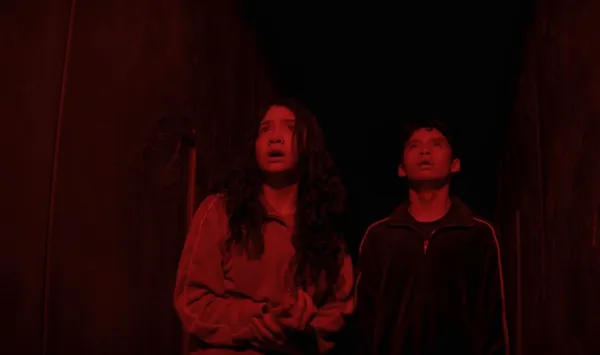
| Home Bodies Photo: Fantasia International Film Festival |
American director Casey Walker's Home Bodies, written by Steve Manale, Adrian Murray, and Marcus Sullivan, is a story with a simple premise. Two adolescents, one a girl called 'Red' (Emma Ho) and a boy called 'Blue' (Ian Ho), live in an automated house. They convene daily with papa, a disembodied voice. On Christmas Day, he announces the arrival of Pal (Ess Hödlmoser) a mute android who the children are expected to look after. Pal's arrival, however, creates a rift between Red and Blue.
Walker has previously produced The Void, Pyewacket, and In A Violent Nature. He has directed A Little Bit Of Zombie, about a dysfunctional wedding party who take a cottage holiday before the big day. If the squabbling weren't bad enough, things go awry when the groom gets bitten by a mosquito that just happens to have bitten a zombie first. He has just completed the famine horror Ithaqua.
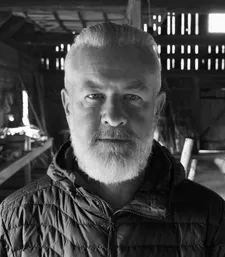 |
| Casey Walker |
In conversation with Eye For Film, Walker discussed the value in creating distance and emptying one's head throughout the filmmaking process. He also reflected on enforcing necessary rules and the extensive prep.
The following has been edited for length and clarity.
Paul Risker: There's the idea that there are three versions of a film. There's the film you write, the film you shoot, and the film you edit. Do you agree, and would you describe film as a journey of discovery?
Casey Walker: I've never been on a movie where you can go back and go minute per page for everything, and where everything’s perfect. Most of the time on set, when you're trying to achieve what's written, you're also rolling with every curveball that comes at you. And sometimes that means scrapping a page or a scene or changing dialogue. There might have been an improv or a happy accident that came along, and you said, "Oh, let's go in that direction…. let's explore that." But then when you take all of that stuff that may or may not be in the script into the editing, some of those things you explored might no longer be working.
I rewrote dialogue for the kids and papa in the edit, so I could sculpt the story and the performances a little more and to really build on the nuance that I was trying to get across. I wanted to ensure our emotional arc was consistent. Film after all is an editing medium.
PR: Is the edit a part of the process that you have a particular affection for?
CW: I love all the work I do before I make the movie because it gets me excited and a lot of ideas come out of it. But then I love filming. I love being on set and collaborating with that family. And then I love being in the edit. I thrive in all three, but the edit is one of those spaces I have a lot of fun in.
I have a longer process, and it's not like: "We'll edit it in 20 days and walk away." I like to take breaks, and I will not work on an edit on Fridays. I'll work every day, but there are those jobs I let the editors do on their own when I'm not there. Then, on Monday or Tuesday, I'll come in and get a fresh perspective. I give myself time away because I find that I always notice something that we wouldn't have noticed without some distance.
When we are at the stages of the rough cut, fine cut and lock, I make sure my editor takes at least a week off at those points. There's this constant thing of money is time, and we should light it on fire as fast as possible. Well, that doesn't always lead to good content and good art. So, that distance in that space is what I try and afford myself to make sure that we are seeing things. And then, right before we lock picture, it's a ritual for me to go and see whatever Hollywood movie has just come out that weekend, which has the least to do with our movie. I do that to put something totally different in our heads before we go back and watch our movie one last time. And every time we do that, there's two or three little things that we find after emptying our heads that makes the movie so much better.
PR: The characters' personalities contrast and from the opening scenes they each have their own unique presence that helps to shape the story.
CW: It was important for me to make sure the audience got a strong sense of their presence and personalities. The longer you take to develop that, the harder it is to get an audience to buy in. And I needed that bandwidth for the repetition because you had to be able to see the repetition over 20 minutes to understand why 'Blue' might be so annoying right off the bat. At first, you might interpret it as that she's a sullen teenager, but after 20 minutes, you realise, she's not a sullen teenager because she's going through puberty and there's trouble at school. Instead, she's realising how fucking boring her existence is and there might be something more going on. And it's the same with him. He has this stunted growth and fear of change. All of that is so important to get in before we take the audience on the journey with the two characters.
PR: What was your approach to the film's visual language and world building?
CW: I'd had most of that imagery in my head and I knew how I wanted acts one, two, and three to change and what my broad strokes were. And then, for my cinematographer Bryn [McCashin] and I, this is the second movie we've done together in 18 months — our shorthand was solid. We went through the script, and we talked first about the emotion. He, like me, is very detail oriented. So, we've shared a massive amount of Google Docs on each thing.
We'll then talk about light a lot and how it plays into the course of the scene and how it creates tone and atmosphere. Then I do my shot lists on my own, but in our next meeting we'll talk through the shots and why, in my head, I need them for the edit. I really don't have to battle him, but Bryn forces me to come up with a really good reason why I want to do an insert or why I want to move the camera. He challenges me, and it's not so much him thinking, 'Oh, this guy has bad ideas' as much as he's trying to understand and get as deep as he can inside my head.
So, we spent two four-hour meetings a week for six months on prep before we started the month of prep with the rest of the crew. Within those six months, I was also working with my production designer because I'd already scribbled out on my iPad what I wanted for the set layout. I was very specific about the dynamics of how the hallways worked, and the necessary position of the kitchen, bathrooms, bedrooms, and living room for the flow.
We originally were going to have this pristine house and then break it down with an axe. But the economics, of that, in the end weren't possible.
I've always been an urban explorer, running around abandoned buildings, crawling in and out of things and climbing up on top of things. And I like decay. So, I thought, what if this space that they're in has the hint of a former majesty, but you can't really put your finger on when that time was. And the maintenance of it is ongoing, but it's obviously poor. But you also never see who's keeping the place together and the kids just see it as being like the world they've always known. So, there's no, "Oh, we live here." It's the only thing they've ever known and so, that's normal to them.
I established a ridiculous number of rules for my team because this simple idea that Marcus and Adrian came up with, even beyond what they comprehended, required an incredible amount of complexity in order for us to be precise in creating this world, and for the audience to be able to take that journey. If it wasn't maintained by those rules, there's no way you would be able to be immersed in this space. There are so many cheats or little tricks we couldn't use because it meant breaking the rules. If those rules were broken, I would have been in postproduction hell trying to put the movie together.
Home Bodies premièred at the 30th edition of the Fantasia International Film Festival.