 |
| Director Eriko Katagiri on the set of When You Open The Door Photo: Fantasia International Film Festival |
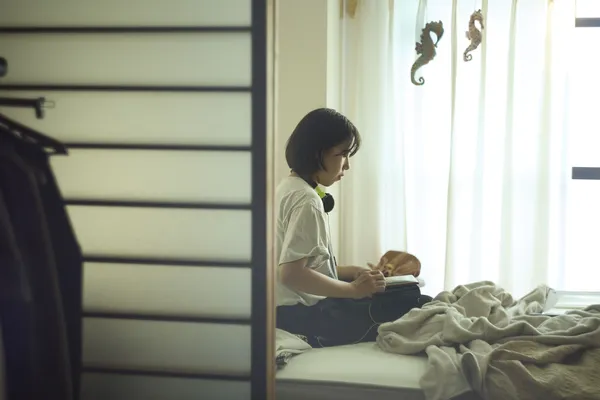
Most werewolf films are full of sound and fury and darkness. Eriko Katagiri’s is quiet, pale, delicate, but still with something wild at its heart. Screened as part of Fantasia 2026, where it charmed and thrilled the audience in equal measure, When You Open The Door might remind us that real wolves are, for the most part, quiet animals, but when I spoke with Eriko, with the aid of a translator, she explained that what she really wanted to emphasise was something different.
“One of the aspects that I was trying to portray is that her initial emotions were repressed and almost imprisoned. That was what we were trying to depict in the first half. However, in the second half we were trying to show something that would be more like getting released, and that was something that was intended.”
The heroine is Miki (Serena Motola) and she finds this release not just through being bitten by a wolf, but through connecting with a group of older women known as itako or ogamisama – part of a traditional caste of seers who go through intense purifying rituals into order to connect with spirits. Having done my reading, I mention my surprise that they are not blind or visually impaired.
“It was intentional [to include them] because itako are indeed kind of the type of miko that would be venerated,” she explains. “But in Okinawa, for example, they don't have to be particularly blind or anything. It really depends on which region the itako are coming from. There is different interpretation and different ways and procedures. Of course I was aware that a lot of itako are portrayed as not being able to see properly or being blind. However, in the case of Miki, we portrayed it as she can still see, but she is still a bit of an outsider to the society. She would still have some other qualities, but it would connect to how much of a difficult life it was that she was experiencing.”
We see her faint before she's bitten by the wolf and later we hear from her mother that she claimed to have encountered a wolf when she was a child. Was the wolf thing always part of her personality, just waiting to come out?
“Yes,” she says. “it was definitely the case that Miki would experience a lot of emotions inside her that she would not be able to control, and you could see it as the wolf.”
Miki’s treatment by a doctor whom her husband takes her to see shows us how’s people fail to take her seriously, she says, and we go on to discuss Miki’s troubled relationship with her mother.
“The relationship between a mother and a daughter is something that is very important. The way that the mother would always normally take care of their daughter would be like they would take care of precious treasure. But also that sentiment might sometimes feel suffocating, and really one of the ways that women can be sometimes a bit under emotional sway. Sometimes it would be sway from love, or no love. The children might feel that they are being loved and sometimes they would not be loved. And so for the children they might feel a bit scared of that.”
I suggest that we see that reflected in the way that Miki interacts with her dolls, and she agrees. I ask about the Java sparrow that Miki keeps as a pet.
“In one scene, you can see that there's a little five year old girl that, when she opens her eyes, suddenly turns into a 20 year old adult. The way I interpret it would be that when she opens her eyes and turns into an adult then that it's basically like the doll woke up. The five year old is kind of a bird, with very pure, innocent emotions, that is trapped into a cage. But there is kind of a dialogue between the doll and the caged bird, so that is one of the things that I tried to portray.”
Most werewolf films put a lot of emphasis on transformation or on gore and she has stepped back from those elements. Is that because she wanted to be able to focus more on thematic elements and make them take up a bigger emotional space within the film?
“Yes, I definitely tried to portray something more of what's inside the heart and more of the divine aspects,” she says. “In Japan there is the tradition of the odori, which is a dance that takes place during the ceremony of the dance. This is when the people would be dancing to bring the dead spirits around and dance together. I was thinking that I would like to portray that as a continuation of such a kind of dance, I was thinking maybe it would be kind of cute and fun to have something like that.”
With all this going on, it's a big thing for one actor to carry for the whole length of a film. How did she find the right person to do that? She saw her in another film, she explains, but it wasn’t her acting background that stood out.
“One of the things that she does as a main job is a fashion model, and one of the things that meant is that she did not have a lot of roles under her belt, but I really like the way she lives and her personality, so that is how I ended up finding her.”
She’s thrilled to have the film at Fantasia.
“I'm really happy that I was able to come to Fantasia. I could really feel that the crowd here are passionate about this genre of films, and I really felt honoured that I was being accepted here, because I love genre films. There's so much to see in terms of other films that I like. There's actually a movie from one of my older students that is going to be airing: The Mouse.”