





Eye For Film >> Movies >> Sour Minnows (2026) Film Review



Ever since he broke through with the singular Lace Crater in 2015, Harrison Atkins has shown himself to be a director with a deep interest in the structures of cinema and its relationship to the intersection of the real, the imaginary and the otherworldly. In his first feature for a decade, which screened at the 2026 Fantasia International Film Festival, he brings together a collection of odd ideas which individually seem meaningless but which, in combination, suggest a threat from something so alien that it is difficult to comprehend, let alone escape.
“It felt like something I wasn’t supposed to see,” says Ricky (David Brown), after he and his friend Tepper (Chase Williamson) stumble across a group of six men sensuously licking the pavement. It’s the sort of incident which people sometimes jokingly refer to, these days, as ‘a glitch in the matrix’, as if it were an indication that reality as we know it is artificial and cannot be trusted. Life tends to be easier when we dismiss such things, wondering later if they really happened at all; and yet Ricky can’t forget.
Back at their flat, he and Tepper see a news broadcast about the death of JoJo Montana (Phil Burgers), Hollywood actor and theoretical physicist. He’s talked about as if viewers might have known him personally, as an inescapable presence, and yet our heroes, despite being cinephiles – Tepper makes short films himself – are unfamiliar with his work. They sit down to watch one of his movies, Cries Cranberry. Afterwards, Tepper reacts as if he’s just seen something deep and moving, but Ricky can’t remember the experience of viewing at all – it has completely vanished from his mind. Another glitch? He begins to reflect on that fact that several times recently he seems to have experienced memory lapses.
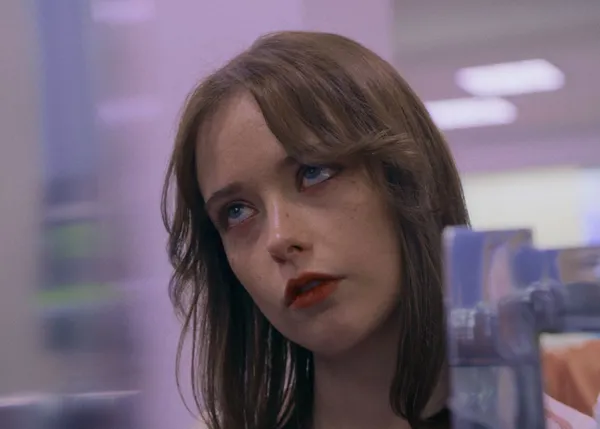
Filmmaking, uncertainty about what is real, parasocial relationships – there could be no more natural setting for a story like this than Los Angeles, especially an age where AI is bringing constructed realities into every home. Ricky spends his working life training AI. He also consumes a good deal of cannabis, but he still can’t account for the myriad small strangenesses in his life. He doesn’t even think about those occasional odd flashes of yellow – a very particular, unnatural yellow – until they are raised by Aura (Suzanna Son), a young woman who also has memory lapses and stole lipsticks in high school and is impressed by his film lore. From her, he learns about the local legend of a yellow thing which wears people like costumes (or, perhaps, like an actor exploring different roles). She puts him in touch with a network of people who claim to have had similar experiences.
Eat grapes, he is advised, and listen to jazz. It doesn’t like jazz. Is it uncomfortable with improvisation, with unpredictability? Or is it interaction, real communication through music, where something inimitably human is found?
Sometimes Ricky seems to see himself from a distance, as if he has briefly switched places with the audience. JoJo Montana spoke about the yellow thing before he died. Sometimes we see things in unexpected places. The newscaster from the television sitting in somebody’s back garden, become a prophet of despair but always in a carefully modulated, professional manner. In the mall, Ricky finds something unexpected in his pocket, but when he looks down, it’s the floor tiles which catch one’s eye: a uniform shimmering beige, like Hollywood skin, bright and unnatural. Elsewhere, a potted plant sits on a white faux-Classical pedestal, weighted with meaning yet entirely shorn of context. Watch it enough and your mind, as if learning a new language (a challenge to the established language of cinema?) will find or construct meaning – but can you tell the difference between the two?
Sometimes there is nothing to be said. The camera lingers on the actor’s faces, communication become voiceless. Hope seems far away. The film is dedicated to a friend and collaborator of Atkins, Jeff Baena (Life After Beth), who died by suicide shortly before its completion. One hears more and more about mental illness within the indie filmmaking community. It is a tough time to be a creator, seeing one’s efforts lost in a tide of soulless, meaningless AI slop.
Atkins’ characters search for meaning. Their messiness is testament to their remaining humanity; their flaws may be their best defence. At their most broken, they move through life like automatons, fulfilling the functions assigned to them like the zombies at the end of George Romero’s original Dawn Of The Dead. But inventive as he is, his work overflowing with ideas, Atkins himself is furiously alive, and Sour Minnows is rich in possibilities still to be explored.
Reviewed on: 31 Jul 2026


