





Eye For Film >> Movies >> The Leader (2026) Film Review


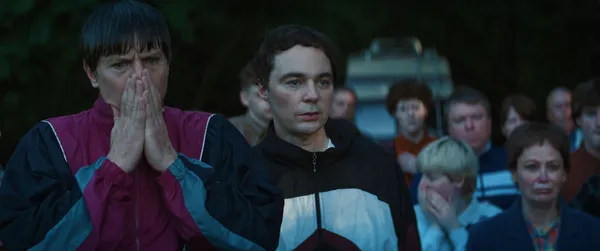

On or around 22 March, 1997, 39 members of the Heaven’s Gate religious movement, identically dressed, died by suicide in a large country house in San Diego County, California. All or most of them believed that, in so doing, they would free their spirits from their corporeal ‘vehicles’ so that they could ascend to a spaceship hiding behind the tail of the Hale-Bopp comet and travel to a futuristic paradise, escaping the imminent destruction of Earth. How did they come to hold such unlikely beliefs? Were they brainwashed? If so, by whom?
Watching Marshall Herff Applewhite (Tim Blake Nelson) deliver a speech about his beliefs at the start of the film, you’re more likely to be wondering where he found the rather striking purple curtains in the background than whether or not this rather dull, anaemic-looking man is the fount of all knowledge. How did such an individual come to wield so much influence? We encounter him first in the main part of the narrative when he’s in hospital having his stomach pumped after intentionally overdosing on prescription medication (an incident the real Applewhite always denied, claiming that he was only in the building as a visitor. There he meets the rather more charismatic nurse Bonnie Nettles (Vera Farmiga), and the two form an instant connection.

This bit of chemistry is rather more convincing. The actors sell it well, and we know from supporting scenes that Bonnie’s marriage is failing. This provides the first clue to the film’s thesis – that leading people is easier if one begins by finding people who want to be led. Furthermore, Bonnie will go on to act as co-leader for many years in the religion that the two of them come up with together. Whilst it’s implied that this may have begun as a scam or even as a game for Bonnie – Herff (as he is generally known) showing more signs of real mental instability – it become something more concrete for both of them over time.
“Our beliefs create the truth,” says Bonnie.
There’s a fascinating scene about a third of the way through where they brainstorm the practices they will include in their religion. Nothing here really smacks of revelation, but it’s not clear whether they are scheming, role playing or successfully selling something to one another (and themselves). Their leaps of logic are absurd but make a little more sense in the context of the beliefs with which they were raised (something we barely see here). The overall sense is that they are choosing a set of ideas which they imagine they can find fulfilling. Unlike many cult leaders, they are willing to have the same strictures that they place on their adherents apply to themselves.
The rules are many, covering everything from gender (do your best to eliminate it) to sex (don’t even think about it) to the correct way to make a sandwich (with no vegetarian option). The pitch is that once they have familiarised themselves with these, followers will be free from the myriad tiny decisions they would otherwise have to make over the course of a day, and their minds will be able to focus on spiritual matters. The reality is that everybody is so focused on trying to get things right that they have little time to think at all – which of course makes leading them easier again.
It would be impossible to represent all this without making people laugh, and director Michael J Gallagher acknowledges this with some scenes which place the absurdity up front, especially where followers interact with members of the public. This helps to keep the film from becoming one long spiral into misery. Although we know the ending, the fates of specific individuals are less certain, which creates a different level of tension. Gallagher takes care to create space for us to sympathise with some of them even if they also do things which, from the outside, look ridiculous. Grace Caroline Currey stands out as Michelle, a young woman who finds her way there after seeing a poster in a phone box when she’s at a low point in her life. They offer her hope and she grabs it, but she seems too sincere in her emotions, too alive in small ways for their fate to fit her.
Mentally managing all of the contradictions involved in the group’s beliefs requires a level of cognitive dissonance which is difficult to sustain. This acts as a filter of sorts, dissuading those who have merely reasoned themselves into that mindset, and reassuring those who have faith. Some scenes are observed from a distance, theatrically framed, as if those involved are semi-aware that they are playing roles. Every day spent in those roles represents a deeper investment, making them more likely to stay. This is how prophets hold onto their followers even when they fail. The group – and Herff – will experience a major test of faith before they get anywhere close to seeking out the mothership.
The timeline here is compressed for dramatic effect, and a few minor details are changed, but it is, overall, a fairly accurate depiction of the known events. What’s really significant is the way that Gallagher highlights Herff’s uncertainties and crises of faith, especially towards the end, and the way that he not only tries to reassure himself but is actively reassured by other members of the group. By this stage, a feedback loop has developed. They talk each other into things such that even when those things are deeply worrying (and too much for at least one member), the emotional rewards for accepting them are huge. To doubt would be to be alone and frightened; to concur is to be part of a warm and loving family.
Who, then, is leading who? Here, ideas do not flow hierarchically: they are conceived in the space between two individuals (that same space where the Apostle Mark argued that we can find God); they emerge from conversation and are endlessly recycled, coming to seem more like the obvious truth every time. They hijack the circuitry of brains which evolved to see patterns, as well as to anticipate threat and seek safety in community. Herff, whose doubt might otherwise have saved him, is helpless against this. Death wears a smile.
It’s a complicated role, and Nelson approaches it with courage, using his charisma to charm when necessary but always keeping it on a tight leash, whilst exposing depths of emotional frailty. Farmiga also impresses, building something emotionally coherent out of an intellectually messy individual, and the two complement each other beautifully. The film is slow but it’s difficult to see how else one might cover events which took place over 20 years without sacrificing that important humour. Even with it in place, some will find this too depressing to watch. It is, in that regard, a welcome alternative to the sensational depictions of cults that we tend to see in cinema. The real life suicides sparked copycats; it is difficult to see this providing anyone with that sort of inspiration.
The reality of ‘cults’ (always a difficult term, with no clear definition) is that they have a tendency to fascinate from a distance, but up close they are grimly mundane, if not outright miserable. Gallagher shows us the positives that Heaven’s Gate offered to its members, but also makes it very clear how accessing those in this way required the sacrifice of reason, and ultimately of life. If you’re looking for escapism and dreams of a future in the stars, let The Leader be a warning, then go back to the cinema and watch the latest science fiction blockbuster and live.
The Leader screened as part of the 2026 Fantasia International Film Festival.
Reviewed on: 02 Aug 2026


