 |
| Public Access |
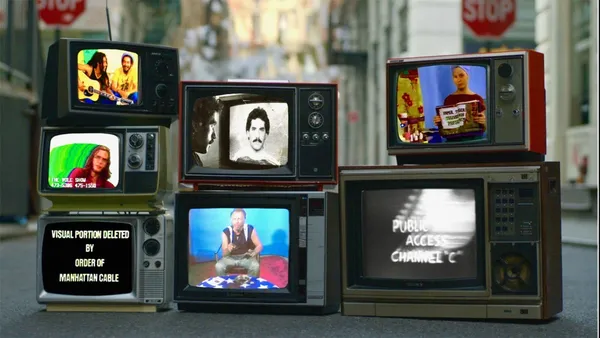
Documentarian filmmaker David Shadrack Smith's Public Access takes audiences inside New York's ground-breaking television experiment. In the early 1970s, one television channel gave anyone and everyone the opportunity to create and broadcast their content. From musicians including Patti Smith and the rock band Talking Heads, to shattering the rules with taboo material, New York's public access became a platform for the counter-culture movement, alongside a broader freedom of expression.
Ahead of the première at the 2026 Sundance Film Festival, Eye For Film spoke with director David Shadrack Smith, alongside television writer and comedian Jake Fogelnest, who launched his career with the public access show Squirt TV.
They discussed memories of this specific chapter in media broadcasting, the film's philosophical inclinations, and their questionable hopes for the future.
Paul Risker: What compelled you to want to tell the story of public access television, and why now?
David Shadrack Smith: I grew up watching public access TV. I was a kid in New York, as Jake was and many of us stumbled on this wild channel that was just living on the dial next to all the other mainstream stuff. And it just left an indelible mark. It was the first time users could create their own content and broadcast it. That was a revolutionary idea that we take for granted now. I think the DNA of seeing people just have the guts to do it, embedded itself in me as a filmmaker.
Many years later, my career as a documentary filmmaker went in all sorts of ways, but I never forgot what I saw. And I'd watch my children consume the media's version of public access today, that we would call social media. There are important differences, but really, a light bulb just went off, and I realised that's kind of what I was looking at — there was something comparable there, which I wanted to investigate.
I just went down that rabbit hole and found so much more than I remembered or knew. There was a lot of relevance. And as we've been making the film, issues of the first amendment, free speech, self-expression and protecting spaces for self-expression are even more relevant than when we started the film. That's why I felt I had to make this film. This is me as a kid dreaming that I could make something, and now, I get to make it. And it feels timely.
PR: What's interesting about this documentary, is there are people for who it will be like a memory, whereas others will be discovering a part of New York's cultural history.
Jake Fogelnest: Like David, I remember being a little kid and discovering these public access channels and going, "Whoa, this is nuts." I thought, 'These people are on television doing some of the funniest stuff I've seen... There's some stuff here that is definitely informing my sex education.' And when I was a teenager I said, "I'm going to do one of these public access shows."
It went sort of proto-viral and the tapes would get sent around everywhere. Even back in the Nineties, people coming into New York City from Baltimore or even the UK would get to their hotel room, turn on the television and think, 'What is this? It's crazy!'
What's wonderful about this documentary is for those lucky people who were in New York to experience it first-hand, it's great to see some of this stuff again. I lived it and there's stuff in the film that I had never seen before. But what's really cool is that it puts you in another world that is reminiscent of the world we live in today. It's like, "Oh, that person's doing porn" or "That person's very passionate about a political issue." All of this was going on in the 70s, the 80s and the 90s on a very local scale, and it mirrors the larger world that we live in today, which is so globally connected. Essentially, we're going through the same thing, and there's a lot more of it.
DSS: […] This is something that's come up before. Anyone who saw it, remembers it because it's seared into your brain. You'll never forget it. And the nostalgia of that is very present in the film, but it was localised; it wasn't global. I've had to explain the concept of public access to either people who were too young to remember it or people from around the world who didn't have it. I have to say, "Well, you're going to discover that this whole thing we live in now has happened before, and we are going to take you on an archaeological journey into the foundation of the world we live in now. You're going to see how it turned out, because that's what we're living through." And some who have seen it, who are under the age of 30, had no idea it existed. I think their minds were just blown by what people were doing.
PR: On one level, Public Access explores the idea that culture is filtered through a series of recurring patterns. It provides it with a philosophical side and reminds us that to understand the present, we must understand the past.
DSS: It is a philosophical film in some ways, and it's also really fun, we hope. But at its heart, it does get to this idea of the nature of human creativity. It is a celebration of this urge we have to be heard, to connect with others, and to put ourselves out there. And if you give us space, then we will fill that space.
Now, what happens, which is also remarkable, is how we use that space, and how it is a mirror of us. And what we see happening in Public Access and what we see happening now shows the full gamut of the human identity. There's so much good that comes out and there are plenty of things we'd rather not see or know about. We grapple with how to control that, but ultimately, we're yearning to express ourselves.
JF: And a lot of that expression can be through humour. Sometimes it is not; sometimes it's just straight up hate or anger. But ultimately, people want to be seen, heard and understood. And there's more and more opportunity to be seen and heard, but in the time that we're living in, you're not necessarily understood the way that you want to be, and that's the tricky thing that we're navigating right now.
PR: Early in the documentary, there's an interrogation of whether some of the content is pornographic. Even here, Public Access shows its philosophical side by tapping into the idea that people just want to feel seen, heard and understood. However, pushing cultural boundaries complicates this.
DSS: You could say we made the editorial choice to raise the question and not provide the answer because who are we to answer?
JF: This is a discussion that we're having now and will continue to have.
DSS: There will be a new technology; there were technologies that preceded this one. Art, creativity, the mediums of self expression, the technologies that underlie it are going to keep changing and we will use them. And there's a responsibility on us too, to talk about and think about how we best want to use these.
JF: And maybe we can reduce the fear around those conversations by looking back and saying, "Oh, wait a second. We've gone through something like this before."
DSS: The world hasn't ended yet, and we'll see what the next one brings. But they do keep scaling up.
JF: Things are going faster and faster.
DSS: I'm not totally optimistic, but generally speaking, yes, there are always these moments with each new technology that allows us access.
Public Access premiered at the 2026 Sundance Film Festival in the 'US Documentary Competition' strand.