 |
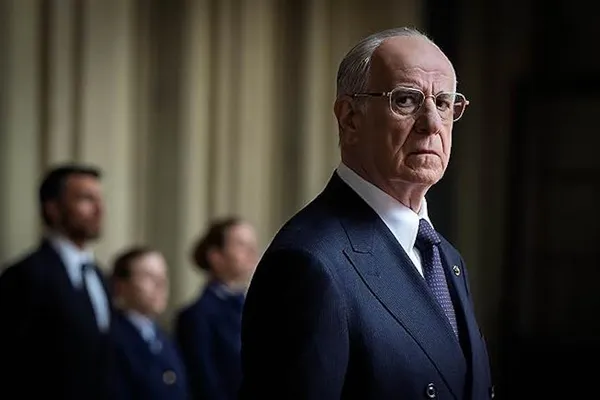
| Toni Servillo (as Italian President Mariano De Santis) in Paulo Sorrentino’s La Grazia on costume designer Carlo Poggioli: “I guess for Poggioli it was challenging to give the overall sort of vibe or mood for the movie.” |
Toni Servillo, star of Paolo Sorrentino’s Oscar, BAFTA, and European Film Award-winner, La Grande Bellezza (plus È Stata La Mano Di Dio; Loro 1 & 2; Il Divo; Le Conseguenze Dell'Amore; L’Uomo In Più), joined me and interpreter Lilia Blouin on stage at the SAG-AFTRA Foundation Robin Williams Center in New York for an Italy on Screen conversation (hosted by Loredana Commonara) on his latest Sorrentino collaboration, La Grazia (a highlight in the Spotlight programme of the 63rd edition of the New York Film Festival), in front of an invited audience of Oscar and Golden Globe voters.
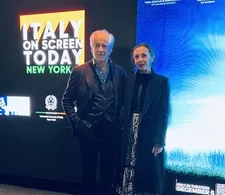 |
| Toni Servillo with Anne-Katrin Titze: “From time to time I would call up Paolo and say, hey don’t forget about La Grazia!” Photo: Lilia Blouin |
Servillo’s illustrious career includes working with Roberto Andò on three films - La Stranezza (Strangeness), Le Confessioni (The Confessions), and Viva La Libertà (Long Live Freedom), Marco Bellocchio on Bella Addormentata (Dormant Beauty), and Daniele Cipri’s È Stato Il Figlio (It Was The Son).
Paulo Sorrentino’s profound La Grazia, his seventh starring leading man Toni Servillo (Best Actor winner at the 82nd Venice Film Festival), lets us catch a peek into the life and mind of Mariano De Santis, President of Italy, during his final months in office. Unlike real-life Prime Ministers, Giulio Andreotti (Il Divo), and Silvio Berlusconi (Loro), which Sorrentino and Servillo tackled in earlier films, this statesman, whose nickname is “Reinforced Concrete,” is an invention.
La Grazia can mean many things in Italian, among them “official pardon”, and De Santis wrestles with two possible ones, as well as with new legislation on euthanasia. He is a widower and works closely together on these issues with his daughter Dorotea (Anna Ferzetti).
“Who owns our days?” This becomes the fundamental question. In the evening he sneaks out on the roof with his trusted Cuirassier, Colonnello Labaro (Orlando Cinque), to smoke one cigarette. And he confides in the Holy Father (Rufin Doh Zeyenouin, who rides a motorcycle) that he feels lonely. His wife’s infidelity from 40 years ago haunts him and their old friend Coco Valori (Milvia Marigliano), who presumably knows who the affair was with, taunts him, scolds him, and cheers him up simultaneously. As a man who always needs more time to decide, and with exactly this running out, he is riddled with doubt on many levels.
In our conversation, Servillo and I discussed his show-stopping rap and the valiant Alpini song, what La Grazia means for him and his director, the costumes by Carlo Poggioli, how different this character is from the flashy Jep Gambardella, his role in the Oscar-winning The Great Beauty, the relationship with the cuirassier and Coco Valori, and what a gift it was to play such a doubting, graceful man, aware of his power.
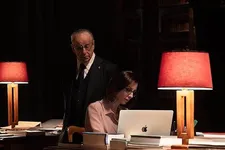 |
| Italian President Mariano De Santis (Toni Servillo) with his daughter (Anna Ferzetti): “This President is someone who is actually guided by love to a great extent.” |
The evening and screening of La Grazia was introduced by Fabrizio Di Michele, Consul General of Italy in New York.
Anne-Katrin Titze: Let’s jump right in with two of the showstoppers! The rap and the valiant Alpini song! Which one was more challenging? Which one was more fun for you?
Toni Servillo: Definitely the rap was hardest. But it was also the most fun. What I think was interesting, was that Paolo Sorrentino imagined this man who is moved by singing the Alpini song and then afterwards when he is all alone at home, he tries to sing the music he thinks his daughter likes. And to try to say goodbye to his life and his mission as the President by giving space, giving a little bit of space, a crack of light to come in that takes him to look to the future and not just the past.
AKT: Which is fascinating, because those two songs do represent that, the look into the past and the look into the future. And the grace it takes to maneuver between the two. I’d like to talk a bit about the title. Because in Italian la grazia is more than grace. It is also pardon and mercy and favour and blessing and charm and so much more. Can you talk about the title?
TS: I think grace is something that enlightens the thought, but I don’t want to complicate this evening more than I should. I’m sure St. Augustin devoted a lot of writing and thoughts to it. We should stick to the definition Paolo Sorrentino always mentions, and that is that grace is the beauty of doubt.
This is a movie that Paolo wrote over three years ago, before Parthenope, and then he shelved it for a little. It wasn’t the right time. Then eventually we did make it. What I find fascinating in this character is that he’s a very unique President of the Republic. This is a President who is radically different from the presidents that we tend to see in the same age, who tend to be arrogant and who show muscle in a very sort of tough-man stance. He is rather the opposite. He leaves nothing to show business, he has a great moral rigor and a solid intellectual life. He is faced with two important decisions; he has to decide on two pardons and a law on euthanasia.
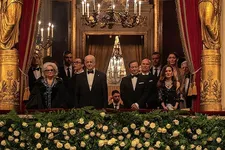 |
| Coco Valori (Milvia Marigliano) with De Santis (Toni Servillo) at La Scala |
And he is tormented by doubt about his decisions. He goes through all kinds of conversations that bounce back and forth with his daughter, with his advisors, and he is also deeply impacted by the death of the horse of his head of the Presidential Guard. We should go back to the definition of grace that Paolo came up with, that grace is the beauty of doubt, which inhabits the President up until the very last minute. It is challenging to do that and there’s no time to be led astray by other thoughts. The President really needs to focus on the resolves of what he has been pondering over during the course of the movie.
AKT: It’s interesting that besides all of these pressing issues, he is in mourning for his wife and he is tormented by her affair from 40 years ago. The interweaving of the personal and the decision-making is beautifully done.
TS: Yes, this mix between who I am in my private life and what I show to the public is something that viewers tend to find fascinating, it’s something that draws the viewer in. This going back and forth between the private sphere and the public sphere allows us as viewers to get a glimpse into the life of a President of the Republic, which we normally see through a newspaper. In this particular case, having this dimension warms us to him and there’s a dimension of affection that normally wouldn’t be there. This President is someone who is actually guided by love to a great extent.
The love that he feels and felt for his wife, and then he has this obsession with the betrayal and the cheating. And the love that he feels for his daughter and the love he feels for the law, as a law scholar - so he’s definitely a person who is deeply oriented by his feelings and things that he tries to hide. But they do govern his directions, definitely over the last six months of his mandate, which turned out to be pretty much the last six months of his life before he gives in to old age.
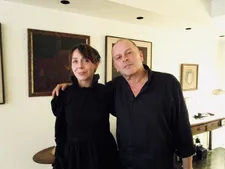 |
| Anne-Katrin Titze with La Grazia costume designer Carlo Poggioli at Ann Roth’s apartment Photo: courtesy of Anne Katrin Titze |
AKT: On another note, a few years ago I was at the apartment of the great costume designer Ann Roth, and there was Carlo Poggioli, the costume designer of La Grazia. He told me that in every costume, he always adds something that is wrong, an accessory, a detail that’s off. And that makes the person real. So I was looking at your costumes, which are clearly not in the center of the film at all, and I was trying to find the little thing that’s wrong. I did notice something and may be completely wrong, but your glasses have that little black marking on the side, as if the glasses are in mourning. You know how people have black armbands?
TS: Ha! I don’t know about that! Well, what I can tell you is that probably for Carlo Poggioli in this movie it wasn’t all that challenging. You know, Paolo always gives me roles where I’m an old man. I’m no hot young thing, but actually the characters he writes for me are so ugly! Except for Jep Gambardella in The Great Beauty who was very colourful and flamboyant and elegant.
But I guess for Poggioli it was challenging to give the overall sort of vibe or mood for the movie, but as far as my character goes, I just had a coat, two gray suits and two blue suits, which are in line with the nickname Paolo chose for the President, which is Reinforced Concrete, and which truly suits him. Because he is so closed off in the beginning. But what I hope that the viewers will find fascinating is that throughout the movie, little by little, this Reinforced Concrete does crumble.
I can actually add something that just came to my mind right now. I think that the greatest challenge in this movie was keeping this fine line between this commitment that we had to the audience, to show that this man is the President of the Republic. So he is the highest figure in the country; he has a very important institutional role and at the same time we wanted to show his fragility. There were a number of scenes where what was required of me was a great deal of emotional involvement.
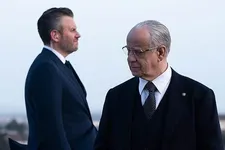 |
| Cuirassier Colonnello Labaro (Orlando Cinque) with the boss (Toni Servillo): “We shot in the Cuirassiers’ headquarters and most of them are so fun.” |
In the scenes I’d have Paolo whispering in my ears: Always keep in mind that you are still the President of the Republic! So you cannot give into sentimentalism. There was a scene that was in the script at first, where the character was in his pajamas. Both Paolo and I immediately agreed that that scene had to be cut. Because you could not laugh at a President of the Republic, that needs to show a certain rigor, in their pajamas. We always wanted to have audiences realise that they are faced with the top figure in the Republic. He is the President and even though, a little later though, we understand as an audience that he is a very special kind of President.
I remember the day that Carlo Poggioli came with these wonderful pajamas, bought in the coolest pajama store in Rome. And then he had to pack it up and put it back in the stack and walk off set. We wanted to show a President that had a sacred attitude, because we felt that figures like that are what we are missing right now. Somebody who was totally in refacturing to showing off, to spectacle.
AKT: Still at the end, when his mandate is over, he says “I wanted to be someone who could wear a red jacket and white trousers.” And if I remember correctly that’s what Jep Gambardella wears in The Great Beauty.
TS: Yes, that’s Paolo quoting himself!
AKT: That’s what I thought.
TS: Maybe it was really to draw a clear line between these two kinds of men. He had fun quoting himself.
AKT: You’ve made seven films together and you’re becoming better and better with each film.
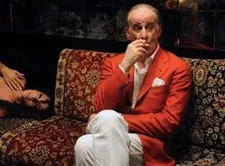 |
| Toni Servillo as Jep Gambardella in The Great Beauty |
TS: Thank you!
AKT: Are you still surprising each other while working together? Is that the magic?
TS: Definitely for me at the seventh film together, what came as a surprise was the gift that Paolo gave me with writing such an important character. I was aware from the very first time that I read the script that this was a character that I wanted to play. As I mentioned, it took three years to make this movie and from time to time I would call up Paolo and say, hey don’t forget about La Grazia! We still have to make it.
And I’m really happy that I insisted. One can imagine that maybe after seven movies one came to routine and settle on things that were already familiar with no new challenges. And yet it wasn’t like that. He created a character for me that is so complex and yet at the same time so full of lightness. That was definitely a surprise to me and a true gift.
AKT: There are so many wonderful relationships shown in the film. With the daughter, with Coco Valori, with the Pope. But I do want to ask you about the relationship with the Cuirassier. It’s wonderful, he is shadowing him, and he’s always there with the bug spray or the cigarette and everything he needs.
TS: It’s a way that Paolo chose to lead the audience into this world that is unknown to most of us. He imagined that this man, who is a very lonely man, can open up in a privileged way to the people that surround him in the activities in his daily life and the ceremonies that he has to go through because of his institutional role. The Colonel of the Cuirassiers is the one who is the closest to him. This man is a widower who has a conflictual relationship with his only daughter and he has a son who has moved abroad.
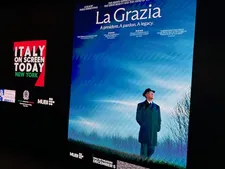 |
| Italy on Screen New York presents La Grazia event with Toni Servillo Photo: Anne-Katrin Titze |
So the people that are close to him in his most intimate, most private moments - the person that he actually confesses to some little naughty things, like smoking - is the person who is responsible for his safety. This was a way that Paolo chose to draw the audience closer to this world that most people are familiar with only through what they read in the papers.
It’s also a way to multiply the weight of affection of this person whom we know as Reinforced Concrete. It’s not what we’re used to with him. He does have this world of affection that little by little we do get a chance to discover through this kind of relationship.
I just want to add that we shot in the Cuirassiers’ headquarters and most of them are so fun. We really had a blast there. So handsome and tall and fun! I also think that a creative invention of Paolo is the character of Coco Valori (Milvia Marigliano), which is so effective. We have this man who is alone, who is elderly, who is a Catholic and then we have this great dramaturgical invention of a counterpoint, which is this crazy, irresistible woman that is pure enjoyment for the spectator.
This contrast, where we see him praying and eating very frugally and smoking in hiding, and being devastated in longing for his wife and thinking about the cheating. And then there’s this woman. One of the scenes I think most fondly of is when they go to the premiere at La Scala, the Milan Opera House, and they come back in the car. This woman who is so full of life and so irresistible, extremely intelligent, and she’s interpreted brilliantly by Milvia Marigliano.
AKT: I think this is all the time we have and I am wishing you that you will never be attacked by a red carpet the way the Portuguese President was in the film! May La Grazia live on! Thank you so much!
TS: Grazie! Grazie!
La Grazia opens in the US on Friday, December 5 and starts streaming on the Internet on Thursday, December 25.