




 |
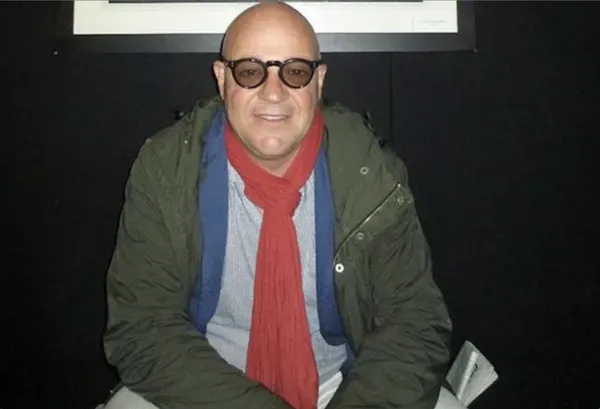
| Gianfranco Rosi’s Below the Clouds (Sotto le nuvole, Venice Special Jury Prize winner) is a highlight of the 63rd New York Film Festival |
Christian Petzold’s miraculously soothing Miroirs No. 3 (Mirrors No. 3), starring his frequent collaborator Paula Beer (Transit, Undine, Afire) opposite an equally excellent Barbara Auer; Late Fame, Kent Jones’s second feature (after Diane, a Tribeca Film Festival 2018 highlight, winning Best Cinematography for Wyatt Garfield, the Founders Award Best US Narrative Feature and Best Screenplay) with Greta Lee, Willem Dafoe and Edmund Donovan; Cannes Best Director winner Kleber Mendonça Filho’s The Secret Agent (O Agente Secreto, Brazil’s Oscar submission) starring Wagner Moura (Cannes Best Actor), and Gianfranco Rosi’s Below the Clouds (Sotto Le Nuvole) are four of the early bird highlights in the Main Slate of the 63rd New York Film Festival.
Luca Guadagnino’s After The Hunt, Bradley Cooper’s Is This Thing On?, and Jim Jarmusch’s Father Mother Sister Brother (Golden Lion winner of the 82nd Venice Film Festival) are the Opening, Closing and Centerpiece Gala selections, and Chris Cooper’s Springsteen: Deliver Me from Nowhere (with Jeremy Allen White as Bruce Springsteen) is the Spotlight Gala pick.
The Main Slate selection committee is chaired by New York Film Festival Artistic Director Dennis Lim, and includes Florence Almozini, Justin Chang, K Austin Collins, and Rachel Rosen.
 |
| Miroirs No. 3 |
Miroirs No. 3 begins on an urban bridge. A woman, whom we will later get to know as Laura (Paula Beer), stares down at the water. Her pale blue sweater (costume design by Petzold regular Katharina Ost) looks torn and frayed at the edges, so that it takes a second glance to realise that the garment is made of precious yarns. The deconstructed duck in the front hints at a style choice and not a sign of wear but we cannot be certain. Beer’s expression, equally illegible, only hints that we are watching someone on the brink. A man in a black wetsuit paddles by, standing in his canoe. He could equally be a sporty Berliner or Charon and brings to mind how, as in Petzold’s Undine, the worlds of lore flow so effortlessly into the everyday. The film’s title refers to the third movement of Maurice Ravel’s suite, “Une barque sur l'océan,” and the curtains in Laura’s apartment that twice prominently fill the screen, have a big blue border at the bottom, as if half under water. A weekend trip is planned and she finds herself in a red cabriolet with her boyfriend Jakob (Philip Froissant) and a couple whom he is eager to impress in a work related matter. As they pass by a lovely house at the side of a road, she exchanges a foreboding glance with Betty (Barbara Auer), the second person in the film dressed in head-to-toe black, who is painting her fence. More than in his previous films, Petzold here offers us a homecoming to a place we never knew and maybe always knew. A peace in knowing you are allowed to be taken care of or, the other trajectory, allowed to take care of someone.
The US première is on Monday, October 6 with Christian Petzold in a Q&A - Alice Tully Hall
 |
| Late Fame |
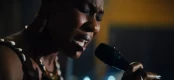
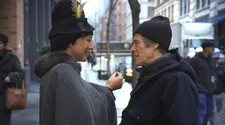
Greta Lee’s breathtaking rendition of the 1929 Brecht/Weill song “Surabaya Johnny” forms the pulsating, disquieting core of Kent Jones’s second feature, based on Arthur Schnitzler’s only recently discovered late 19th century novella, adapted for the screen by Samy Burch (Todd Haynes’s May December). The past comes back in layers, brittle, shatterable, delicate; and cinema is the perfect medium to probe memory. Willem Dafoe is Ed Saxberger, who one night returning home from his job at a Downtown New York post office finds an eager admirer named Meyers (Edmund Donovan) waiting for him on the sidewalk. The young man, wearing somewhat old fashioned garb (wittily sparkling costume design by Carisa Kelly), compliments his idol on his book of poetry, written many decades ago and long-forgotten by the world at large, and invites him to join his group of young writers for their jour fixe at a nearby café. Saxberger’s newly found fans, dressed in duffle coats, turtlenecks under shirts, and other clothing signifying a love for what was popular in decades past are so very different from his workplace pals, with whom he meets in a pub to eat and play pool, that his heart seems to split into two. Where does he belong? On his bookshelves at home we can quickly spot spines that read Pauline Kael and Beckett’s Murphy. His new friends are half-faking recognition of Robert Creeley or Gregory Corso and their “Enthusiasm Society” is planning a “sincerely ironic throwback,” an old-fashioned reading, to which their new rediscovery shall contribute a fresh poem.
The North American première is on Sunday, September 28 at 12:15pm with Kent Jones in a Q&A - Alice Tully Hall
 |
| The Secret Agent |
Marcelo (Wagner Moura), a technology researcher and widowed father of a young son, exists in the fine tradition of secret agent flicks where the fact that they are an agent is mainly a secret to them. The respectable men in Hitchcock’s thrillers who find themselves at the center of a diabolical plot of national political importance or the figures of intrigue, with their tight shirts buttoned low and just so, like Jean Paul Belmondo, who solve an urgent mystery are of the universe where Marcelo belongs. It is the time of carnival in 1977 and he is on his way to Recife, Mendonça Filho’s hometown in the north-east of Brazil. The regime is brutal and that’s why Marcelo wants to pick up his son and get out of there. Before that can happen, he has to stay for a while in the safe boarding house, under the loving custody of Dona Sebastiana (Tânia Maria) who takes care of a diverse group of refugees and owns a Janus cat with two faces, a real condition that also symbolises beautifully and eerily much of what is happening. The mix of absurdity and realism, mischief and horror in the topsy-turvy season of carnival allows for anything to occur. A dead shark with a human leg inside has been discovered, which introduces two themes of the film in one gorily funny wretched pile of flesh. Marcelo’s son, who likes to spend time with his grandfather, Mr. Alexandre (Carlos Francisco), projectionist at the local cinema (no doubt inspired by a real person we know from Kleber’s Pictures Of Ghosts), is obsessed with Jaws. References to the devilish 'Hairy Leg' striking again are used as commonly understood code in the local papers to write about corruption and misdeeds of all sorts by police and business officials.
The New York première is on Saturday, September 27 at 5:15pm with Kleber Mendonça Filho and Wagner Moura in a Q&A - Alice Tully Hall
 |
| Below The Clouds |
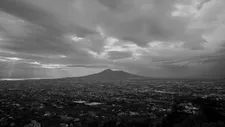
“Vesuvius makes all the clouds of the world” states the epigraph by Jean Cocteau, fittingly sending us off into the enchanted and very real realm of Gianfranco Rosi’s marvelous new documentary. Mount Vesuvius and the region of Naples below is the setting, but the apprehensions of tremors that could foreshadow catastrophe, though heightened there, are universal. The clouds in black and white (as is the entire film) and the mystical fogs swallow up distinctions of time. The great disaster that destroyed Pompeii in 79 A.D. lives equally in the past as in the future. Set in the in-between, the now includes both and is limited to neither. An old regional tram can encroach like a monster at night and resemble the calm orderliness of the trains and stations in the films of Yasujirō Ozu. A woman in a white lab-coat studies her friends, antique statues in a vault, like a Dr. Frankenstein inspecting a head and commenting on the wonderfully graceful coiffure set in stone. As he did in Sacro Gra and Fire At Sea, back to Boatman, Rosi expertly paints a picture of a community, with all its widely varied facets. The local fire department, extraordinary in word and deed is first shown in action in the tunnels aiding an inspector investigating grave robbers ransacking the treasures hidden underground often under abominably dangerous conditions. A find of boxes of medication not yet expired mean that the thefts were recent. At the department’s call center we get a sense of what they deal with night after night. A child makes a prank call, old Mr. What-Time-Is-It checks in, and numerous scared callers wonder if the small and large tremors and earthquakes are possibly tied to Vesuvius. The dispatchers have a great sense of humour, you want to listen all night.
The US première is on Sunday, October 5 at 3:00pm with Gianfranco Rosi in a Q&A - Walter Reade Theater
The 63rd New York Film Festival runs from Friday, September 26 through Monday, October 13.