 |
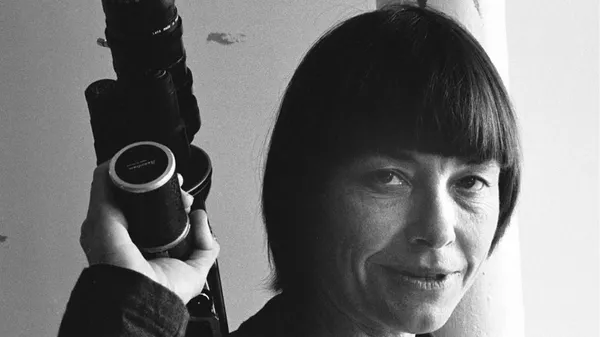
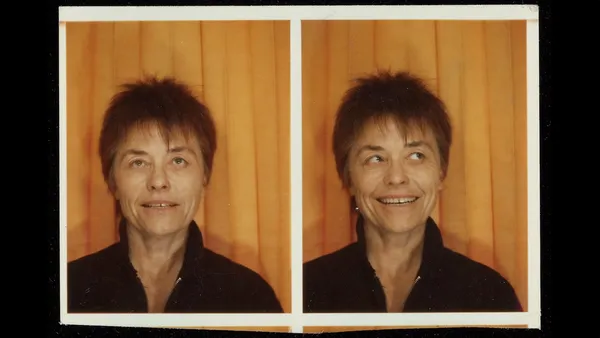
| Barbara Hammer in Barbara Forever. Brydie O'Connor: 'We cut to this idea of the body and moving through the world as Barbara was moving through the world' |
That intergenerational response has been one of the most gratifying parts of the film’s journey so far. O’Connor says she has met both younger queer viewers discovering Hammer for the first time and older lesbians in their seventies and eighties who, somewhat astonishingly, were also only now encountering her work. “I’m really grateful that it’s resonating with both audiences that know and love Barbara’s work already, and also who are learning about her for the first time.”
Part of the reason, she notes, is practical. Hammer’s films have simply not been widely available. “They aren’t streaming, people oftentimes need to catch a screening or see an exhibition or retrospective in order to see Barbara’s work and spend time with them,” O’Connor says. “I knew that there was a gap in terms of how many people would relate and love Barbara and her work and how many people have just had the chance to see it.”
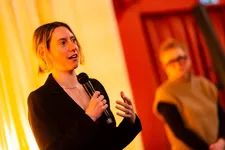 |
| Brydie O'Connor speaking during a Q&A in Berlin. 'The specific idea that I
wanted to build the feature around was this idea of Barbara narrating her own life story' Photo: Courtesy of Berlinale |
What opened the feature up further was the archive itself: not just the published filmography, but outtakes, hard drive recordings, oral histories, and the audio interviews Hammer gave to scholar Sarah Keller for her book Barbara Hammer: Pushing Out of the Frame. “The specific idea that I wanted to build the feature around was this idea of Barbara narrating her own life story, and her being the expert on her own work, and intentions for her career, and visions for the future.”
That idea feeds directly into the film’s central concern: queer wisdom. O’Connor sees Hammer not only as a radical artist, but as someone who understood that queer history has to be insisted upon, preserved, and handed forward. “Who makes history and who gets left out?” she asks. “Oftentimes history is dictated by people who don’t see as much value in queer histories and queer lives, and it really is on us, and our community, to make sure that our histories live on.”
Hammer, in O’Connor’s telling, did exactly that. “She demanded space in the public sphere. She demanded space in the art world, and the film world, and in the queer world.” More than that, she built an archive that would outlast her. For younger audiences, that offers not nostalgia but instruction: “There are endless ways that audience members, a younger queer generation, can be inspired to create our own histories, to document our histories, share and save them.”
 |
| Barbara Forever |
One of the documentary’s most moving dimensions comes through Florrie Burke, Hammer’s partner, whose presence gives the film its emotional present tense. Speaking about Burke, O’Connor becomes audibly emotional. “Florrie has made this entire film possible,” she says. “There is no film without Florrie, and without her enthusiasm about this film and project.” Burke, she adds, is not there to function as Barbara’s mouthpiece, but as someone living within the afterlife of Barbara’s vision. "Our present is Barbara’s future.”
For viewers newly arriving at Hammer through the documentary, O’Connor points toward Sarah Keller’s book and to the Barbara films currently available on DAFilms, while noting that broader access is in the works. That feels consistent with the spirit of Barbara Forever itself: not as a final word, but as an opening gesture toward an artist whose life, work and wisdom still have more audiences to reach.