




 |
| Urchin |
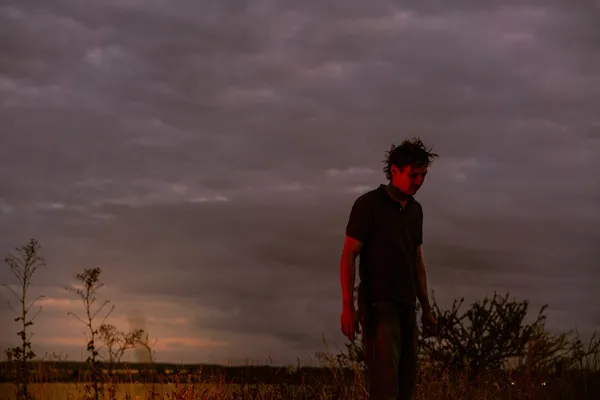
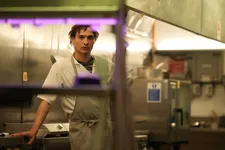
Actor Harris Dickinson's directorial feature début Urchin, follows Mike (Frank Dillane), a homeless man living on the streets of London. His self-destructive behaviour culminates in a custodial sentence after he assaults and robs a good Samaritan that took pity on him. After his release, Mike attempts to change his life and gets a job in a kitchen. However, past patterns of self-destructive behaviour, risk Mike's best intentions to turn his life around.
British-born Dillane is known for playing Nick Clark in the apocalyptic horror series Fear The Walking Dead. His other roles have included Tom Riddle in Harry Potter And The Half-Blood Prince, and Edmund Jordan in Athina Rachel Tsangari's folk horror, Harvest.
 |
| Urchin |
In conversation with Eye For Film, Dillane discussed his lonely relationship with cinema, building the character of Mike with Dickinson and being introduced to Albert Camus' existential novel, The Stranger. He also reflected on the confusing nature of bureaucracy and how complex situations have no easy answers.
The following has been edited for clarity.
Paul Risker: How would you describe your relationship to cinema?
Frank Dillane: I can only speak as an actor because my relationship to cinema is one of being an actor, in the sense that I often feel that my experience of cinema, either watching a film or being in a film, is very different to other people's experience of cinema.
So, for me, shooting a film has nothing to do with the film itself in a sense. It's taken me many years to be able to conceptualise for others my experience of a film I've shot, in a way that is linear and digestible, because for me, a film is about studying human philosophy — that's my experience. And I'm not saying that's everyone's experience of watching a film.
I love working on films and on stories, and I spend all my time doing it. Often, by the end of the day, the last thing I want to do is watch a film because it'll begin again, and this time I'm evaluating someone else's performance, or they're messing with my emotions through the music.
By the time I'm done with my day, I just want my emotions to be left alone because I've spent so long picking the wounds through whatever script or audition I'm working on. I suppose my relationship to cinema is a slightly lonely one.
PR: Was there an inspirational or defining moment that sparked your interest in acting?
FD: Well, my parents are both actors, so I grew up in theatres. I can split my life up into roles my dad was playing at the time. I remember what was happening when he was doing Hamlet or from Angels in America to Prospero and Macbeth. And I remember going to those theatres with my mum and loving the world of make-believe and the smell of the theatres from the smoke. As a child, my mum used to put me in a cardboard box under the seat so that she could go and watch my dad, and take him home after the play ended.
So, my relationship to acting has just been one of nepotism. I suppose that is the word that is being thrown around at the moment, and I'll take it. I can see that is a part of my story, but my love for it is my own. I'm influenced by my father and my mother, and in many ways, back in the day, if your dad was a tailor, you'd be a tailor. It's what I know; it has been my whole life.
PR: When you first read the script for Urchin, what was it about the character and story that compelled you to believe in the project?
FD: […] Harris and I built Mike together very slowly, and it was Harris who turned me on to Camus' The Stranger quite early on. I remember that being a big moment for me because I understood it was about everything, and there was a bit of a blank canvas.
Mike doesn't talk that much and there are many ways to skin a cat. Harris knew what he wanted; he knew what the beats and the themes were, and what the story was. We explored the different ways in which we could achieve those beats, and you take addiction, cyclical behaviour, homelessness, which are all such big, juicy ideas, and you can do anything with this stuff. And I guess it was exciting to realise we could go anywhere with this.
 |
| Urchin |
Harris's script was so big, it read like a Terrence Malick film because it's about everything — the universe and God or the lack of God, and reincarnation, and all this other stuff. So, I kind of intuited after a while, 'Wow, we can go anywhere with this.'
PR: A reason Urchin should be appreciated is that it reminds us that people should not necessarily be defined by their worst moments. Instead, we need to create a more empathetic society, where we understand people are complicated with many layers.
FD: I completely agree, and I'm so glad that you felt that and took that away from the film, because that's absolutely what we were after. And something that Harris would continually remind me of was that this isn't a sob story, this isn't about hugging a hoodie, and this isn't about victimisation. This is not even about homelessness; it's about mental health and humanity.
We had this idea of the human animal that is underneath our culture, underneath our society, underneath our manners, and all of that stuff. So, what are we left with? And what we're left with is this push-and-pull system of fight or flight, wanting to be loved, and acting honourably at times and dishonourably at other times. Is that not who we all are? And this nuanced take on things we hope will have a bigger impact, as there are no simple solutions to complex problems.
So, if you can just sit with someone while they're going through their stuff, and don't tie them to their worst mistakes, then that will be enough for this film. Or just that small thing of looking at someone you know with empathy.
PR: Does Urchin belong to the type of cinema that doesn't necessarily pursue answers, but is content to sit with the questions?
FD: I keep on thinking about this sentence: "Within imperfection, perfection is possible." I relate it to your statement, but I'm not quite sure why. If someone has a slight imperfection on their face or if their nose is broken, and it's just that one little thing, then it means that you see the possibility of perfection by thinking about what if the nose wasn't broken.
So, with questions not being answered, we are left with the possibility of there being an answer in some way, which in itself is kind of enough.
For the current generation, there's a humbling taking place, at least for myself. We are much further behind than we thought we were, in terms of knowing what we need to do. It's like, "Come on, just tax the rich." That's not me saying, but it's a solution that is being banded around. Or let's recycle and stop using oil. We know what the answer is, and yet we can't do it. And the reason we can't do it is that we're not enlightened enough yet.
Maybe this is too big a leap to tie it back to the film, but there's something about humbling ourselves and just returning to empathy and suffering, or sitting with someone and seeing their mistakes. And if you can't forgive them, then at least seeing and recognising yourself in someone else who you wouldn't usually recognise yourself in — this is almost enough.
PR: There's the idea that all art is political, so, could we view Urchin in a political context? I'm not suggesting that it's aggressively political, rather it explores the politics of the human condition and the broader human experience.
 |
| Urchin |
FD: I can only speak artistically. I worked with the Single Homeless Project charity for a few years before making this film, and Harris was working with Under One Sky. So, there is a political aspect to the film, and while I can't speak for Harris, I'm interested in the human condition.
Bureaucracy is dense and confusing, and being dyslexic, it is for me — I can't imagine what it would be like for someone else. Thank God I have my dad, mum and friends to help me through things like lease contracts. But if you're trying to get yourself back into a system that doesn't want you, it can be dehumanising and demoralising. It's very complicated, and then there are people that often don't have IDs or the necessary paperwork. And you can't get a job without a house, nor can you get a house without a job.
PR: Is cinema a transformational experience for you personally, and should cinema create some kind of change for the audience?
FD: I really hope so. One of the greatest things about this film is that I've received some of the best feedback I've ever had. People have told me they thought about it the next day, and that is amazing to me, because a film changes me if I wake up the next day or the day after, and I'm still thinking about it. So, people coming up to me and saying they've continued to think about it is a dream come true. And it's a testament to Harris' vision, his sensitivity and his heart. He's a special director and a special artist. I'm very privileged to have worked with him.
Urchin is in US theatres from 10 October.