 |
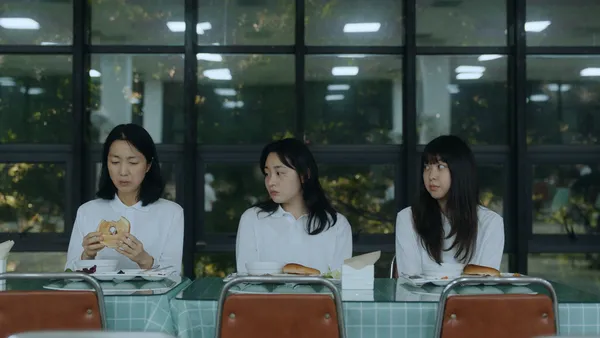
| Hana Korea Photo: Stephanie Stål Axelgård |
Danish director Frederik Sølberg's narrative fiction début, Hana Korea, is inspired by real events. Instead of staying in the documentary genre, Sølberg decides to dramatise the experiences of North Korean refugees leaving a part of themselves behind in their homeland, as they seek to build a new life and find a new place to belong in South Korea.
The story follows Hyesun (Kim Minha), a young North Korean refugee who must navigate the challenges of this immigrant experience and the cost of freedom.
While a transition for Sølberg from documentary to narrative fiction, Hana Korea is in part a thematic continuation from his documentary feature debut Doel, which honed in on a ghost town to explore the importance of people having a sense of belonging and a place they can call home. Sølberg's work tends to have a political dimension, including his earlier documentary short De Har Solgt Verdens Lunger, which explored the destruction of the Peruvian rain forest by foreign oil companies searching for oil and gas.
In conversation with Eye For Film, Sølberg discussed how his transition from documentary to narrative drama is not so clear-cut. He also reflected on the cost of freedom, how Hana Korea is a unique and universal story, and his desire to break the rules he sets.
The following has been edited for clarity.
Paul Risker: Why filmmaking as a means of creative expression? Was there an inspirational or defining moment for you personally?
Frederik Sølberg: From a very early age, I have been a storyteller — I've always told stories. My father is also quite good at telling stories, but he worked for the Danish tax administration — a different career path.
So, being fascinated by film from an early age, my first inspirations, or big moments with film were fiction, actually. I don't know what specifically, but directors like David Lynch and Lars von Trier were definitely inspirational in my early teens. And let's say from 15-years-old, I was certain that I wanted to be a filmmaker.
PR: Hana Korea is your narrative feature debut. How do you reflect on making the transition from documentaries to fiction and was it always your intention that Hana Korea would be a drama?
FS: I've done music videos, short films, and I've worked in TV, and I've always had a cinematic approach. But in this case, it was the story that led to why it ended up being a fiction film, because we actually approached it as a documentary to begin with. And that's a long story, so I'll need to take a step back.
I came to Korea for the first time 15 years ago, and the first thing I did was I walked into a restaurant, and I struck up a conversation with two Korean men who told me how they felt about the division of Korea. I remember one of them ended up saying, "All we want is Hana Korea", which means "One Korea." I think I fell in love with Korea and fascinated, I just started researching.
At that time, I was doing TV documentaries. During my research, I read about the Hana Integration Centre, which is the National Integration Centre in South Korea for North Koreans. I was puzzled by the whole idea of having a centre where you teach North Koreans to become South Korean. I'm interested in this transformation they go through, and I went back and did a radio documentary about that Hana Centre. I interviewed North Koreans and talked to experts and people that worked at Hana. And I still remember when I arrived at Incheon Airport in Seoul, thinking, 'Oh, my God, this feels like I've arrived in the future. This is such a hyper-modernist country.' So, I knew there was the potential for a film that starts the moment the North Koreans arrive.
[…] A few years later, I reached out to Sara Stockmann, the film's Danish producer from Sontag Pictures, and we teamed up with Heejung Oh, our Korean producer from Seesaw Pictures. We approached it as a documentary, and we had a motto to make a film that had the view from the outside but knowledge from the inside. And we've been working very tightly together for six years. This film has only been made possible through an intense, tight collaboration between Denmark and Korea.
At that time, the idea was it would be a staged-hybrid kind of documentary. We talked to a lot of North Koreans, including young North Korean women, and one woman, Hyorin, opened up and shared her story. She was being honest to an extent we had not expected and haven't experienced before or since.
So, we started interviewing her, and the further we were through the process, it became clearer that to make an immersive and intimate film, and for the story to have the potential to unfold, we had to fictionalise it and work with a strong cinematic concept. And for an audience to connect with a character going through that transformation, it was necessary.
In that sense, it was the story that ended up influencing us to make it as a fictional film. But the approach was a documentary style, by the fact that Hyorin has been a part of this project for years. We've interviewed her over several years, and I've also spent a lot of time with her — just me and her. We don't speak the same language. She speaks Korean and I don't, but she and I have visited her old neighbourhood in Seoul. We've been getting to know each other but also trying to understand how you take in all these impressions and all these new changes. The whole story is the question about identity and belonging. What price did she pay for freedom? Well, that is leaving her past behind to some extent. How do you do that? How do you deal with that? So, that's what the film is about.
PR: The film explores the idea that, being forced to flee, the North Koreans have left part of their identity behind. While they might be free, their freedom is not without sacrifice.
FS: It's both a unique and a universal story that has, of course, made me reflect on my own position. Being misplaced is a human condition. There are millions of people in this world that are forced to flee and are forced to leave their pasts behind. We are unfortunately seeing that right now with the genocide in Gaza and the war in Ukraine. That displaces people and creates refugees. We have also made this film to give an audience the opportunity to reflect on what are the costs of being pushed or forced to leave your past behind, and what is it you leave behind? And that's the struggle of the protagonist of the film.
PR: When you were recounting spending time getting to know Hyorin, you reminded me of a conversation with the documentarian Suzanne Raes, who told me, "I always take a long time when I’m making a film, which is another thing I love, because you become acquainted with the world you film. The people really accept you, forget you, and you’re able to follow a process in the making of the film…" Patience can be an asset, but the business side of cinema can often make it difficult to take one's time.
FS: That is the big difference. I sometimes compare it to cooking, which I like. There's a difference between fast food you'd buy in a convenience store and then stew that has been on your stove for the whole day. It might not take that much longer to eat the meal itself, but it will have a lot of depth in its taste. And I hope that our film, in that sense, has a depth you wouldn't get from fast food.
PR: The music in Hana Korea appears to have a specific purpose, in which you're trying to synchronise it with the emotions of the character. What's also striking is the way the music anticipates Hyesun's character arc.
FS: It's something I put a lot of effort into. I have a background as a musician, but I don't necessarily like films that have a lot of music — you have to use music in the right way. And so, early on, I knew I'd like to work with Jonas Bjerre, who's the lead singer of a Danish indie band called Mew, who I've been listening to for the last, I don't know, 20 or 25 years.
I knew him a little bit, and we shared a love of British IDM (Intelligent Dance Music), like Aphex Twin or Techno — more like a dark type of electronic music. And for me, it was important to work with a score that had the right mix of being alienating with this hyper-modern and new reality, that to our protagonist, is alienating. So, I wanted music that played with that to some extent without hopefully tipping too much, but at the same time, it also had to represent her inner feelings, her longing, her loss, and her doubt. So, we worked very intensely on finding that balance between something alienating and cold, and something warm that wouldn't be too depressive or too optimistic. And we used that as a device, but it wasn't like now she's feeling down, so let's use sad music. It was much more structured, and at the same time, an abstract approach, in my opinion. But of course, it is about bringing forward emotions and Jonas did a great job of finding the exact balance.
I had another problem, because I like to have rules and then break them. There was a rule that there would be no piano, no acoustic guitar and no strings, because that would be the typical thing to do. I wanted an electronic soundtrack, and I was inspired by the Safdie Brother's film Good Time, which is a completely different type of film. It has a soundtrack by Daniel Lopatin [also known as] Oneohtrix Point Never.
In my film, as Hyesun adapts and the film develops, the music gets more human. So, that's how I broke my own rule. Suddenly the music is not electronic nor is it as dark anymore. Jonas and I worked intensively on creating that musical journey that you could say would have its own kind of little dance with the film.
PR: Throughout Hana Korea there's a bristling anxiety, and your approach is one that forces the audience to find their place in the film, just as Hyesun and the others are trying to find their place in their new reality.
FS: I'm quite communicative. I talk a lot, and I believe I'm pretty good at expressing myself. When it comes to my work, I do it a little bit differently in the sense that it's not so dialogue heavy. I like that you as an audience need to connect some of the dots and the film is not a statement, it's a dialogue. So, to some people it will come across as subtle or even vague where they will be confused because they don't know what to hold on to. We do help with connecting those dots because I personally like films where you feel that the film is taking you by the hand in a way, but you also have to find your own path. And that's what we've been trying to do.
Also, working with such a sensitive subject, I would rather suggest a way to read it or a way to understand, feel or relate to it. There's not a big banner saying here's the conclusion. It's for the audience to make their own conclusions.
Hana Korea premièred at the 2025 Busan International Film Festival.