 |
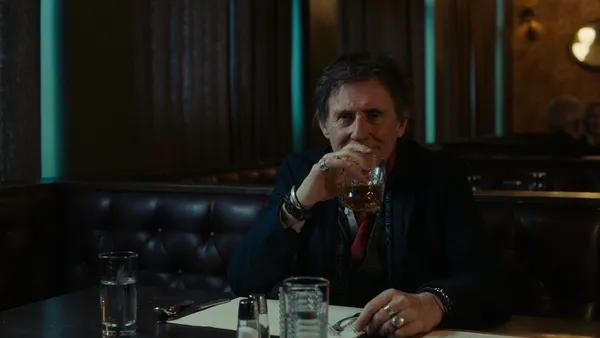
| Gabriel Byrne in Death Of A Ladies' Man Photo: Jonathon Cliff, courtesy of Corey Marr Productions Inc., Films DOALM Quebec Inc. and Port Pictures Ltd. |
Director Matthew Bissonnette's comedy Death Of A Ladies' Man follows hard-drinking Irish professor Samuel O’Shea (Gabriel Byrne), who begins seeing unusual things and experiences delusional conversations with his long-dead father (Brian Gleeson). A visit to the doctor reveals Samuel has a terminal brain tumour. What else would the hard-drinking, twice-divorced professor do, but pursue the dream of writing his own book by way of retreating to the family's remote Irish cottage?
Bissonnette's previous credits include Who Loves The Son, about a troubled young man who reconnects with his wife and close friend after being missing for five years, and Passenger Side, the story of two brothers driving around Los Angeles in either a search for a deeper meaning or drugs.
Connecting remotely via Zoom ahead of the US VOD release of Death Of A Ladies' Man, Bissonnette and I joke about surviving another day. I apologise for the dark humour, and Bissonnette says, "That's all that's happening out here." My eyes are drawn to the stack of books to his right. In good spirits, and with a self-deprecating pinch of humour, he tells me, "That's just to make me look smart. They're all 3D printed."
During our conversation, Bissonnette discussed his affection for Leonard Cohen's music, which features prominently in the film. He also reflected on his love of cinema, which he describes as the "magpie of all the art forms," the inevitable experience of taking stock of one's life and finding hope in life's dark and difficult experiences.
Paul Risker: It's easy to assume a film has only recently been finished, but Death Of A Ladies Man was completed around five years ago.
Matthew Bissonnette: Yes, we finished in 2020, and of course there was Covid, which complicated everything in the entire world, and in an unimportant or minor way, our film. What happened was that it ended up playing in all these places where Covid wasn't. It opened in Australia, and then it went to Turkey, Russia, Taiwan, and Sweden. So, it has hopscotched around the world for the last three or four years, which has been, on the one hand, painful and frustrating, and on the other, it has kept the film alive. And then, for various reasons that I won't get into, but principally financial, it took a while for us to find distribution.
PR: Looking back, what compelled you to want to tell this story at that particular point in time?
MB: I've always been interested in family dynamics, and with this one, I was a single father at the time. I'm married now, but when I made the film, I was thinking about relationships between fathers and sons, fathers and daughters. I was also getting sober, so I was thinking about addiction and the difference between what you think things are like and what things are — the difference between either fantasy or desire, and that construct you have in your mind, versus what's really happening.
I'm from Montreal, so I'm super aware of [Leonard] Cohen's art. He's an incredible poet and songwriter, and I like his humour and perspective. And it seemed to fit with the things that I was thinking about as I was writing the film.
One thing I like about the movies is that they incorporate song, and you can put in dance. It's the art form that's really the magpie of all the art forms. It can bring all these things in, and I'm in favour of bringing a lot of stuff in. I guess I like that freedom or opportunity that the art form provides. And so, the more we thought about it, and the more we talked about it, we ended up with up to seven or eight of Cohen's songs.
We've used some of Cohen's stuff before, so he knew who we were. We sent him a little fax, because that's how we communicated with him, and he faxed back, and he said, go ahead. He was always very generous and gracious in allowing us to use his stuff.
The other nice thing about film is it brings you into contact with people you wouldn't normally run into. Then, it's always surprising how kind and gracious a lot of people out there in the world are. That's the long answer for you.
PR: It has often struck me that darker stories reveal more to us about ourselves and our world than happy stories do. In Death of a Ladies Man, you mix darker tones and humour, using the two to complement one another.
MB: Nick Cave said something where he was talking about art and the benefits or how the process might be more important than what it makes. I think he was particularly talking about his distaste for the word 'content', which I share. The important thing about art is that people are making it and people are watching or listening to it.
Life is many things all at the same time. What I've been drawn to in movies are those areas that are a little more complicated or a little darker. I approach them in a way that is a bit lighter or with a sense of humour at least, because if not, then it's unbearable. From Shakespeare to [Samuel] Beckett, people have been doing that. I appreciate a work of art, whether it's a photograph, a painting or a song. It doesn't have to be funny, but I like it if the perspective of the person making it has a sense of humour about themselves, about the work and about the human condition. I find that bearable and perhaps the other stuff is a little harder to bear.
PR: Samuel has always wanted to write a book, but he has spent his life teaching other people's work. His sudden decision to fulfil his lifelong ambition is a reflection of how late we leave it to take stock of our lives, and the dreams we have shelved. Samuel is at that point in life where one starts to look back rather than look ahead.
MB: When I wrote the script, I was taking stock in a certain kind of sense. I was drawn to an older character to do that because that crystallises that time in life. You can take stock anytime, but certainly when you're towards the end of your life, you really start to think about the value of every day.
It's different for everybody but at a certain point, people start thinking about how many years they might have left. So, it does make you think, 'How am I going to spend those moments?' It would be interesting if you could start that earlier because you only have so many of them. And I guess the better spent, perhaps the better off you are.
PR: There might be a Karl Marx quote that says we get to shape our life, but not necessarily the way we imagine. Samuel's character, as most of us must, is wrestling with this to some extent.
MB: There's that old thing, if you had to make God laugh, make a plan. And that is for sure my experience of life. You have an idea where it may go, and life might have a better idea than you do. And certainly, my experience has been that it's a lot better off if you live the life you're living, as opposed to one that doesn't exist and obviously probably never will. But yes, that's a fundamental tension as human beings, and hope gets into that a little bit, because you can hope for something else, but as we say when we make an independent film, "Hope for the best, plan for the worst." And so, that's a decent idea for going about life, at least in my experience.
PR: If filmmaking is as difficult and fraught with stress as directors suggest, the question, I suppose, is why put yourself through it?
MB: There are a lot of things that I really enjoy about filmmaking, and why I do it. But the most magical aspect of it is that you sit in your garage, and you type words on a page, and then hopefully, at some point a year or two or three, or even seventeen years down the line, you're on set with actors. And on this film, we were lucky to start with Gabriel. Then, everyone else was pretty much the first person we thought of. I think a lot of that had to do with Gabriel being involved and people responding to what they knew he would bring to the project and also, to a certain extent, the script. So, we were very lucky to have consummate professionals and wonderfully talented artists.
They think much more than I do about a particular character, at least in my experience. So, when they show up on the day, it's kind of a revelation. Gabriel had conceived the character of Samuel from the way he was dressed to the way he carried himself, and I didn't really talk to him about it. He did that with the costume designer. I didn't really think of Keith Richards as being the touchstone for this particular role, and, of course, it was correct. And that's a wonderful gift. So, you have a sense of the story and what these people are like because you're writing them, but then they show up on set.
We like to do most of the things in camera, including the more fantastical elements. We're doing all of that live and the one thing you always wish is you had more time. It is such a magical thing to see it come to life in those few instances, because if you think about it, if you spend a thousand hours on a movie, you're only shooting for about 20 minutes of that total time. The actual moment between "action" and "cut" is very small.
I guess I'm circling back to that thought of trying to appreciate and understand what's happening in the moment and really being there for it. And the longer I do this, rather than worry about the moment, I try to enjoy it for what it is, because it's a privilege, and it's a gift.
PR: Samuel's daughter Josée is one of the film's more intriguing characters because she's the question mark of whether the next generation can escape the mistakes of their parent's generation.
MB: Karelle [Tremblay] is an amazing actress. She really brings a level to it that maybe wasn't there on the page. And it's true that her relationship with her father is complicated.
The interesting thing about not repeating a problem is that it's not usually the case where there's a problem, and then it's 100% gone. As you move through the generations, then maybe, hopefully, the problem is chipped away at. Human beings are a process, and so, it's not going to go away in one generation. But maybe there's a little more understanding the next time around, where things might not be dealt with, but they're understood a little earlier on. And maybe the person who suffered has a little more insight into what happened, and how they might be helpful to the next person.
That's one thing that I felt strongly about with Death Of A Ladies' Man because I don't think films should have answers. I think Spike Lee said that a movie will hopefully leave more questions than it answers. And so, in a little way, we were trying to do that, by looking at the situation and how things might play out as history moves along. And the other thing you always want in a movie is a bit of hope. I'm a fan of reality and hope, and you're trying to reconcile those two things in any art form, including filmmaking.
Death Of A Ladies' Man is now available on VOD.