 |
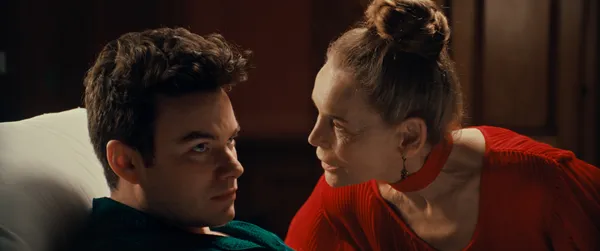
| Chris Colfer and Alice Krige in The Restoration At Grayson Manor |
A domineering mother. A gay son and heir reluctant to play the role that his heritage has decreed for him. A terrible accident, and an experimental scientific solution that pushes them both to the brink of destruction. The Restoration At Grayson Manor is the kind of film they don’t make anymore, and it’s a perfect fit for Fantastic Fest. Just before the festival I got together with director Glenn McQuaid and star Alice Krige for a conversation about horror and heartache, relationships and rebellion, and desperate heteronormative striving after eternity.
“The project began with an idea for an audio drama,” says Glenn. “I have an audio drama show with Larry Fessenden called Tales From Beyond The Pale. And I was drumming up new ideas, and The Restoration At Grayson Manor was one of them. But I felt if we're going to tackle the killer hands genre, it's better if we show them. So Clay and I began to work on the script. Then I wrote a treatment and just entrusted it to Clay, and we really got stuck in. It really quickly became clear that Clay was the right man for the job, because so much of the sardonic wit and the barbed nature of Boyd and Jacqueline came from him.
“The inspiration was really The Beast With Five Fingers. It's a very formative memory. When I was young, BBC2 ran a series of horror double bills every summer, and it was always a black and white movie followed by a colour movie. So on a Saturday night, you’d get something like The Beast With Five Fingers followed by Race With The Devil. And truthfully, I'm sort of fascinated by the subgenres of horror as well, like these little strange avenues that the genre goes down. For the longest time, I wanted to tap into the killer hands subgenre and also bring a sort of sense of melodrama as well. I really wanted to lean into heightened dynamics.”
“I was sent the script and was absolutely amazed by it,” says Alice. “The way that you simply did not know what was going to happen next, that it was kind of horrifying and fascinating all at once, this savage relationship. But there are moments of heartache in the middle of it, and then tenderness and then viciousness, and you just really didn't know where it was going to end. And moments of wild hilarity. The mix of it and the roller coaster of it was so unusual.”
I suggest that it’s easy to frame her character, Jacqueline, as a villain, but really she's driven by her own concerns. She feels that she absolutely has to have an heir, and she’s trapped by that mindset.
“Absolutely,” she says. “I mean, utterly trapped. She was brainwashed – you know, give me a child by the age of seven and it's mine for life. That was it. That was her whole raison d'être, to continue the line, do you see?
“I think you can probably love someone and hate someone at the same time. That's what was happening with Jacqueline. She was so deeply invested in him and so hurt by him and so angry, but she loves him at the same time and wouldn't know what to do without him. I love the way the movie ends. They're going to be there bickering, it seems, for the rest of their lives.”
Melodrama has a tradition of producing great female characters and women who have a lot of power and a lot of dignity, I observe, and she agrees.
“Films like The Lion In Winter were a huge inspiration for me, but it was also really important that Jacqueline not be judged as a bad person,” says Glenn. “She's as much a victim of the Grayson ancestry and Grayson Manor as Boyd is. Boyd is just absolutely rebelling against it. I think Grayson Manor itself in the movie represents the heteronormative pressure placed on queer, defiant shoulders. In a way, the manor, of itself, is really a pressure cooker. I think the Manor and the Graysons themselves are the catalysts to a lot of spiraling of others.”
“If you think that it's a heteronormative weight on Boyd's shoulders, it's an equally heteronormative weight on Jacqueline's,” Alice points out. “As a female, that's what's required of her: to produce the heir. I mean, she doesn't rebel, she's swallowed it whole. She can't see beyond it, whereas he can, and it's trapped them both.”
Glenn says that he thinks Jacqueline wanted to rebel, in her own way, but was gradually worn down. I note that Jacqueline is clearly a really strong person, but her own strength seems to have been used against her in this situation. Despite her battles with her son, she seems to admire his strength.
“Absolutely what I wanted was a clash of two titans,” Glenn says. “I think Jacqueline, at one point, is just like, ‘Well, this is it. This is how it is, and this is what's going to happen.’ And I think there's strength in her beliefs as well. She finds strength in the fine line of ‘this is what needs to happen.’ There's going to be no looking back. I mean, she never looks back at all. It's all completely justified, and I don't hate her for it.”
Alice compares them to her bulldog, who becomes all the more determined to have her own way when told “No.”
“I think they push each other, the pair of them. You know, him saying to her ‘You won't get an heir’ just makes her double down because of who she is. ‘I will get an heir. I will, I will.’ They're like catalysts for each other's personalities. They're locked in this terrible embrace. But the heartbreaking thing is you do get a sense that there were times when they had fun, when they played with each other.”
“I think that was really important for us, so that it wasn't all just terrible,” says Glenn. “So that there were hints that they did dress up, and of course, Jacqueline dresses up, and of course, Boyd dresses up. They're doing it to this day with the idea of, you know, they made plays and so on. There was a period of time where the love was absolutely genuine. I still think that they love each other. I mean, at the end, I think it's all about love. We leave them as we met them, bickering, and in their safe, codependent relationship, it's a safe emotion.”
I ask Glenn if his early experience in theatre influenced the way that he styled the film.
“I grew up in Dublin and got into the Dublin Youth Theatre,” he says. “I was fascinated by theatre. I didn’t like acting, so I got into behind the scenes and so on. And what I wanted to do on this project was really and truly lean into the work with the actors, be their safety net, have a Lot of fun on set and try new things. Workshop ideas. I mean, we did some Meisner techniques also, just to loosen in the air in the room and have a nice easy back and forth. And there's quite a bit of improv in the movie as well.
“It's true,” says Alice. The. The great tragic characters in literature always have an air of melodrama to them because they're larger than life. And that's not necessarily theatrical. It's just those stories of tragedies, you know, like Oedipus, like Electra. They're huge. And what's wonderful about this genre, is that it lets you go there.”
We talk about the set design and how it reveals the character of the house.
“We had a lot of fun with what the house already had to offer, which was all the taxidermy, all the paintings,” says Glenn. “There's some careful blocking with within the movie as well. Jacqueline really is echoing quite a few of the stances we see in paintings behind her, and so on. I love this idea that she's absolutely possessed by this idea that it all lives on through her and through Boyd. I think that's an interesting concept, and I suppose I'm poking fun at that heteronormative idea that we must have offspring to continue to exist.”
He’s thrilled that the film has been picked up by Fantastic Fest, he says.
“I just got into Austin yesterday, so I'm excited to see what's going on. I have no idea what to expect. I’ve heard great things. My friend Jenn Wexler was here recently with her movie The Sacrifice Game. I'm just excited to start meeting people and getting into the vibe. It's been a long process. It's kind of an emotional moment as well, for it to be about to go out into the world and live its own life. I'm very, very, very proud of it. I'm very excited that its maiden journey is about to embark.”
“One has one's heart in one's mouth,” says Alice. It's the total focus of your life for however long, and then you give it away, and you just hope that people feel what you felt, see what you saw, and that it touches people. In a weird kind of way, it's a terrifying cautionary tale, isn't it? Of what happens in a codependent relationship. It’s so savage.”