 |
| The Vile |
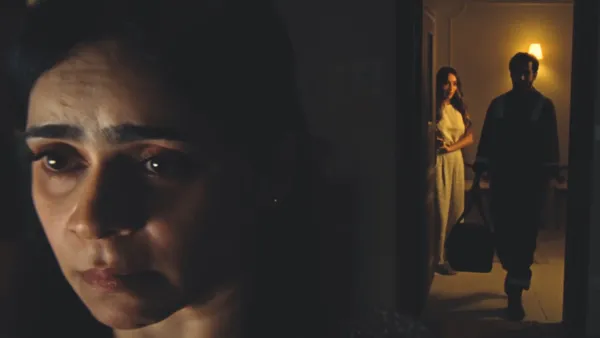
One of the most impressive films screening at this year’s Fantastic Fest, in a strong line-up, Majid Al Ansari’s The Vile charts the breakdown of a marriage in Abu Dhabi after the sudden and unexpected arrival of a second wife, taking in the sinister fate to which husband Khaled (played by Jasem Alkharraz) has unwittingly consigned himself because of his selfishness. At the centre of it is Amani (Bdoor Mohammad), his original wife, who is caught between winning him back, saving herself, and protecting her daughter Noor (Iman Tarik) The new wife, Zahra (Sarah Taibah), is a chameleon-like character, difficult to pin down, and though Amani will later learn some worrying things about her, to begin with she seems sweet. It’s the suddenness of it all that plunges her into crisis.
I have had a few friends in traditional polygamous marriages, I tell Majid when we meet – not enough to make me feel like an expert, but still I get the feeling that a woman discovering her husband has married again when he suddenly turns up at the door with his new wife is not normal.
“It's not normal,” he says. “But this is what happens in households here. We did a lot of research and one thing that kept on coming up is that it's the suddenness of it. It's sudden, it's vicious, it's a punch and it just turns the house upside down. I remember when we were doing the script, I had a 15 minute setup scene on who the family is. And the more I started researching, I'm like, no, I want people to really watch it and feel the suddenness of it because that's closer to the truth of what happens here in reality.”
Zahra seems a bit lost at first – not much of a threat.
“I wanted the journey to be about Amani and what Amani goes through. That's the main subject matter. And you know, this subject matter means something. Where I grew up, in my neighbourhood and my family, and there's not one person in my circle around me that doesn't have someone who did that, whether it's a great grandfather, whether it's an uncle. And it's weird how it affects generations, right? And for me, it was always a question of what If this happened to my mom or happened to my daughters, what would they go through?
“It used to happen way more than it does today. I mean, in my grandfather's generation, my father’s generation, way more. But today, of course, the dynamic of the UAE is very different. We have more females in leadership positions and CEOs of companies, and in the private sector and the government sector. So it's a very different playing field today. But in my father's generation, he saw that a lot, so I just wanted to be as honest as possible with the subject matter.”
To what extent is it possible for women to live independently in Abu Dhabi if they want to? That obviously affects the options that are available to Amani.
“You see more of it today, but culturally, we're not,” he says, noting that there’s pressure on men as well as women to conform to tradition. “I'll tell you a story of what happened to me when I came back from California. I was 21, and I loved my independence. I was used to living by myself. I go to my mom and I'm like, ‘Hey, I'm living by myself. I'm moving out of the house.’ My mom's like, ‘Oh, really?’ Behold, one day later, my uncles from Kuwait flew in and looked at me. They were like, ‘We will kill you if you take one step outside this house.’
“Culturally, until you get married, you don’t leave the house. That's what happened with me. It happened with my sister. We were not in a culture where sons and daughters could leave the house. But now, in a certain age group, you see them more living by themselves, but it’s still rare. Of course, it's very different for women. It's much harder for women to live by themselves. But in today's generation, it's way different than it is in Amani's generation, or Amani's community.”
Teenage Noor seems to face quite a difficult situation either way.
“Yes, exactly. And, you know, it's funny: there's certain lines that she says are there that I saw my mom telling my brother. It's like, ‘Yeah, you're never leaving.’ There's a conversation. My brother's 22 years old, and she's like, ‘You’re not leaving the house. There's zero chance of you leaving the house.’ He was like, ‘Are you going to be with me until I die?’”
The film spends quite a lot of time building up those two characters, but there’s a slickness about Zahra that makes it difficult to know who she is.
“With Zahra we never know, going into the movie,” he says. “Yes, she's the second wife. She's the homewrecker, and she is the one that people are going to hate, right? We expect the audience to hate her. But when me and Sarah had a talk, I was like, ‘What if you played the opposite? What if you're lovely? What if you're nice? And then slowly we start unpeeling you and unpeeling the character.’
“So that's how we constructed Zahra throughout the movie. I wanted it to feel like it's a normal thing. She wants to blend in. I wanted her to unravel slowly. You just see the peel coming off and the truth coming out of her.”
When we find out that she's pregnant, it makes her potentially very vulnerable, because she couldn't be unmarried and pregnant in that situation.
“Yes, one hundred percent. And also that brings another layer of it. The million dollar questions is, would Khaled bring her to the home if she was pregnant with a daughter? That's the conversation I was having. This is not a knock on polygamy. Like there are polygamous relations where they're done right. There's consent, there's agreement. There's circumstances where the first wife will push the husband and the husband doesn't want to do it. I saw right in front of me that this happened, because she couldn't give him the kids that he wanted. She was like, ‘No, no, you're going to go married and you're going to [get] the kids that you want.’ And they accepted it.
“In this scenario he just sucker punched her, right? He backstabbed her. And that's the ultimate betrayal. I think a lot of it with Khaled is like he's so sneaky and he lies and he jumps up and down. For me, it was always a relationship that they had. She was his mistress before, but once he knew that it was a boy, that's when things really changed. That's when he was like, ‘You know what? Now I'm going to bring it to the house. Because having a boy in my name and my blood is more important than anything.’
“That's his selfishness, that's his narcissism, right? That's his everything about himself and not his family. But doing that is what breaks the whole family. And she tells him at the end of the movie, ‘You had everything. You didn't see how valuable your household was and you ruined it and you chose this because you're selfish.”
He has spoken about the influence of Fatal Attraction on the film. I mention that it was that film that I thought of straight away during a scene with Zahra bonds with Noor outside the family home.
“Oh yeah, there was that and there was the moment when she switches the light on and off. That's the blatant homage. I love Adrian Lyne and love how he really gets into the relationships and the characters he builds and the relationship, and it was something very interesting. He's one of the first filmmakers I studied and when I was trying to find an angle for the movie, I knew the subject matter but I was too scared to jump into it too soon. I didn't want to disrespect the polygamy, but also I didn't want it to be a full on drama. I wanted to have the thrill and the horror and the fun-ness. So I needed to be very delicate with it and not disrespect the subject matter. It was one of the movies I watched that helped me kind of go through what he did there and find the right angle for the film.”
Going back to the pregnancy, whilst polygamy is acceptable, presumably it's still not acceptable to be having a secret affair.
“Yes, exactly. And it's this contradictive personality of his. He pulls religion out but then he disrespects religion. But there was a big line in the movie where he says – when they're in the car – ‘You're lucky that I didn't do this behind you. I did it in front of you.’ I remember that was one of the lines I was very scared of keeping in. I knew culturally it will work. We have a lot of banter. I hear my father and he's like, ‘Hey, if you don't do that, you know, I'll get another wife.’ This is normal relationship banter, sure. Nothing will go on to be serious. And he just made it come to life.
“I remember that I used to hear those kinds of conversations and I wanted to keep it in, but I was scared when it came to the non Arabic-speaking audience watching it. One of my fears was, hey, I'm just attacking men for the sake of it. I'm just making Khaled look as bad as possible just for the sake of making him look as bad as possible. But that wasn't the case. It was conversation that really I've heard. It was a balance between making sure that I don't alienate the people that are not from the culture watching this movie, and making sure that they get it.”
There's an interesting scene which may or may not be real in which we see Khalid regretting what he's done.
“Yes. That, for me, was always what Amani wanted. And it's funny, it came out of a conversation I had when I was doing research where women said ‘This is what I wanted for my husband, for me to forgive him. This is why.’ Deep down you can see she wanted it. Because there's a very different cultural and family dynamic we have in the Arab world. Just like me not being able to leave my mom's house until I'm married, it's the same thing with a divorced woman living by herself. Usually they would go back to her family, but it's looked down upon in the community. It's just the culture, it's just the surroundings. It's not religious. It's nothing to do with that. Humans being humans, right? It's just this group see it this way.
“So for me, when I was speaking to that woman and she was like, ‘I just needed him. This is why I wanted to hear from him,’ I had that moment and I wanted to explore if Amani wanted to hear anything from Khaled. There's a chance of Amani, let's say, forgiving him. She's confused. I don't think she ever forgives him throughout the process. It's too short of a time for her to not feel it was a total betrayal.
“I was like, ‘What would she want to hear?’ If she were able to. And that's where that scene really came from. But again, that's playing with the psyche. The rule that we made early on in the movie is I always wanted the character of Amani and her journey to dictate the horror and not the other way around. I wanted her to be the one that's on the wheel and riding and then the horror would be the one that's complementing her journey. So that's where this came from.”
There’s also a scene where Amani sees the wedding video and we don't know whether that's something that she hallucinates or something that's actually happening. At times we don't know which woman Noor is safe around. We don't know which woman is becoming dangerous.
“I wanted to channel in the feeling that I got from the interviews and from the research from sitting down with a lot of family members, where a very sudden cloud comes in, boom. It's a very sudden impact. Here's the second wife, right? That lets them go into a rapid spiral where they start losing their personality and they start losing who they are. That's what she discovers in the end. It’s ‘Oh, wait, I'm changing myself, I'm losing myself. And I want to go back to who I was. I'm losing my personality, and that's more important than me being with this person.’
A lot of the women I've sat with that this happened to, they felt that they started becoming not themselves. Some of them go up to a year and a half where they started acting in a way where it's just not them. It's insanity. And they look back – they're telling the story ten years after, right? They look back at it and they're like, ‘That's insanity.’ And I wanted to reflect that in the movie. Hence why we have this crazy dream sequence in there. And that's kind of an abstract way of looking at that. The chaotic brain going through this ultimate betrayal. I wanted to channel that, to give that energy to the moment.”
We discuss some of the symbolism in the film, starting with the presence of birds.
“I wanted to have a canary. It's a canary bird. But canaries are warning sign. That's one of the big things that I never knew, that canaries, when they sing, it's usually a warning sign. It's a weather warning or something bad is about to happen. I wanted to play with that. And it is freedom, but one part of it is freedom and another part of it is that ‘Hey, there is something that's a danger.’ And that's why in the end, it's also freedom, but it also flew away. Danger flew away.”
The flowers and plants in the film were originally a bigger part of the story, he reveals, point out that the name Zahra means ‘flower’ in Arabic..
“There's also a flower called Zahra Iblis, Satan's flower, which is actually a plant that you get really drugged if you actually take it. It grows in some parts of Southeast Asia, where people use it to drug people and do bad things. I think that's what it's used for. So essentially when Zahra brings Amani the flower, that's the flower that she brings – that's actually a poisonous flower and it's also like her rooting herself into the house. I really wanted to play with that. I hope it makes sense.”
The film begins and ends on photographs of Amani, Khaled and Noor together in happier times.
“In every household anywhere in the world, you always have these cherished family photos,” he says. “For me it's a symbol of a connected, well built family, and there's nothing more beautiful and nostalgic and heartfelt than when you go into your mom’s or your dad’s or your uncle’s and you see these pictures that take you back in time and you can remember things the family did. And that was a constant thing that I wanted to bring in.
“The way we opened the film is this is a family that had a good foundation for a father, for a mother, for a daughter, everything that it should be happy for. But then because [Khaled] was thinking about himself and only himself, he chose to break that. And I wanted to represent that. And that's why when Amani watches the wedding video and when she is in the room after he leaves, this is part of that nostalgia. It also goes back to me speaking to women that said ‘I don't want to leave that. I don't want to lose that. I don't want to lose my battle.’ They look at it as a battle sometimes, but what they end up losing is themselves. This is something that not only Amani goes through. You see it in Amani, but there's a lot of women...and that's your sanity, that's your identity. You sacrifice your identity for something that's not worth it.”
The Vile screens at Fantastic Fest on Saturday, 20 September.