 |
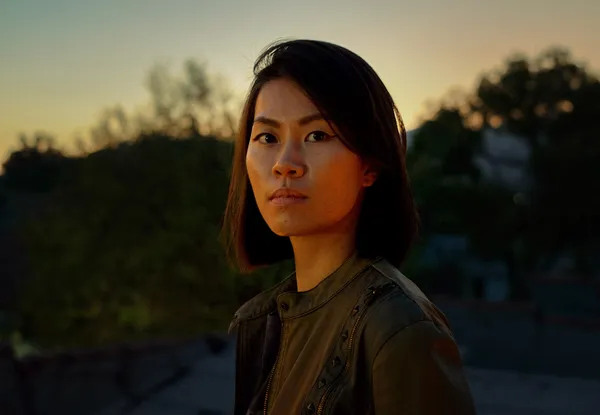
| Amoeba director Siyou Tan Photo: Danielle Krudy |
A teenage girl’s exploration of her own identity brings her into conflict with a society unsure about its own in Siyou Tan’s Amoeba, which is screening as part of this year’s Toronto international Film Festival. Set (and mostly filmed) in her native Singapore, it follows Choo Xin-yu as she settles into a new school, acquires a new set of friends and tries yo deal with the presence of a ghost in her bedroom. Undercutting all this is Choo’s struggle to reconcile herself to the official narrative she’s supposed to repeat in exams, as she becomes more aware of the country’s real history. A few days before, I met Siyou and we discussed the background to the film.
“I started thinking about the idea in 2018, after a previous short film I made, Hello Ahma. I had moved to the US for university, and I stayed in the US. Going back and forth between home and my new country, I always thought about my female friendships in general, but specifically of my middle school, my secondary school experience, because it was still quite close. I felt that I was unable to find these kind of friendships in the US. I think the shape of the friendships changed.
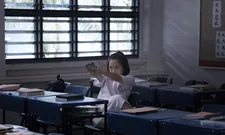 |
| Ranice Tay as Choo Xin-yu in Amoeba Photo: Christopher Wong |
“I think there's something very intimate and essential about the friendships formed in the secondary school age of like 15, 16. And I was kind of sad that we all went on different paths and so that kind of lingered with me. I wanted to explore the time of formation and friendship and rebellion and everything. So I started working on a script in 2018, but it felt a little bit too autobiographical, and I didn't want it to be a documentary. I was somehow unable to fictionalise them. And so I made a short film, Strawberry Cheesecake, as a way to approach it from a different angle.
“I also went to some labs: one in Thailand, and Torino in Italy. [It really helped] having mentors who were able to see the film from outside and encourage me with some structure, because I'm not very good at narrative structure. Just having those pillars of structure, I was able to make it into a film and not a series of vignettes, and have a narrative driving force and fully flesh out the characters in relationship to each other. Because the initial starting point for the film was, like, the title and gang rebellion and ghost and like, how do you make that into a film?”
The chemistry between the girls is magnificent. They really feel like a natural friendship group. How did she cast it and get that to work?
“I'm so happy you said that, because when we started I knew that that was going to be one of the most important things for me,” she says. “They need to feel like a real group of friends. If not, there's no film. So casting, we started really early – eight, nine months before the film was scheduled to shoot. And I worked with the same casting director for Strawberry Cheesecake. So we had a database of girls of the right age, but I was like, ‘Let's start fresh. We're not going to do anything the same.’ And so we casted in traditional ways like posting on groups. And also she did outreach to theatre groups. And I mean, we did crazy things. We went to parties, we went on the street, we did all sorts of things. Because I was a bit curious how it would be if we found a group of friends, non-actors, 16-years-old, [and said] ‘Let's get them in the film,’ you know?
“It turns out that it's a bit difficult to do that because in Singapore, at least until 18 or 20, you are very much under the control of your parents. You don't really have independence. And so trying to work with 16-year-olds is working with the adults who are completely concerned with their exams and their future. And so in a way we went around like, ‘Okay, actors.’
“Finding the main character was most important. She's a theatre actor, a national athlete, and we thought she was very interesting. I sent her an invitation to come into our workshops and she did. And she was so strange and quiet and did not mix with everyone. I was like, ‘Oh, that's interesting.’ So we cast her and then we did a second round and we put them in groups and eventually we tried different combinations of four and this seemed to be good, but still it was very awkward. But after we cast them, we had many outings. Like I would cook dinner for them, and we would go on walks, and we did workshops where they had to be very vulnerable with each other. And through the course of making the film they really became friends. I was very happy to see that because as much as you can be a manipulator of these organic things, when it actually happens, it's very satisfying. And so now they have their own group chat and they hang out and they are great friends.”
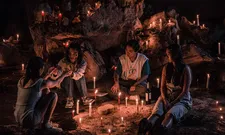 |
| Choo Xin-yu and her friends in the cave Photo: Polo Boado, courtesy of Akanga Film |
We talk about the ghost in the film, which Choo is sure lives in her room, and I tell Siyou that I find it interesting in relation to the girl’s determination to find out what's true and what isn't.
“It's about truth for her,” Siyou agrees. “What you see and what you don't see, but what feels real. And also about the past of Singapore and the spaces and everything...It came from a desire to exorcise something – I don’t know what. But there was a ghost in my childhood bedroom. It became a thing in Singapore. It's quite common to have ghosts. So I thought ‘This character has a ghost in her bedroom, and it makes her troubled and different from her family and also unable to connect with everyone in her family.’ Because why is she the only one with a ghost in the room?
“Everyone thinks she's not telling the truth. Also because she's rebellious, people can say ‘Oh, she's just acting out.’ and everything. And this pushes her into more isolation, and so it pushes her into a friend group more. In the writing process, I also had to deepen the ghost thing, and I thought ‘Why not make the ghost a point of connection between Choo and Vanessa?’ It makes their relationship connected by something more mysterious, because I think attraction is a very mysterious thing. How do you define what's chemistry and everything? So I wanted to have them be united by this thing.
“The ghost becomes like a group thing with, like, ghost hunting, using the camera to look for the ghost. Something that becomes an excuse for Choo and Vanessa to have any kind of intimacy with each other. So in a way, it's a real ghost that comes and goes as it pleases. It's in her bedroom. And on the other hand, it is a metaphysical thing, as you said. It's a way to express truth and differences with the rest.
“For me, when I was confronted with this ghost in my bedroom, it was like, ‘What is real? Is school real? Is the ghost real?’ You don't see it, but your hair is all standing and you know it's there. You know someone is there or something or some presence is there, and it makes you question and challenge what's real and what's not real, and what do you do about it? Do you suppress it all or do you speak up?
“Also, about the past, it's also about the ghost being a thing. As relating to Choo and Vanessa, it becomes about suppression of desire. On the other hand, it's also an expression of what I want to say about Singapore, expressed through the construction and the destruction of things, constantly destroying spaces and building up something shinier. And so it's about how the things that are buried continue to come up.”
The girls in the film hang out in a cave on a construction site where work has temporarily been halted because of the discovery of artefacts from the past.
“I guess I was trying to show that they don't have any kind of privacy in their lives,” says Siyou. “ Above ground. There's so much surveillance with the people in authority. And for Choo, I mean, she can't even hang out with her friend in her bedroom without being bugged upon. That was a real thing I felt like growing up in Singapore. You have no privacy. I shared a room with my sister. Then you go to school. There's nowhere to really be vulnerable each other. And so they have to go underground where it's like a sealed underground space and they can just share their secrets with each other.
“It was a real cave. That's why we shot in two countries, even though it was supposed to be a shoot only in Singapore. When we started shooting day one, we had not found a cave, even though we tried for many months to get permission in Singapore. There are some in Singapore, but they are all for either military use to store bombs or like, I don't know what they're doing actually – I mean, it's actually kind of fascinating. They have a huge underground cavern where they do oil refinery stuff.
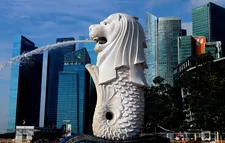 |
| The famous merlion Photo: Prayitno Photography |
“Because Singapore is tiny, any space above and below ground is for productive use, and so it seemed like it was impossible to shoot in Singapore. On our crew, there were three friends, colleagues that came from the Philippines. Our AD team was from the Philippines, and so was our production designer. One of them is our second AD, who was the producer. She saw that we were having so much difficulty with the cave, so she stepped in and she said ‘Do you guys want to consider shooting in the Philippines? I'm going to make it happen.’ So we shot there for a day, all the scenes. And it was a real cave – a huge, huge cave. And they use it for filming. It's a private cave, so no government permission needed.”
It’s not easy to get support for a film like this from the government in Singapore.
“Let's see how the reception goes,” says Siyou. “There are many things that they will have issues with. For example, the gang thing. It's a thing that even till today, there's all these arrests made during funerals. At funerals of ex-gang members or suspected ex-gang members, the gang members come out and they want to do like a last hoorah, like a send off, so they sing their gang song. And so when they do that, all of them are arrested. The gang thing seems to still be a sensitive topic, even though I think it's ludicrous because they have been so suppressed and stamped out and arrested and detained without trial that there's really nothing left.
“I think actually the biggest thing that to me is a bit more subversive is the thing about history and questioning Singapore's legitimate history, which is the state narrative. When I was writing it, I was trying to explore it in a way that was not going to make the film censored or banned, so I had to be a little creative about it. Not like an outright middle finger, you know? And so for example, when they smash the statue, that might be an issue because he kind of looks like our founding father. And questioning the merlion is not allowed. Using the Singapore flag in ways that are not positive is not allowed. So we'll see how it goes.
“I'm trying to disguise the film a little as coming-of-age, but in a way what I want to address and question and challenge are these manufactured myths and narratives used to control young people. And how do young people grow up and negotiate this kind of repression?
“When you are young, you laugh about it, but eventually I think the realities of growing up and the societal pressure – I think the societal pressure is a very, very powerful thing. Most people end up toeing the line. Having children, you know, having a job that they are not very interested in. And that's it. Life is a mortgage and children, and you have to do exactly what you're supposed to do.”
She’s excited to be back in Toronto.
“Toronto was like my first festival,” she says. “I've made shorts before, but I always felt very embarrassed about them and I never sent them anywhere. I was pushed to submit to festivals with this short film and Toronto was the first festival I attended and it was so friendly and I felt like, ‘Wow, it's really an audience. It's a festival for the city and for the people.’ I like that a lot because you really get to talk to everyone and it's a very friendly kind of place. So I'm very excited to be bringing my family to Toronto. And I think Toronto also is a place with a huge immigrant community, with maybe young generations that can relate to this kind of parental pressure and things. I’m so I’m very curious how they will react.”
There are further screenings of Amoeba at the festival on 9 and 10 September.