 |
| In Transit Photo: Edinburgh International Film Festival |
Director Jacalyn Bethhany and screenwriter Alex Sarrigeorgiou's Maine set drama, In Transit, is a tender and intimate tale of one woman's contented life being disturbed by the arrival of a stranger.
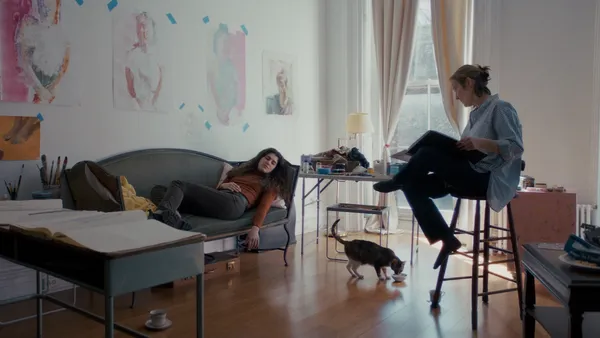
Lucy, played by Sarrigeorgiou, is content working at the local bar her father had worked at the whole of his life and going home to long-term boyfriend Tom (François Arnaud). But when Ilse (Jennifer Ehle), an artist going through the throes of divorce, arrives in town, the two strike up an immediate connection. Fascinated by the younger woman, Ilse asks Lucy to model for her. The time they spend together stirs the feelings they have for one another, which pushes Lucy to question the life she truly wants.
Born in Greece, Sarrigeorgiou is a New York-based poet, actress and filmmaker. Her poetry has been published in Red Tree Review, Bodega Magazine and Hypertrophic Literary among others. She wrote and starred in the short film Con Spirito, about two women stuck in a tree discussing the challenges confronting their new literary newspaper, and has directed the shorts Grip, Cave People and A Little Body, A Little Earth.
In conversation with Eye For Film, Sarrigeorgiou discussed finding inspiration in the "strange and surreal" experience of art modelling, the desire to depict what life is really like, her love for the sound of charcoal on the page and the opportunity of connection through vulnerability.
Paul Risker: A good place to begin might be to reflect on how the journey of this film has taken up a significant part of your life.
Alex Sarrigeorgiou: It sure has — the better part of the past five years. I started writing this script in 2020 or maybe even 2019 — I can't even remember when I had a first full draft. And I've been working with CC [Kellogg], who's one of our producers since 2022, and Jacalyn came on board shortly after. But, yeah, it has been a long journey.
PR: When speaking with filmmakers, they've said films become like time stamps or reference points for remembering periods of your life.
AS: It has been the main thing I've thought about for the past few years and especially around our shoot. That was such a marker for me because it was an amazing experience. This is the first feature script that I've written that has been produced, and it's my first lead in a feature as an actor, so it definitely marks a moment.
PR: I remember director Sean Brosnan telling me that he discovers the themes and ideas, while Pablo Larraín said he finds the film in the final cut. Is filmmaking a journey of discovery for you?
AS: It definitely was a journey of discovery for me. The first glimmer of half an idea about this was in 2019, come to think of it, because it was pre-Covid. I'd worked as an art model for a few years as my day job, which I loved. It's such a unique and strange thing to do for money [laughs].
I remember being in a drawing session with a small group of three or four people that were just doing a portrait of my face that day. So, you're sitting perfectly still and quiet, and meditating or thinking about whatever it is, and I just remember having a moment where I thought about how weird it is to have people look at you in this really intense, focused way. And they're also not looking at you at all. They're thinking about your form, the shape of your nose or whatever it is, but not you exactly. And they are also trying to capture something about who you are.
So, I was thinking about what a strange thing it was to be sitting here and being looked at for hours at a time. Not everybody gets to experience this strange and surreal thing, and so, I wanted to write something about this, and I started exploring it.
At that point, I had been doing it professionally for a few years. I didn't even think about it, but I was thinking about how, for somebody who's doing it for the first time and has no exposure to what this is, it's an interesting experience. At the same time, I was having a bit of an existential crisis myself where I was torn between being an actor or a writer and pursuing a career in film. This is a really difficult industry, and I was also living in New York, which is really tough and expensive, and so, you're always sort of hustling.
I was torn between the side of me that wanted to keep doing what I was doing and the side of me that was thinking, 'Well, maybe I would be a whole lot happier if I got a job in a smaller community that I like, if I found my people and I just led a much quieter and simpler "life." Why am I fighting so hard?' So, those two ideas merged and then these conflicting sides of myself became Lucy and Ilsa, who are each looking for meaning in their lives in totally different ways.
PR: While Ilsa is proactive in her search, Lucy is someone living a settled life that's suddenly upturned by the arrival of this stranger. Lucy is propelled to search for something more beyond her contentment because of her encounter with Ilsa, but also Gary, the owner of the bar she works at, who asks her why she doesn't want to finish her studies, and her boyfriend, who tells her that she loves him like she loves the bar her father built. He's just there, like their house. One person's search impacts another person's contentment, revealing the life they have been living might not be as content as they've come to believe. In Transit is a sensitive exploration of the way we shape one another's lives.
AS: Lucy is the sort of person who has found contentment in her life, which is so hard to find. What sets this film in motion is she meets this person, Ilsa, who makes her all of a sudden feel seen in a way that's new to her. I think there were ways in which she was content, absolutely, but also just sort of there, and not alive in this bubbling way that Ilsa is alive. So, something is stirring in her where she thinks, 'What does this person see in me? What else could my life look like? And then simultaneously, she suddenly finds out that this bar that she's worked at her whole life, and her father worked at his whole life, is about to be taken from her. Then it's like, 'Well, if all this stability and contentment is taken from me now, who am I outside of that? I don't know. I have to figure that out.'
It's interesting that a lot of times people talk about story in a way that everybody has to have an objective and to have something they're after. But I don't think most people are like that. I think a lot of people are just getting by and trying to make their lives as happy as they can be, given their circumstances. And so, it's this weird thing to me where why are we denying what life is like for most people who live this way?
PR: One of the striking things about In Transit is that it's happy to exist in the silent moments of the characters' experiences, by emphasising feeling over verbalising emotion. In this sense, you're trying to capture a more genuine snapshot of the human experience and forego traditional narrative storytelling models.
AS: I'm so glad you felt that way, because one of mine and Jacqueline's goals with this film is to let moments sink in and to let the feelings be there without articulating them clearly at every turn. We want to let the audience walk away with questions rather than answers. And we want the audience to think about the person in their lives that changed how they saw things. Who is the person that transformed them in a way that they can't quite articulate but changed their lives in a way that it will never be the same again?
That's how it works for most of us. It's not that something happened, and then I became this person — it's ineffable.
PR: I've heard directors and actors talk about workshopping scenes, and In Transit has that kind of feel. There's a spontaneity and willingness to forego transitions and just cut to the next scene. The characters are also in the moment, and the style of performance has a lighter feel, as though they are discovering their words and actions. All of this brings a naturalism to the film.
AS: That's one of Jacqueline's strengths as a director, and also in the way she and Sam [Tetro], our cinematographer, worked. They came up with this visual language for the film that allowed for a lot of stillness, long takes and oners, where we got to be in a scene from beginning to end, and not cut away a million times. Instead, we could just be there with the characters in real time who are experiencing it.
As an actor, that's such a gift in film. You don't often get to roll for 10 minutes straight and just be in a scene and walk around a room and explore. Jacqueline also gave us a lot of freedom in this way where, of course, there were marks to hit at certain moments, but within that framework, you were free to just be in the scene and see what came up. And as an actor, the most exciting thing for me is when you're doing a scene, and you discover what it's about as you're doing it, or you finish it, and you find things come up that you had no idea would. It's such a powerful thing because that's what life is like — you're not plotting what you're gonna feel when you discover things today. Instead, things just happen, and you learn something about yourself as they happen.
PR: In one of the scenes where Ilsa is drawing Lucy, I find myself hanging on every word as Illsa tells Lucy a story about the artist who hid their self-portraits in still-life paintings. The sound of charcoal on the page was also something that seduced me on a sensory level. Then, there's the sparing use of music throughout the film, leaving space for the natural soundscape to breathe. The score is still important, and notable was the use of the piano to express the film's emotions.
AS: Oh, I love that. And Jennifer has such a beautiful speaking voice, and, of course, you're mesmerised listening to her say anything. But it's interesting you point that out, because when I was working as an art model, I cherished this quietness: 'Okay, I'm going to work, and I'm now going to have two quiet hours when all I'll hear is charcoal on the page.' I'd be thinking about anything and everything, and it's so peaceful, and it's so rare. So, I love the sound of charcoal, and it's such a comforting sound to me now. And it's also so expansive in a way — you can just kind of rest in it.
I'm glad you appreciated that, and you're right to point out the score. We worked with a really wonderful composer [Juan Pablo Daranas Molina], and Jacqueline's instinct to use the score sparingly was one of the things that I love about the film.
PR: We don't talk about vulnerability enough in relation to cinema. The filmmaker has to allow themselves to be vulnerable, as do the actors. The audience must also share their vulnerability because that's how they connect with the characters. So, it's important to consider vulnerability when making and talking about films.
AS: The art that I'm drawn to, the films and the books that I love are those where I feel like somebody's let me into their world, their mind, and their vulnerability, like you said. I read Virginia Woolf, and I'm like, "I know you deep in my soul." Of course, I don't, but I feel a connection with the person because I feel like they've let me in, in this way. And being an actor and a writer doing this, you have to let people in, because if you're not risking anything, then it's not going to be worth anything. I think you have to risk being seen in this way for it to have an impact on the person watching.
We're heading to our world première next week and the thought of sitting in a room with a bunch of people seeing this for the first time is scary because it's vulnerability, like you said. I'm letting you see the things that are in my head and how I feel about the world, but that also allows for connection and that's all we've got.
In Transit made its World Premiere at the 2025 Edinburgh International Film Festival.