 |
| Terrestrial Photo: Fantasia International Film Festival |
Steve Pink alters his trajectory again, eagerly seeking to challenge himself. From 2021’s romantic drama The Wheel, about a couple retreating to the mountains to repair their relationship, the director pivoted to the political drama, The Last Republican, in which he and Republican Congressman Adam Kinzinger sought to explore the events of the January 6 Capitol riot. His new film, Terrestrial, abruptly takes Pink into the realm of a psychological thriller with a sci-fi slant.
Pink his perhaps best known for co-writing the black comedy Grosse Pointe Blank and the adaptation of Nick Hornby’s High Fidelity, as well as directing Hot Tub Time Machine and its sequel. He has also directed episodes of the comedy series New Girl, Sirens, Rhett and Link’s Buddy System, Wayne, and The Karate Kid spin-off, Cobra Kai. Pink’s directorial credits show there’s no shortage of nuance to his narrative range.
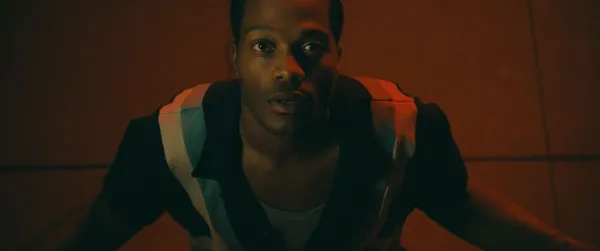
Terrestrial revolves around four college buddies, who reunite when Allen (Jermaine Fowler) decides to host them at his luxurious Los Angeles mansion. A writer in the middle of working on his first novel, he appears to be basking in success. His friends, however, cannot help but notice their friend’s strange and erratic behaviour, while the holes in his success story become increasingly difficult to ignore. Soon, they find themselves involved in something their wildest imaginations couldn’t have dreamt up.
In conversation with Eye For Film, Pink discussed his unpredictable body of work, memories of Chicago’s theatre community, and drawing inspiration from classic sci-fi literature. He also shared some amusing thoughts on being an unabashed pitcher and sandwich Wednesday’s and revealed a self-deprecating humour.
The following has been edited for clarity.
Paul Risker: When you’re making a movie, are you watching any specific films to help stir your creativity?
Steve Pink: I try and watch within the genre. Ari Aster's work is obviously inspiring to me, just in terms of the way he creates psychological trauma in the characters. Robert Eggers is also fantastic. So, since this is my first foray into a psychological thriller, I’m looking at guys who are doing it as their life's work, to see how they generate the emotional context and worldview of characters inside a terrifying reality. And they're great at it, obviously.
The Shining was also a huge influence, and then Hitchcock films as well, because there's so much psychological stuff happening without necessarily a ton of gore. So, then you have to figure out how to terrify people without showing explicit horror in order to maintain the stakes of the story.
PR: Are you looking for ways to play with the cinematic language, to tell different types of stories, and challenge yourself in new ways?
SP: Always. I've been on a challenge run. People know me as a comedy director because I spent my life in comedy, which I, of course, love. But I did a romantic drama called The Wheel, and then I rolled into a political feature documentary, which was in festivals last year that I'm very proud of. And then I’ve rolled into a psychological thriller. I’m exploring all the different things that I want to capture in a story, and genre has been where I've been for the last four or five years. It has been incredibly exciting and rewarding, although now I'm about to launch back into doing a comedy, and it’s exciting to be back on home turf.
I've been really lucky because my producers, Josh Jason and Molly Gilula of Hurley/Pickle Films, brought me the romantic drama that we did a few years ago. When they brought me this psychological thriller, I said, “I just love that you keep bringing me a different genre and also have faith that I can pull it off.” I also said, “You guys are insane. You should start to really think about who you're sending movies to.” So, because of that relationship, we were able to build the film from the ground up. I didn't write this one, as I hadn’t the romantic drama. So, meeting the writers and talking about how we would execute the film inside the box we had from a budget perspective, not teaching, but orienting the writers around what we could and couldn’t do, but still try to tell the story they wanted to tell, was a challenge. Obviously, it's always a challenge no matter what budget level you're at.
To that extent, we built it up, and then we had to cast. We were lucky because the cast we have is bananas, but you know, it's a testament to the power of begging. I would say if you're worried about the downsides of begging, there are none. You just keep begging till your actors say yes. You wear them down — that is the key.
PR: There are times in life you can’t be afraid to ask or go after what you want.
SP: I'm an unabashed pitcher, and I'm not just gonna ask you, I'm gonna throw every argument I can at you. “Well, Wednesdays are amazing sandwich Wednesdays. So, not only will you enjoy the character and the story and be in a really good movie, but you’ll have great sandwiches in the middle of the week.” I'm not opposed to pitching every angle that would make an actor become interested. And sometimes the sandwich would do the trick. Not often, but sometimes.
PR: When you were talking about working with Terrestrial’s writers, you reminded me of the collaborative writing process of Grosse Pointe Blank, where you, John Cusack, Tom Jankiewicz and DV DeVincentis would share drafts. What you’re talking about is almost second nature to you by this point, and it strikes me that you’ve always valued that process of batting around ideas between different people.
SP: Oh, yeah, for sure. I was lucky to be part of a huge community of theatre people, including a company that I co-founded with my colleagues years before we were in the film business, and a lot of those theatre people migrated to Hollywood.
There was a group of us at that time who were all relying on each other. Once you’ve built sets together in an ADC Black Box Theatre on the south side of Chicago, then pretty much any other collaboration is going to be easier. First of all, if you're lucky, you're getting paid to do the thing that you were doing for free. And when everyone's doing everything, there is no ego, right? I hate admitting that I was ever an actor in those plays, and for the people who had to endure those performances, apologies in retrospect. But sometimes you would act, sometimes you would direct, and we all did props. It's theatre, right? So, it's just that: Hey, let's put on a show in the barn kind of philosophy. And then, we carried that on into film.
I didn't even know about auteur theory in and of itself. And especially when it came to Grosse Pointe Blank, we had a very specific vision of how to execute that film. And once everybody could understand what it was, including the studio obviously, the director and Johnny Cusack, who was amazing in that film, everybody was just going down the same road together. And that's what made it so much fun to make that film.
PR: Terrestrial has a larger-than-life vibe and yet, it’s grounded in the anxieties and insecurities of human nature. This is often true of sci-fi, whose imagination is expressed in relatable ideas. Terrestrial’s themes reach down to the roots of the genre.
SP: I have always been a sci-fi nerd when it comes to literature: Kurt Vonnegut, Arthur C. Clarke and I love Neal Stephenson in the cyberpunk era. Sirens Of Titan was a huge favourite of mine and obviously Snow Crash in the modern era. And then, of course, there’s Philip K Dick and William Gibson. All of those novels were concerned with the nature of reality, which is something you can, on some level, question and explore through science. Then, of course, it flips on you, and it either goes horribly wrong or right.
This movie allowed for all those things. At first, the characters are trying to figure out what happens when the world rejects you. That’s a fundamental question — what happens to everything you believe in and maybe even something you're actually good at. And in this movie, you find out something about what Allen is good at, but doubt has crept into his life because all he has experienced is rejection. And so, the world he creates to withstand that feeling of rejection is either in his mind or it might actually be projected or even exist on another planet, literally in this case. The nature of being accepted could just be self-acceptance, or it could be acceptance by people or creatures that aren't earthly, right? Maybe there is someone or something out there that will accept you — what would that be like? That would be a greater acceptance.
PR: You could almost describe Terrestrial’s story as falling down the metaphorical rabbit hole, but in this instance, it’s not a single rabbit hole, but multiple ones. And the experience of watching the film is like peering into that hole only to find yourself falling in and becoming lost amid the chaos.
SP: Well, I hope you felt that way when you were watching Terrestrial. It was a very hard thing to achieve, and at times, I was worried that I wouldn’t be able to achieve it. I do feel like you get drawn in, and it grabs you at a certain moment — it even grabs me when I watch it. And then, I wanted to escape in that moment, but I couldn’t because I didn't realise the door had locked behind me.
I like that feeling, and it was something we tried to achieve, so, I hope the audience does feel that way. Then they are forced to double down, lean in, and keep going down that rabbit hole — the only way out is through, right? And so, once you get to that moment, it’s like the film’s propulsion that keeps you moving forward — you can't escape, and it's terrifying. I hope it comes together like that.
At the same time, you feel bad because you know the nature of a rabbit hole doesn't mean there's malevolence. There are a lot of unintended and tragic consequences, which are terrible, but there's no malevolence in the movie. The character is striving constantly to manifest something, and then in that failure spirals and can't get out.
Terrestrial premiered at the 2025 Fantasia Film Festival.