 |
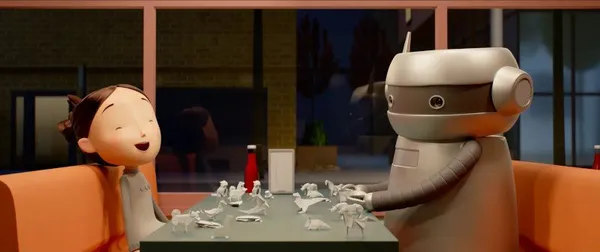
| Eric San says the origami scene was inspired by a meal with his mum. She turned a chopstick packet into a shape. 'I was holding it like it was a jewel in my hand,' he recalls Photo: Outsiders |
Kid Koala – aka Eric San – makes a virtue out of simplicity with his debut animation. He employs an uncluttered clarity in Space Cadet to tell the story of a little girl, Celeste, who dreams of being an astronaut like her mother, and the guardian robot who has looked after her since her mum didn’t come back from one of her missions. As the time comes for her to prepare for her own space mission, they are both set for a fresh adventure
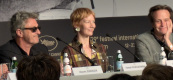
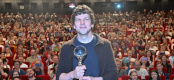
The Canadian’s sweet tale of love, caring for others and letting your imagination roam free premiered at Berlinale and has recently screened at Annecy Festival, where we caught up with him over Zoom to chat about his work. Best known as a scratch DJ, his music has featured on the soundtrack to films including Baby Driver and Scott Pilgrim Vs. The World, he has also gone on to write graphic novels, including Space Cadet, from which he has adapted this film alongside writer Mylène Chollet.
It seems he’s someone who is always on the look-out for a fresh challenge. “Staying in that beginner phase is kind of the most joyous part,” he says. “Where you're trying to learn and trying to keep up.”
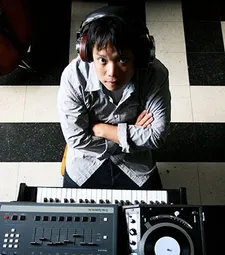 |
| Eric San - aka Kid Koala - 'Staying in that beginner phase is the most joyous part' |
He also tries to push boundaries, writing soundtracks for his graphic novels. San says it all starts with the story. He adds: “But that’s just in the lead by about a day because the second I start drawing the first panel I already have music and think, ‘This would be the perfect tone or musical motif for that opening page, so I'm already thinking like that. It helps me to stay in a tone zone if you will. Often I'll find music that I like to draw to or I'll record something and just kind of put it on a loop so that I can stay in the zone while I’m finishing the whole page.
“It's rare that I would draw something without music playing. Similarly, If I start working on a track, I'm already imagining some sort of visual.
Articulating the difference between writing music that is intended to accompany something like Space Cadet as opposed to simply for a gig, he says: “Especially when it comes to film scoring, there's always the idea that it should serve the the emotion of that scene, whether it's more poignant or suspenseful or melancholy. All those things guide where it should go and I have been invited to do some work on different films and I always enjoyed listening to the director, and them telling me what they were thinking in terms of the feel and the motivations.”
This time, it was San who was in charge of generating the feel and motivations for the Space Cadet soundtrack, he also worked with a host of established singers, including Emilíana Torrini, the Yeah Yeah Yeahs Karen O and Mariana “Ladybug” Vieira.
“I kind of reached out to a few of my favourite singers to be the voices of comfort. Honestly, I still can't believe it. I saw the poster yesterday in Annecy and just having all their names in a row there, I got a little misty.”
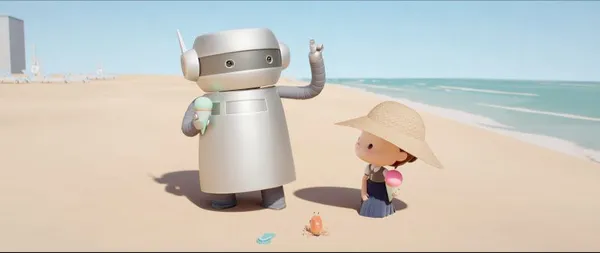 |
| Eric San on the minimalist look: 'Your eye’s not just dashing around trying to collect information, you're just really staying with the camera in the moment' Photo: Outsiders |
“The original graphic novel was inspired by the passing of my grandmother and the expectation of the arrival, my first daughter. So I got really existential there. But as far as me coping with the passing of my grandmother, who I was close with. We loved watching Charlie Chaplin movies together and I was thinking back to those moments in my childhood and sometimes they were very short subtle interactions that were able to just change my whole perspective on the world.
“So I was thinking about what my parents and grandparents taught me and those moments that I was trying to cherish and honour.”
Although some of the themes of the film are quite adult, centring on memory and grief, Space Cadet is a very accessible story for any age group thanks to its visual storytelling and gentle sweep. San says he wanted it to be “as universal as possible”.
He adds: “One of my favourite childhood memories was watching Modern Times and hearing her laugh – it was contagious to be around my family and be responding to the same body of work. Three generations sitting in the living room around the TV. When people ask who it’s for I say the parents of emotionally intelligent children.
“A friend of mine I showed the screener to recently said, ‘Oh, this is like Lost In Translation for kids. I'm like, ‘I don't think that's an audience, dude.’ Anyways, I hope there's enough universality in some of the topics that you could relate to it on some level. I think children possess a high emotional intelligence that we don’t give them credit for.
“But, for me, writing the book was the process of coping and grieving, just cherishing those memories and those moments.”
One of the moments to cherish in the film is an origami contest that breaks out between the robot and Celeste at a diner. San says it was inspired by a moment he shared with his mother.
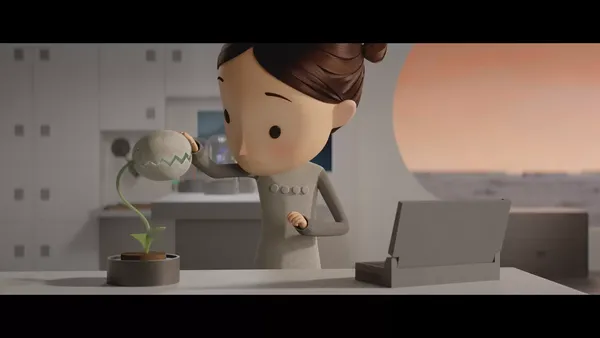 |
| Eric San: 'I was thinking about what my parents and grandparents taught me and those moments that I was trying to cherish and honour' Photo: Outsiders |
San’s film is laced with potential and possibilities, not least in the artwork that Celeste’s robot starts to make. He moves from it being an act of simple replication to something more deep.
“He was a guardian robot, so when she leaves, he’s kind of in an empty nest situation. His job is sort of done, so how he spends his days is now up to him. At first it's very confusing for him but eventually he finds that he wants to spend it remembering.”
Returning to the uncluttered look of the film, San notes that it wasn’t easy.
“Simple is actually the hardest to do, especially for me as a scratch DJ who loves to just add little notes everywhere. I'm generally inclined to be more maximalist about something, but I think, when I was doing the original graphic novel, I remember even within a panel when I started getting too involved with too much detail, in the background, I felt the focus was kind of distracting – out of the feeling of the pane.
“So, Lillian Chan, our production designer and CG character designer really wanted to see if she could do that in a CG World but maintain this sort of minimalism. She and Corinne Merrell, our art director, worked very closely to not have it feel like too much information, even restricting the colour palette. Just designing it in a way where space was the operative word, even if you're in a living room, that there was space. So your eye’s not just dashing around trying to collect information, you're just really staying with the camera in the moment.”
As for whether he might make more animation, he says: “Absolutely. I've been a fan of animation since I was 12. I remember making claymations in school and I even applied to film school and got in after, after high school, but for financial reasons I decided I wasn’t going to go for that and my career took a different path through music. But we’re here decades later and it’s a dream come true.”