 |
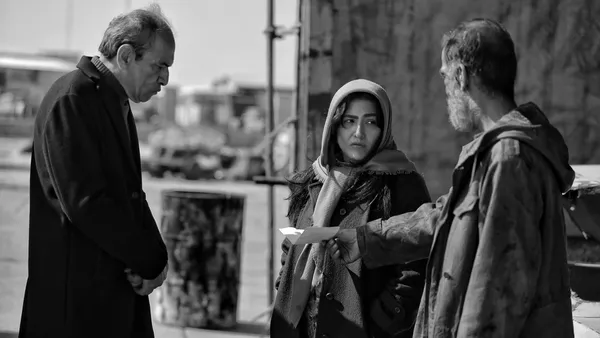
| Baran Kosari with Behzad Dorani, left, and Babak Karimi in The Wastetown. Ahmad Bahrami: 'The personal reason that I've worked on these types of topics is that I want to show this brutal situation so that others see what is happening and how to avoid it in the future' Photo: Courtesy of POFF |
Iranian director Ahmad Bahrami’s continues bleak consideration of his homeland with The Wastetown[film] - the second part of an intended trilogy after his Venice Horizons-winning [film]The Wasteland. Set against the backdrop of a car breakers yard, it sees Bemani (Baran Kosari), who has been temporarily released from jail after 10 years, attempting to find out the whereabouts of the son she was forced to give up in prison.
The film co-stars Ali Bagheri as Bemani’s brother-in-law, who previously also starred in The Wasteland, Babak Karimi and Behzad Dorani. A tense drama that, like many of the films of Bela Tarr, who Bahrami cites as an influence, The Wastetown is built upon rhythmic repetition, and paints a bleak depiction for life for women in his homeland - something that is back on the world news agenda at the moment in the wake of protests after the death in custody of Mahsa Amini.
We caught up with Bahrami after his film had its world premiere at Tallinn Black Nights Film Festival to talk about its themes and the state of his nation.
The film is built upon repetition that involves interactions between Bemani and three different characters.
“I actually had three short stories about three protagonists,” says Bahrami “And I wanted to do them in a repeated way, repeating the dialogue and everything so that the audience can see the connection between these three stories?”
Much of the violence in the film is implied rather than shown - Bahrami says he wants the audience “to use their own imaginations” - but in many ways it's no less brutal thanks, in part, to strong sound design.
Bahrami says: “When I'm doing the script for the film, I separately do another script for the sound design. For example, I knew that the sound of the wind was always going to be in the background. I capture the ambient sound when I’m in the scene but later during the production process I also work on it.”
One of the strongest elements of the sound design is that of a female dog, which is heard scavenging at key moments in the film
Bahrami explains: “The sound effect of the dog has another application in this movie. It is simulating the inner spirit of the woman - that she can, as dogs do, stand up for herself and defend herself.”
It wasn’t easy to be able to shoot the film in Iran but Bahrami perservered.
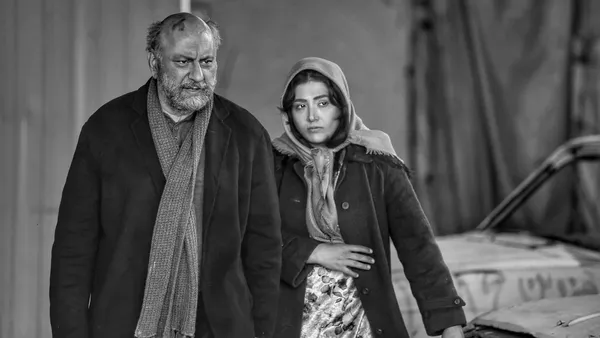 |
| Ahmad Bahrami: 'Every filmmakers believe that in showing what's happening inside the country maybe we can show the state what's happening and maybe we can use it as a leverage so that they change their ideas and make some corrections in their policies' Photo: Courtesy of POFF |
When I ask him if it is getting harder to make films, especially with a female protagonist as he has done, he notes: “This is a problem that already happened in the contemporary history of Iran for 100 years.”
He adds: “After filming was over and I went to obtain the permits for a screening. They already censored 15 minutes of different scenes of the movie. And in Iran now, the thing that people are seeing is the censored version.”
When asked about the ending to his films, which have so far been brutal and bleak, he says: “There is a quote by Bela Tarr, the Hungarian filmmaker. They asked him, ‘Why is there no hope in your movies?’ He answered: ‘If I wasn’t hopeful, I would be sitting in my home not going to work or making films. So I have hope to make films.’”
He adds: “For me, the personal reason that I've worked on these types of topics is that I want to show this brutal situation so that others see what is happening and how to avoid it in the future. I want to somehow mirror the past fr it not to happen in the future. I show this brutality and violence with the hope that the audience, when they come out of the cinema, will think about it and how to avoid it, how not to make it repeat.
“I believe that artists, and filmmakers, their work as meaning when they are inside their society and then they are immersed in their community.
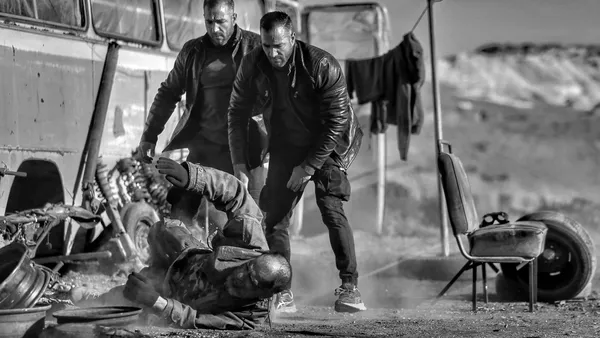 |
| Ahmad Bahrami: 'I show this brutality and violence with the hope that the audience, when they come out of the cinema, will think about it and how to avoid it, how not to make it repeat' Photo: Courtesy of POFF |
“Every filmmakers believe that in showing what's happening inside the country maybe we can show the state what's happening and maybe we can use it as a leverage so that they change their ideas and make some corrections in their policies. That's what we hope and that's why we stay inside Iran and try to make things there.”
The star of the film Baran Kosari was intending to be in Tallinn as well in support of the film but was unable to get a visa from the Iranian authorities to travel, there were reports in November in Iran’s judiciary’s Mizan Online that Kosari had also been summoned by prosecutors in the latest wave of protests. I ask whether he is every worried that one of his stars might have problems with the police as a result of involvement with one of his films.
“Actually, there are so many concerns about this,” he says. “But still, we have our ways to somehow pass through all the censorship and convey our messages. And I personally try not to be tired and not to get frustrated about the situation and to continue working. But who knows, maybe someday I’ll also give up. What I see as my duty, and other Iranian filmmakers see as their duty, is raising awareness.”
Given how relevant his film is to the current oppression of women in Iran, he adds: “It's like filmmakers have some kind of prophecy. When we started filming this movie was actually last year, when we kind of saw that the pressure on women was becoming more and more and somehow we predicted the situation.
“If you have lived inside Iran, you wouldn't be surprised because it is like a process that gradually happens and you can see the trend of how it is shaping. Yeah, so no surprise.”