





Eye For Film >> Movies >> After The Hunt (2025) Film Review



Everything about the publicity for Luca Guadagnino’s Yale-set drama speaks to the director’s wish to make it provocative. Even before the film begins, there are the credits, written in white-on-black Windsor Light, which he has acknowledged are as much a reference to Woody Allen’s personal circumstances as to his work. Debate rages as to whether this was crass trolling or just poor taste. Whichever may be the case, it’s a mistake – because whatever else Allen might be, he’s thoroughly au fait with the intellectual topics he addresses in his films, whilst Guadagnino is painfully out of his depth.
The primary emotion one experiences when watching this is not the personal moral discomfort that Guadagnino purports to have been seeking, but rather what the Dutch call plaatsvervangende schaamte - a sense of acute embarrassment on behalf of others. In this case, its object is split between the characters and the actors. What ought one to make of a philosophy professor who badly mangles well known concepts when lecturing her students about them, or of a group of supposed elite intellectuals whose party patter consists of pretentious boasting about subjects they understand at the level of second year undergrads (who have not yet been told that everything they’ve learned so far has been simplified to the point where it’s almost self-contradictory)? Some of this dialogue is so twee that one suspects it is intended as satire, until the central narrative is mangled in parallel ways.

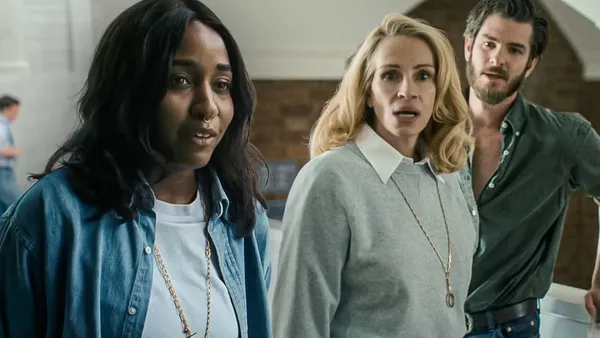
One feels particularly bad for the actors because they are all high calibre and because Guadagnino’s primary talent lies in extracting good performances from his casts. Julia Roberts takes the lead as the cultivated yet brittle professor Alma Imhoff, reminiscent of her role in Charlie Wilson’s War but without the wealth or the underlying confidence it brings. She’s ridiculously wealthy for an academic – perhaps thanks to adoring husband Frederik (Michael Stuhlbarg) who has a bit of a Gomez Addams thing going on – but still precarious enough to be nervous about her upcoming tenure review. As the film opens, she’s trying to please the right people by hosting an elegant party, with a handful of students present to look suitably awed – notable amongst them Maggie (Ayo Edebiri), whose adoration of her verges on obsession.
Maggie is in the awkward situation of being both an outsider – Black, queer, dating a non-binary person – but also, as the daughter of wealthy donors, too privileged to attract much sympathy. The money means that she’s probably clueless as to the real quality of her work, having been quietly given the benefit of the doube over and over again. With a plagiarism accusation about to surface, she is going to find herself out of her depth – but this is not close to the most difficult situation she will face. When, the day after the party, she tells Alma that she was raped by the man who drove her home, she is met with a stunning lack of sympathy, pressure to keep silent, and suspicion as to the truth of her words.
The man in question is Hank, superbly played by Andrew Garfield, who is really much better at this kind of thing than the heroic rules he is usually given. Here he gives his natural creepiness full reign, presenting us with a professor who is brash and inconsiderate as a matter of course, his personal philosophy being that anyone seeking education should toughen up and learn to role with the punches. Casually flirtatious as well, he’s the sort of man who easily falls under suspicion – which does not, of course, mean that he’s guilty of this particular act. Unfortunately for Maggie – and probably for Alma as well – he is one of Alma’s closest friends, the two enjoying that species of closeness generally reserved for former lovers who have given up on resurrecting a relationship they know won’t work yet see no reason to be shy about how much they adore each other.
All the actors acquit themselves well. Edebiri may be cast against type, but this makes her all the more effective if you’re familiar with what she usually does, and we get a brief glimpse of her warmth and energy at the very start, before something happens at the party that makes her uncomfortable. The impression we get thereafter is of an ordinarily vivacious person struggling under an intense weight of stress, disorientated not just by what may have happened after the party but by the sudden coldness she encounters where she had expected to find support. Her partner Alex (Lio Mehiel) stands by her, but their relationship is clearly under strain. Going public brings support from fellow students but leaves her with still less emotional space in which to reconfigure her feelings.
Complicating Maggie’s journey is her gradual discovery of a secret about Alma’s past – one which emerges, rather incongruously, in the form of an envelope full of clues (so blatant that it’s hard to know what else to call them) hidden in a cupboard where the student goes looking for toilet paper during that party. This is such a crude device that one wonders if it was originally written as a placeholder which got left in by accident or due to pressure of time (all else aside, why wouldn’t Alma have chosen a hiding place that was private to her alone?).
The secret concerns one of those events which is rare in reality but whose very rarity makes it popular in a certain kind of cinema, contributing to misperceptions which have harmful real world consequences. To be fair, it is explored here in a nuanced way, and from it there emerges the suggestion that Alma is deeply damaged in a way that might explain much of her troubling behaviour. She’s a persistently unpleasant person (often the most fun to play, and Roberts clearly relishes it), easily alienating most of those around her. Chloë Sevigny turns in the best performance in the film as Kim, her only real friend; and Kim in turn suffers a betrayal which, one susects, may be as much a consequence of habitual boundary-testing as anything else. Alma fills the void with pills, endures an unnamed illness which seems to comfort her like self-harm, and viciously snipes at Maggie’s tendency to complain.
There’s a lot of inter-generational bitching here, but it rarely rings true. Alma’s smug misgendering of Alex might be intended to make her seems heroic to some, but mostly gives the impression of jealousy. Hers is a much narrower world, shaped by others before she was even born, with little room for personal expression and even less for structural change. Jealousy, too, because despite her complaints about Maggie, she doesn’t like losing any of that attention. Hank seems more honest in his denigration of millennials, but it’s clear that what he really resents is the loss of his own privilege. He speaks passionately about the horror of being ‘cancelled’ – that is, experiencing consequences – and his perceptions are so clearly at odds with reality that one might think even the filmmakers would learn something, but alas, there is no sign of this.
The myth of cancellation seems, in fact, all too alive, buoyed by a plot which implies that when bad things happen to young people it ought to teach them a life lesson but when mildly distressing things happen to middle-aged, comparatively powerful characters, it’s a tragedy. Ultimately, all these characters are too well cushioned by unfeasible wealth to suffer the way the little people do, so it’s hard to attach much meaning to any of it. Trent Reznor and Atticus Ross work hard to instill tension with their score, but its ticking motif ends up being just another reminder of the worst of the internet, and that’s really what this film feels like: a transposition of poorly informed social media drama onto a real life which the filmmakers have little experience of.
Who is it trying to provoke? If there really are people out there who imagine that women never do wrong and men can never do right; who have seen universities consistently prioritise the well-being of victims; or who lack all capacity to make room for human concerns within their tangle of rules, they are vanishingly few. Guadagnino is tilting at windmills and there isn’t even any wind. In the process, he wastes a wealth of opportunities and turns what could have been an interesting drama into something whose most dangerous quality is that it might put its audience to sleep.
Reviewed on: 11 Jan 2026


Director: Luca Guadagnino
Writer: Nora Garrett
Starring: Julia Roberts, Andrew Garfield, Ayo Edebiri, Chloë Sevigny, Michael Stuhlbarg
Year: 2025
Runtime: 139 minutes
Country: US, Italy
Search database:
