 |
| Extremist |
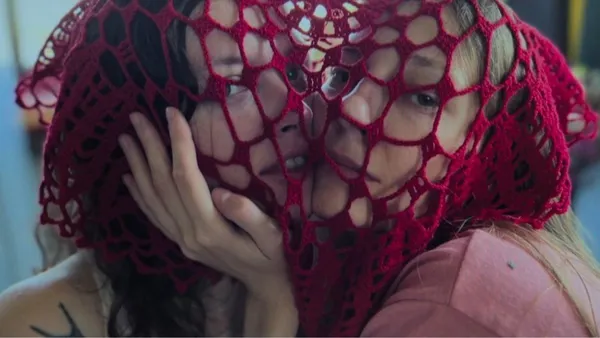
One of the most overtly political films to have made this year’s short film Oscar shortlist, Aleksandr Molochnikov’s Extremist is based on the true story of Sasha Skochilenko, a young Russian woman prosecuted because she tried to spread information about the realities of the war in Ukraine. Aleksandr himself currently lives in exile in New York. “I was directing about 10 years in theatre and film in Russia,” he explains. “Then when the war started, I did some anti war statements publicly in support of Ukraine and so on, and eventually had to leave.”
Although he didn’t know Sasha, he says that his own experiences made the film feel quite personal.
“In general, people who said something against the government or left or stayed and went to prison, many of them I knew. And I've been to courts and I've been to protests where people were arrested, and spent hours on phones pulling out people, police, and trying to somehow drag attention to different political cases of other theatre directors or rappers or actors or journalists. So I knew the vibe, and how these courtrooms and corridors smell, and I felt like this story is something I would love to speak about because it’s something that I do know, and it's happened in St. Petersburg, my hometown. The friends of the characters and who they hang out with in the forest, for instance, is definitely people that are audiences of my theatre plays that I would do in Moscow, so it was about people I knew for sure.”
Much of the material that informed the film came from Sasha’s girlfriend, Sonia, he reveals.
“There was a lot online too because the court was open. Sasha's speech and some details of the investigation, if you can call it that, and the way her trial went on were public. The names of the judges and the prosecutors, lawyers, all of that was public, so I could get in touch with lots of people. But mainly I sent versions of the script through Sonia to Sasha, because Sonia would bring it to her in prison, as she was in prison, and Sasha would give thoughts or notes through either Sonia or lawyers, so I could get some comments from Sasha herself.
“A lot of it, like many details of how things actually are in prisons and how things are in court, all the court details that I didn't know, I had to find out through other lawyers, not her lawyer and friends and people who knew her. Actually, my set designer had many mutual friends with Sasha's mom. So, yeah, there was a lot of access to people who were related to the case. We spent a long time doing that, honestly, because it felt like, since there is some realism and some surrealism in the film, we felt like the realism should be real. So to even dress people properly, to know what uniforms are worn, all of this had to be researched, of course.”
It’s not easy being in a same sex relationship in today’s Russia.
“Just being in love with someone your gender is something very risky if you put it out there. I spoke to Sonja about it a lot, actually, and two other homosexual couples that were in Russia and their experience. But I think that we tried to put in the middle of the story, her bravery and the action she did. So that was sort of the priority. Although officially there’s no law that you can't be homosexual. It’s this law about propaganda for homosexuality, which is such a thin line, you know? You never know where the boundaries of that are. Is kissing on the street propaganda or not? It's sort of a law that can be manipulated this way or the other.
“We just tried to talk to people who did go through it, and I remember once somebody told me that you always feel like you can be attacked from any direction. It's very unpredictable and very uneven. For instance, in Moscow before the war especially, and as far as I know, during the war. It's harder for me to judge because I'm not there now. But before the war, the segment of glamour magazines, for instance, stylists and barbers, was very openly homosexual. No one's ever had any problems with that. In fact, it was even great. But then there was some attempt of tolerance, I think, in Russia for a while, and it wasn't cool to be homophobic. And I guess now it's sadly again becoming a trend. And it's coming from tv, it's coming from big politicians like open homophobia.”
I ask him what he thinks ordinary Russians think about the war, and if they would be likely to believe the messages that Sasha spread.
“Well, that's a great question. It's hard for me to answer because I don't have the statistics right. What I can say is that I think she's talking to people who are the power. She's talking to the judge, she's talking to police, so she assumes they understand. But honestly, it's a question I never can answer. For instance, when Putin is saying whatever he's saying, does he actually believe that, or is that a big lie? When he's surprised that Ukrainians bomb civilian buildings, and he speaks about it like Russia never bombs Ukrainian buildings, which it does all the time, is that what he believes or is that his big lie? Does he already believe his own lie? Where is he according to the truth?
“I think it's impossible to know. I had the luck, I guess, to film a TV show in the summer of the war in a provincial city in Russia, and I definitely can say that the majority of people around me in any profession, like the woman on the reception or some construction workers or a driver, everyone was quite united in support of the war. Even if they didn't actively support it, in general, they believed the TV. And I think that Sasha's action, putting these price tags [with messages on] in a grocery store, is exactly a result of her impression of this indifference of people.
“She wants to put this information right in front of their eyes when they just go to a store because she feels they don't know. Maybe I'm fantasising. I can't say what she actually thought, but it feels like if I were her, I guess it would be a feeling that if I do this, they will see, and I would open eyes of some people at least. But that said, I think that her major action was not even that she put those price tags, but that she didn't back off when all the pressure of the authorities [was] on her, and she gave a speech in court and she went to prison. She stayed loyal to her beliefs.”
She’s out of prison now, he explains, having been swapped with Evan Gershkovich a year ago. Since shooting this film, a lot has happened, and he now feels that its relevance has expanded.
“It's become not only a Russian story because we see people arrested for nothing in the US today as well. And I see by the reaction of audiences on the Q & A's, and the questions, that people really are not watching some niche Russian story, they're watching something that's related to their reality as well. I think that to the Western audience, it's important to sound the alarm that, you know, you imagine this scary, totalitarian country somewhere far away, but if you have signs of the same things around you in your country, maybe you should think twice before going to the next election.
“It's honestly very hard to reach the Russian audience today, sadly, because everything is getting blocked. YouTube is blocked. Our film is on a New Yorker YouTube channel, but to watch it, Russians need a very specific VPN. Not all VPNs work. For instance, my dad could see YouTube a while ago, and now, even with VPN, I think he can't. It's pretty complicated. So I don't know what Russian audience the film will reach, but I feel like in Russia, people who are aware generally of what's going on, they know the story, and those who don't probably wouldn't watch it even if they could. So I guess the truth is it is more for Western audiences.”
There is a chance that Oscar interest could change that, he acknowledges.
“It's just very exciting and at the same time, it brings pressure because now we have a chance to get nominated, so we have to work like crazy to just tell ourselves, after whatever the outcome is, ‘Okay, we did all we could.’ And that's what I'm now focused on.
“There's a lot of work that has to be done in a short period of time before nominations. And I do believe that people should watch this film and filmmakers would be interested to watch it, Americans and UK citizens, Europeans. There's a lot of conversations about a war with Russia this year. More and more people talk about it, that Europe might get into war with Russia. I think it's important to know Russia.
“I feel [there are] people that want to escalate on both sides instead of trying to find ways to peace, although it's probably almost impossible when you're dealing with such a maniac, but at the same time I still think there are ways to find peaceful solutions. And I feel like sometimes Europe could be smarter strategically. I feel like banning Russian culture, for instance, even putting aside the moral aspect, which I don't think also is right to say that, ‘Okay, now we're going to ban Russian culture or people who left and who left their home because they hate this war’ – but generally strategically it’s not smart not to align with any power that is against this. Even banning Russian businessmen, probably morally is great, but strategically it feels absolutely stupid because now this money is all just going into the Russian army, when it could actually probably go against the Kremlin.”