 |
| Butterfly On A Wheel |
A big opportunity awaits music student Jacen (Curran Walters) in Trevor Morris’ Oscar-shortlisted short film Butterfly On A Wheel, but making use of it requires doing something that feels much bigger – getting past the terror that he feels each time he tries to go out of his front door. Morris wanted to illustrate the very real and crippling effects of acute anxiety and OCD, at a time when society at large seems to have little sympathy for those affected. it’s a film which is deeply personal to the British-Cadadian director, as he explained when we met.
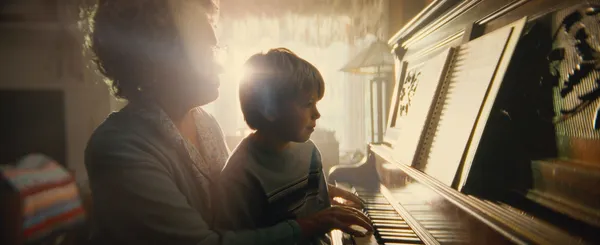
“Butterfly On A Wheel started off as a personal journal entry,” he says. “I was going through a very difficult time in my life and my therapist, who was basically a spiritual counselor, started me journaling. What he said is ‘Start at the beginning. What's your earliest, fondest memory as a kid? Start with what's good.’ And my earliest memory is sitting on my grandmother's lap and her playing Puff The Magic Dragon on the piano.
“It’s that core memory of mine that's in the movie, and it kind of grew from there. So it started off as a huge healing journey of my own in a movie about the healing journey of this musician Jacen, working through his OCD anxiety, trying to just make it through the day and make human connection.”
It's his first time directing, and i ask if it’s because it felt so personal that he decided to take that leap.
“Yeah, well, it's funny; my project producers and I were fishing the script and felt good about it and I said ‘I think I'm the right person to direct this because I know the story the best. With one small problem. I don't know how to direct.’ So I took almost a year and went to directing school, meaning the way that I learned, which is self taught books and all the courses, really a lot of YouTube to be honest. I taught myself directing because I thought ‘I am the best person to tell the story.’”
It's really unusual to come to directing from composing. How much did his musical experience with films contribute to his directorial style?
“A lot, actually,” he says. “Much more than I had anticipated. Because writing music for movies, essentially the job is to elicit that emotional response through music, and directing a musician, let's say to get her performance out of a cello, is not that much different than an actor using words. I found that strangely comfortable. So I've been storytelling for a while.”
He was heavily involved in finding the right actors.
“The casting was just one of those things where the universe was conspiring to help me, because the guy who played our lead character came to me through a friend. Then the brother, Michael, came to me. We had a casting agent who was casting people. I didn't like anybody and ended up finding the top three leads really through just word of mouth. One came from our assistant director, who recommended Brielle [Robillard], who plays Sorrel. We were a week away from shooting and i didn't have her cast yet. I met her on Zoom and cast her in five minutes. Perfect. I’m told that it doesn't normally come together like that.
“We had very little rehearsal. We did some. It was in Toronto, so we flew everybody down. That's where we shot it, and we got a chance to run through some things with that. Normally you'd be cast long in advance for the director actor relationship, which is super important. It’s a trust building exercise where they feel like, okay, they're in good hands with me – and ultimately we ended up there. We did the best we could.”
I ask about young Kole Parks, who plays Jacen as a child, because taking on directing a child the first time you're directing is something many people would advise against.Speaker 2
“I found him to be great,” he says. “He's a super pro actor. He was from a casting agency. This kid looks the part and he acted a lot. I was nervous about how to approach him. I have my own kids, so I know how to talk to kids. I said ‘Okay, in the next part, I need you to be a bit more intense. It's going to be a bit more of a darker place, darker energy.’ He's like, ‘Okay, cool.’ He was great to work with and we still keep in touch. And he's a legitimate actor. He really wants to be a pro actor for life.”
We talk about the representation of Toronto in the film.
“I wrote the script with Toronto in mind,” he says. “It’s where I'm from. My mom and my dad live there. My sister lives there, my friends are there, and I just love that city. And I wanted to not shoot in California. The story is so personal to me. It's more personal to shoot in Canada. That's who I am, Canadian.
“I really wanted to feature the city. Toronto is in movies all the time but it's usually doubling for New York or Chicago, or something like that. They don't show some of the iconic architecture. I wanted to do all that. There's so much more than I shot that's not in the movie, unfortunately, but it is a quiet love letter to the city that I love.”
I tell him that I like the way that, even when he’s out and about, Jacen is frameed in such a way that he’s hemmed in by walls or objects, with very little room to move. Was that intentional?
“Very much so, yeah. He wakes up in what is the most controlled environment he has, right? He's looking down from his ivory tower on the busy city below. And then we tell the story of this guy just trying to get out the door, just trying to get through another day of walking outside and getting to school, really. In the scene when he struggles to go out the door, he turns the doorknob seven times and eventually has a pep talk and we open the door. The sound design of the city was treated very subjectively, very loud, so that it's how he hears the city. Authenticity would occur in real life, so when we were mixing it wasn't about reality, it was about subjectivity, which is actually how I hear the world too. For him, everything is exaggerated and heightened.
“I always say the movie is about a musician with OCD. What it's really about, below the surface, is someone who is, in their own way, trying to get past some of his ‘deficiencies’ or his OCD. What he really wants is to be himself and be authentic, and his authentic voice to be heard. So he changes in reaction to his environment, from safety and stability to his brother, who kind of pokes fun at him, to the streets of the city, which is the most uncomfortable thing ever for him, to the subway and then getting to this concert hall. But all it's about is him working through his own fears, his own anxieties, his own hang ups to try to play music.
“The reason my movie's a little bit longer for a short than most is because I really wanted to have a beginning, a middle and an end, which a lot of short films struggle to do. To be honest, it just took a little more time to show him in the struggle, to show him get to the point where he's on a date with a girl and it's going well and this might actually be the thing he's always wanted. It's a story about someone getting out of their own way.
“When I was a kid, we didn't have terms like neurodivergence or ‘on the spectrum’. You were just labeled different. Or if you're lucky, like me, I was labeled special because I could play music. It was a nicer way of saying it. And what happens, from my experience as a kid, is that label gets pressed into the wet cement of your soul. Once it hardens, that message stays with you. You're different, which is not a good thing. You know, you’re put in different classrooms or with different teachers, or you go over here, you're not like everybody else, and it sort of sticks with you, your whole life. And you kind of wonder why. Why am I different? And why is that a bad thing? And it's not a bad thing.
“As a matter of fact, if you're dyslexic – which I'm not, I'm just saying, as an example, if you're dyslexic, you probably are sharper in other areas in your life. So the things that are your ‘deficiencies’ strengthen you, sharpen you in other areas to perform who you are. Which is why I say, you know, your shortcomings are your superpowers. I wouldn't be who I am without the things that are ‘not normal’ about me. I'm trying to celebrate this. I'm trying to demystify the idea that we're almost supposed to somehow be a perfect version of ourselves or we’re broken or something's wrong with us. It's like. So that's what I'm exploring, this idea that what makes you great is who you are, and your flaws and your setbacks and things you're not good at, it's part of you. We're all like this. It's just giving it a little bit of a spotlight.”
He hired an OCD consultant, Josh, in Toronto to make sure the depiction was authentic, he says. “OCD has been played in movies a lot. It's usually somehow comedies. I don't know why. But this was serious. Josh worked with myself and he worked with the actor separately to reallyget inside of the mindset of what it's like. There's many kinds of OCD, six or seven kinds. One I have is symmetry and counting, which is where the character is relating to the screen, so we worked very hard on that.
“I do feel strongly about it. In the speech with the brother, the brother gets his chance to talk to Jacen and to say ‘Listen, life came a lot easier for me than it did for you.’ He's a good looking kid. He probably got all the girls, got on all the sports teams. It was his moment to look at the lens through the other side, and he's like, ‘It was easier for me but, you know, you're awesome. You're not broken. There's nothing wrong with you.’ But it's interesting that we tend to focus on our differences, not celebrate them.
“I have come to feel like celebrating what's different about ourselves allows us to celebrate what's different about other people. It's like a tolerance thing. Tolerance will go up when you realise ‘Well, I'm flawed in all sorts of strange ways, and I accept me, and someone else is probably flawed, too, and it makes them who they are.’ I would love to see this movie get more people thinking about it that way. I think the world would be a better place.”
Getting on the Oscar shortlist might help with that, I suggest.
“Oh, it feels great,” he says. “And again, the idea of the Oscar campaign is awareness for the message from the actor. You know, I've won some awards. That's cool. It's not really what I'm in it for, but I think the fact that it might get the awareness that I would love to see get on stage like that is really exciting.”