





Eye For Film >> Movies >> Santacon (2025) Film Review


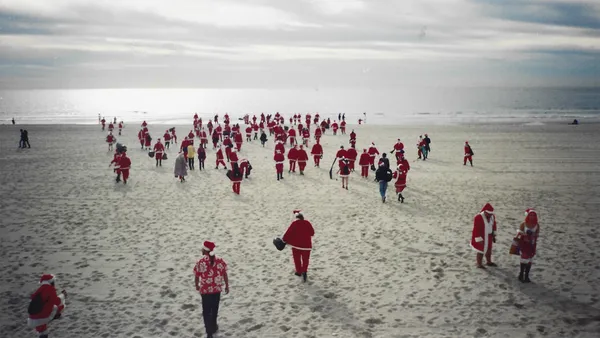

It was supposed to be a joyous, liberating event, something that changed the way people thought, stimulating the imagination. Now, “My lasting contribution to Western culture is two Santas fucking in an aisle of Walgreens,” says one of the founders, shaking his head.
Several hundred Santas running round the streets, some of them handing out presents, everybody there for a fun time. What’s not to like? Pretty much everything, say the residents of cities where Santacon has happened more than once. Many of them lock their doors and hide away when the Santas come to town. Director Seth Porges used to be one of those people – but then, quite by accident, he learned that an old friend had been involved in the event from the beginning and had a huge cache of film of it. As a documentarian, he could not resist.

This film, which screened as part of DOC NYC 2025, is comprised primarily of material from that archive, which is well enough shot to be visually arresting. It also includes interviews with key figures involved early on. Before we get to the advent of the Christmas theme, we are presented with the story of the San Francisco Cacophony Society, its progenitor and the inspiration for Project Mayhem in Fight Club. Formed in the mid-Eighties as a successor to Gary Warne’s Suicide Club, this collection of artists, adventurers and mischief makers aimed to respond to the early stages of late stage capitalism by creating experiences that would wake people up. In its time it ‘reclaimed’ billboards to post its own surreal messages, went car hunting in the desert with big guns, infiltrated the American Nazi Party and launched Burning Man. Nothing quite broke through the way its members had hoped, but Santacon, curiously, could be one of its happier stories.
The documentary celebrates the early days when members of the public really didn’t know what was going on. It’s notable how many assumed it was some kind of advert or paid entertainment, and consequently made every effort not to interfere, no matter how outrageous their behaviour. The police, however, had other ideas, with the theft of a velvet rope and the lynching of a Santa in the middle of San Francisco leading to mass arrests. The organisers decided not to do it again, but as is the case with many large public events, some were already hooked, and over the years that followed, it began to tour – first around the US, then around the world.
The response to Santacon in different cities is very telling. Hostile cops immediately kick off a strategic game in Portland, the reds and the blues trying to outwite one another, poor Chuck Palahniuk caught in the middle, obliged to prove that he isn’t a police spy. In Los Angeles, assuming that it’s just another promotional stunt or part of a film shoot, nobody cares. In New York, where hundreds of Santas go rampaging through the East Village to First We Take Manhattan (we will later see them attempt to take Berlin), somebody stops a cop to ask if he has been naughty or nice. “Depends who you ask,” he says with a grin.
Though it’s a little more melancholy in tone that Porges’ previous work, with much musing on the subject of getting older, there is no shortage of fun here, from Santas trying to get into the UN to adventures atop a famous bridge and an incident with a very drunk professional pyrotechnician. Our heroes meet Michael Moore, invade Planet Hollywood and an expensive hotel, and befuddle a Santa who is not part of their gathering but is merely trying to do his seasonal job. There’s a poignant discussion of the first time people realised Santa wasn’t real, and yet every now and again the camera lingers in the face of a small child alive with wonder – this thing has a magic of its own.
That, in the end, is what makes it a success. Sticking closely to its founders, one of whom is now in the terminal stages of cancer, Porges reveals how difficult it is for them to give up their baby, reveals the discomfort they feel about the new direction it has taken even though they are no longer involved. The final section of the film sees them return one last time to meet some of the young people, and suffice to say that nothing goes the way they had expected. For all the drunkenness and ill-considered antics, there’s a strange innocence about this event which Porges captures lovingly, and his documentary, anarchic though it may be, is full of Christmas spirit.
Reviewed on: 23 Dec 2025


Director: Seth Porges
Starring: Chuck Palahniuk, Michael Moore
Year: 2025
Runtime: 87 minutes
Country: US
Search database:
