




 |
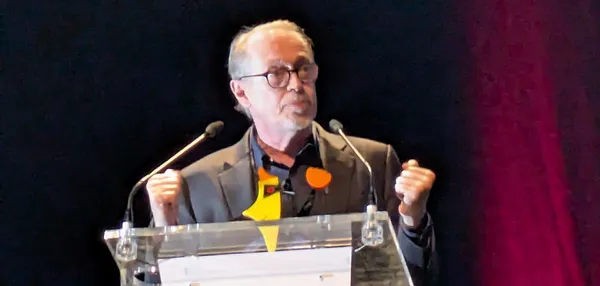
| Steve Buscemi with his Cultural Icon Award: 'I don't direct enough to really feel ever at ease doing it. With acting, I feel like I've been doing that long enough that I'm more confident' Photo: Amber Wilkinson |
So when Evolution Mallorca Film Festival made him the recipient of their Icon Award this year, it certainly didn’t seem like hyperbole. He’s quietly spoken, thoughtful and unassuming in person but when we meet the day after he received the accolade, I put it to him that he’s something of a one-off in the business. While people might talk about “the next” Tom Cruise, Julia Roberts or Amy Adams, Buscemi is so distinctive, he has an irreplaceable feeling, although he says, “It’s hard to know what people’s perception of me is, or what they’ve seen”.
They’ve certainly got plenty to go at, since he’s notched up more than 190 roles, not just on film but notable TV performances, including Enoch 'Nucky' Thompson and, recently, as Principal Dort in Netflix’s Wednesday.
Considering the start of his career, he says: “I just wanted to work. Then when you see the film, when they come out and your part is cut down or cut out of it, you say, ‘Oh? Maybe I need to start looking at rolesthat are more important to the story?’ But that's been a very sort of slow progression. I mean, I've done a lot of movies, a lot of TV, and I think people know the ones that have sort of broken through. But if you look at the totality of the work I've done. People don't really know all of it.”
Some actors say they hate watching themselves onscreen but Buscemi is happy to do that, and not for selfish reasons.
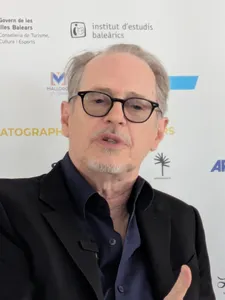 |
| Steve Buscemi at EMIFF: 'One of the things I like about coming to a festival is meeting people' Photo: Amber Wilkinson |
When you’ve had a career that stretches back to the Eighties, there’s always the possibility that you might turn on the TV and be confronted with yourself from decades ago. Buscemi is relaxed about that.
“It’s mainly just remembering,” he says. “Like, ‘Oh I remember that day or what it was like to get that scene’, so there’s a lot of things always playing into the mix.”
Buscemi may have found fame in front of the camera but he’s also proved to be pretty useful when he steps behind it. He’s made films, including Lonesome Jim, Trees Lounge and The Listener and had success directing notable episodes of the Sopranos, including the much-lauded Pine Barrens, which focuses on Paulie (Tony Sirico) and Chris (Michael Imperioli) in the woods.
“Directing is an extension of my acting,” he says, “When I direct, in a way I get to play all the parts because I imagine what every character is, what their motivations are, what they're what they're about.”
On Pine Barrens, he added: “It was so unusual, you never saw those characters outside their habits – and taken out of their world they were literally lost and kind of didn’t know how to survive. So there was great humour coming out of that. Originally it was written as an episode that was supposed to be sort of different from the rest and to kind of stand on its own and would be cheaper to make. But then it kind of ballooned, and it became a bigger episode.
“I actually directed four episodes of The Sopranos, and that was the first one and it was in the third season, so I was already a big fan of the show. So it was a little intimidating to come into that and to be working with all of these actors who I knew from the show and really believed their characters.But they were all great, and some of them I knew from past work.”
Buscemi says directing himself has made him appreciate more what directors are going through and what they’re having to think about.
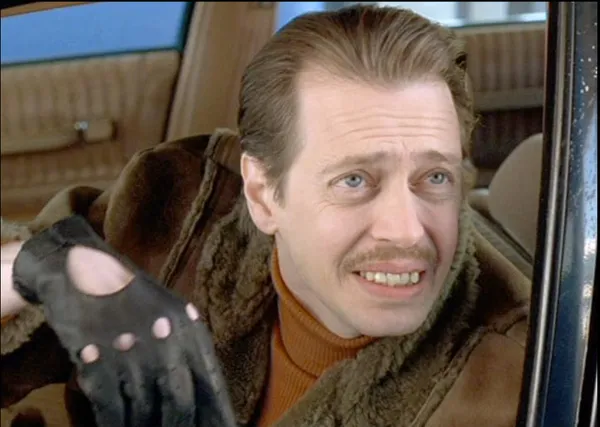 |
| Steve Buscemi in Fargo. 'I've been very lucky, and some of the people that I've wanted to work with, I've got to work with' |
Although he continues to direct, with TV shows, including Miracle Workers and Portlandia also in his portfolio, he says: “I don't direct enough to really feel ever at ease doing it. With acting, I feel like I've been doing that long enough that I'm more confident. But that said, I do like the challenge of directing and when it works then it's just a great feeling. But it's a different feeling than being an actor, there's a different sense of accomplishment.”
Among his films is The Listener, which focuses on a helpline volunteer (Tessa Thompson) as she takes calls from people across a night.
Buscemi says: “When I read that script it resonated. Coming in the lockdown and Covid and what that did to people’s psyche, that played a role in it. But I also think some of the issues that people have had, they've been issues for a long for a long time.
“Somebody asked me this morning about therapy in general. And I think we've come a long way and I think people are starting to feel more comfortable talking about mental health issues, whereas in the past, it's something maybe people want to hide. I think it's more common than we care to admit, or that we realise. I think it's good if we all start talking about it so that we all feel less alone in our struggles and there’s more opportunity to help each other and get support.”
On the all-too oppositional state of the world, he adds: “I feel that happening in the States. The sides get pitted against each other and I think that's unfortunate because I think we have more in common than is depicted in the media so I think it's really important that we find common ground.”
Evolution Mallorca also screened Tolga Karaçelik’s dark comedy Psycho Therapy: The Shallow Tale Of A Writer Who Decided To Write About A Serial Killer. In it, Buscemi plays a retired serial killer who befriends a writer (John Magaro), accidentally becoming his marriage guidance counsellor by day while also being a killing consultant by night.
“I love the relationship between my character and John's character,” says the 67-year-old.
The star can certainly turn his hand to any genre and asked if he prefers the comedy roles or the darker ones, he says: “I like them both.
“I love the fact that I've got to work with the Coen Brothers and Quentin Tarantino and Alexandre Rockwell and Adam Sandler – I love doing his films – so I feel really lucky that I've been able to work in different mediums and different genres.”
 |
| Steve Buscemi provided the voice for Randall in Monsters, Inc, on voice work, he says: 'It took me a while to get used to it and in the beginning, I was very uncomfortable with it because you’re sort of acting alone' Photo: Disney Pixar |
Speaking about voice work, he says: It took me a while to get used to it and in the beginning, I was very uncomfortable with it because you’re sort of acting alone. You're just recording your lines and sometimes you're saying the same line, like three different ways, so it's a different method of acting and it took me a while to get used to it. But now I've done it a lot, so I just consider it a different form of acting in a way. It's basically the same but I really have to imagine what the other character or the other actor is saying.
“I just did a series of commercials [for DirecTV]. I played the voice of a pigeon, and Henry Winkler visually was the other voice and we were never in the same room together. He lives in LA, I live in New York, so I would do my lines he would do his, and then, when they put it together, it really sounded like they were in the same room. I wish that we were because I think it could have been even better.”
Looking to the future, Buscemi seems fairly relaxed about the advent of artificial intelligence in general, though he says: “The only thing I get concerned about is, am I going to be working after I'm dead? I want to make sure there’s protection against that.”
He adds: “The industry is always going through changes and hopefully AI can be a useful tool, and not replace actors but we’ll see where it goes, I think we’re still in the beginning stages.”
 |
| Steve Buscemi in Psycho Therapy. 'I love the relationship between my character and John's character' |
“I sort of have a superstition about that,” he explains. “I've been very lucky, and some of the people that I've wanted to work with, I've got to work with. But I never like to say it out loud.
“But one of the things I like about coming to a festival is meeting people like Phedon Papamichael. I know his work, but I've never worked with him. He's done a ton of work, I've done a ton of work, but it's like, how come we've never crossed paths? Somebody like that, I would say, yes, I hope I get to work with him.”
He adds: “I do have other projects that I'm hoping will come to fruition, but again, I don't like to talk about things that aren't really going.”
Among the roles the world already knows about is a role in The Banshees Of Inisherin director Martin McDonagh’s Wild Horse Nine.
“I don’t know how much I want to give away about that,” says Buscemi “But I loved working on it. We shot it in Santiago and Rapa Nui [Easter Island] and both places are important to the story. I got to know Martin at the Venice Film Festival a few years ago. That’s what I love about festivals. You get the time to actually talk to someone whose work you admire, that you’ve never worked with and that causes a spark.”
He says that while “in theory” he’s happy to still do stage work, it’s tricky due to time commitment but adds: “One of the things that I am hoping to do is, since you mentioned stage, I was working in Dublin last year on Wednesday and my good friend of 35 years, Aidan Quinn, was also working there, and we've never worked together. The Abbey theatre asked him to do a reading of a play – they have a series where they ask actors just to pick a play, any play, and do a stage reading. Aidan picked Ages Of The Moon, this Sam Shepherd play, which he saw at the Abbey years ago and thought to himself, ‘When I’m that age, I want to play that character.’
“It’s about two guys in their mid-60s, sitting on the porch in Kentucky and they’re good old friends. It’s a great two-character piece. So, we did it as a reading there. We also did it in New York for three nights and now Aidan wants to make it into a film and he wants to direct it. So we’re actively working on that. Oren Moverman adapted the screenplay and I’ll be the producer with my producing partner Wren Arthur and Aidan’s brother Declan Quinn, who’s a great cinematographer, is going to shoot it.”