




 |
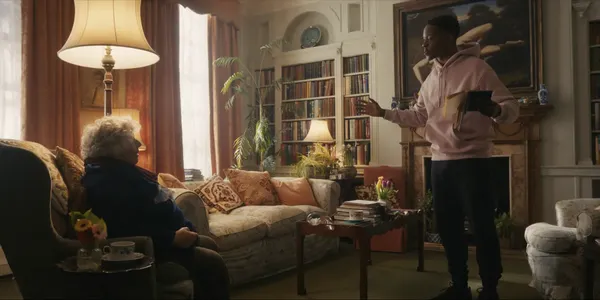
| Miriam Margolyes and Alistair Nwachukwu in A Friend Of Dorothy |
The story of a young gay man whose life transforms dramatically when a lost football leads to him getting to know his elderly neighbour, A Friend Of Dorothy stars Alistair Nwachukwu and Miriam Margolyes, with a cameo by Stephen Fry. It’s notable for having made it onto this year’s Oscar shortlist, and is one of several films there by a first time director. In this case that’s Lee Knight, who started out as an actor.
“I trained as an actor at Drama Centre, which I loved,” he explains when we meet. “Sadly it doesn't exist anymore, which is a real shame. It was just a wonderful school. It was known for being intense. They used to call it Trauma Centre. They trained us to be very competitive, but not competitive with one another. More about ripping things apart. I just wanted to be an actor but they made me do more. We wrote and created our own characters often. It was a great discipline. So that's where I learned my craft, and then obviously, I've been an actor for 15 years, experiencing the roller coaster of the business.”
What made him feel that it was time to take the plunge into directing?
“I think that the industry has changed drastically,” he says. “It is extremely tough for everybody. For actors, it's particularly hard since the writers’ strike, since Covid – and I say actors because, you know, actors are at the bottom of the ladder. We send these tapes in and never hear back, never hear a yes or a no. It's hard to sustain that when you're a storyteller. As actors, we need an audience. But as a director and a writer, you're telling your own stories. You're kind of leading the ship.
“It was not born out of frustration at all, actually. I found I'm very creative. Work creates work, so I'm very creative when I work. I'd often be in my trailer or in my dressing room, writing. I feel that the way the industry's going, I just really wanted to make my own stories. And also there's stories I want to tell that I don't see. I sometimes get tired of seeing similar scripts, similar parts. And, you know, I'm proud that the lead in my film is an 85-year-old lesbian, as she calls herself. I'm so proud of that.
“This film was inspired by an elderly neighbour of mine. Her husband had passed away a couple of years ago, and I had been thinking for a while about how to write something about friendship. It just really inspired me. And it's fictional, but I just kept thinking of different ways to tell it. I wrote a couple of short stories or short plays about this world, and then it landed as a short film very unintentionally. That's the thing. I never set out to make a short film. I set out to tell a story and this was the medium. I felt like I'd been working my whole career to get to this point as a director and I just really loved it.”
I suggest that intergenerational friendship has always been particularly important for LGBTQ people.
“Yeah, absolutely. I do think it's really important. I think older people have a different life experience, a different perspective on things, and I think there's a lot of pressure for young people. And I think if you can find a friend or find someone who wants to listen, you know, and champion you, see the real you, then you've got to grab hold of that.”
As it’s his first directorial effort, he did very well to get two big stars in there. How did that happen?
“I wrote it for Miriam,” he says. “I didn't actually think about getting her, but I had a friend who was popping around hers to get her to sign some merchandise for a charity or something. And she said ‘Oh, I'm going round Miriam Margolyes' tonight,’ and I said ‘I've written this script for her’ – as I'm sure a lot of people say to famous people. And she said ‘Do you want me to tell her about it?’ And I said ‘Yeah, of course.’ And Miriam apparently was so blown away that she'd have a script written for her that she gave me her email and I sent it to her and she just loved it.
“I know it means a lot to her and it means a lot to all of us, but when we were on set filming, she said to me ‘No one's ever given me a script like this in my entire career.’ And I really felt that, how important that was to her.”
So what about Stephen Fry?
“I've always been a huge fan of his, both as an actor and a writer and as an out gay man in a difficult business. I was at a charity event called the Fayre of St. James’s. It's every year, and a friend of mine, Gemma Arterton, the actress, was doing a reading, and Stephen is a patron of the charity and was also doing a reading. And I just remember looking him, thinking ‘God, imagine – he'd be perfect for Dickie.’ Next day I asked my producer and said ‘What do you think of Stephen Fry for Dickie?’ And he paused and just said, ‘I think he's absolutely perfect, and I've worked with him, so I can get to him.’ And honestly, within hours Stephen said he absolutely loved it and he would do it, which was, you know – because of the whirlwind of what's happened with the film, I don't think I've come to terms with those moments yet.”
He’s well aware of how lucky he’s been – and likewise when it came to finding a young star who could stand up to having those actors there and not feel too intimidated.
“We saw some wonderful actors,” he says. “We had some really great tapes that we saw, and then we whittled it down to four actors that we re-called, all brilliant, who all had something very different that they would bring to the role of JJ. As with all these things, it comes down to one person, and there was something about him – he was ready. I felt like not only was I ready for the journey were about to go on, I felt he was very ready. And he asked me a question, and I think I knew perfectly well then that he was right for the part. He just was willing to go that step further. He said to me before filming ‘I'm going to give you my heart and soul, I promise.’ And he did. So, yeah, he's just wonderful.”
The script lends itself very well to a first time director, I suggest, with a principal location which packs in everything the story needs in a really convenient space.
“What you see is someone's house, which is so incredible, and it's in Holland Park. I was very lucky that I was looking for this house and one of my friends said ‘Oh, I know someone that knows someone whose grandma has this house that she hasn't done up.’ So anyway, we go to the house and I walked in and I thought ‘This is like Dorothy lives in this house.’
“It was just perfect. There's two entrances to the kitchen. It was just born out of my script. And there was art everywhere on the walls and books everywhere. But what's even more amazing is that we found out after filming that a very famous actress lived there called Ann Todd, and there's lots of pictures of her with her dog. Black and white pictures of her in the same house exactly as it is. But the most magical thing is that we found out her real name was Dorothy. And so it really was a Dorothy! It was a Dorothy house.
“We switched out the art. A friend of mine who worked on the film, called Matt Goddard, he worked as a production assistant and he is very involved in the art world. And he got a friend who lent us this art. And it was all these incredible life drawings of men, which is what I'd written in the script. They just fit the walls perfectly. So we would take off one bit of art and replace it with another. And we didn't damage anything.”
In the film, he goes with the Wizard Of Oz explanation for the phrase used as a title. I tell him that I have always been more familiar with the Dorothy Parker explanation. Men used to use it as a passphrase to certain of her parties, back when oppressive laws made meeting high risk.
“Yes, I heard that recently,” he says. “Someone on Instagram mentioned it, and I thought it's always good to have a different version. I think once it starts, the idea of a Dorothy, then it can be adapted, which is nice, isn't it? But I like the idea that Dorothy in The Wizard Of Oz’s friends are all the people that are very different. All the ones that don't fit in. So for me, I lean towards that.”
There’s a montage in there, and it's quite a daring thing to attempt in a short film because he has to pack in so much story.
“Do you know, it's funny because I wrote the montage in the script, and then I kept dreaming about it? I kept daydreaming about it, and what I would do is I would put music on and I would think about it. I would play it out in my mind. I could see it. My team kept saying ‘Oh, the montage,’ almost as if weren't going to shoot it. And I was like, ‘Yes, the montage I'm very proud of, and I've written in the script quite clearly.’ But when it came to it, people, I don't know.” He shrugs. “I think they thought ‘There's a lot there.’ But I was very specific, and I'm glad I was, because it was a lesson to me to trust your instinct as a director, as a storyteller.
“You can listen to people around you. That's the great thing about collaboration. But ultimately, you have to trust your gut. I had this idea of them dancing, and on set, one of my producers says ‘There's no way Miriam’s going to dance.’ I was like, ‘She will. The way to get her dancing is Alistair, who plays JJ.’ And I was right. And it was just magical. I mean, at the end of that scene, I was lying on the floor telling them how much I love them. It was so beautiful and spontaneous.
“We had a whole day to shoot the montage, and it was a lot. It was ambitious. But I just thought ‘We have to. We have to be swept up in the characters’ joy.”
Joy like that is really important, I say, when there are so many things happening politically around the world at the moment that are making things harder for LGBTQ people.
“Yeah, absolutely. I think that's always on my mind as a gay person. It's always. It's always on my mind because it's just constant, you know? It's not great. So for me, these stories are important. Championing queer stories will always be at the forefront of what I do because it's a part of who I am and what's important to me. And we need to see more stories. There's not enough queer stories, we need to keep seeing more from all different perspectives. There was a TV show on this year called What It Feels Like For A Girl by Paris Lees. Oh, my goodness! It's just essential TV. It's from her memoir about transitioning and what she went through. It's just amazing, you know, and I just think we need to see more stories.”
So has he been bitten by the directing bug now? Is he going to be doing more?
“Oh, one hundred percent, yes! My plan is for this to be made into a feature film. That's what I'm working on at the moment. And I would direct that. Writing and directing for me is, you know, I just love it so much. I'll always be an actor, but the wonderful thing about this career is they are all stories. They're all just different ways of telling stories.”
Then there is the Oscar shortlist.
“It's mad,” he says, blushing at the thought of it. “It's overwhelming. I can't really get my head around it. How do you get your head around it? The highest possible accolade in our business and you make a shortlist. It's pretty wild. The little story that you write about a young gay guy meeting this older woman and becoming friends. That's lovely.”