





Eye For Film >> Movies >> All That’s Left Of You (2025) Film Review


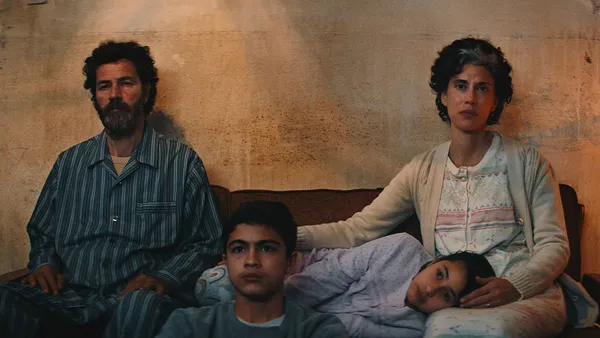

Poetry opens All That’s Left of You not as a flourish but a kind of covenant. There are depths here that will not announce themselves, and treasures that can only be reached by those willing to dive. Cherien Dabis’s tragic family drama begins with a jolt of foreknowledge, a glimpse of calamity that lands like a shiver, and then quietly asks the viewer to hold that knowledge at the edge of consciousness while the story rewinds into the decades that lead there. The effect is devastating. What could have been suspense becomes something more suffocating. Recognition. In this world, tragedy is not an event; it is weather.
Dabis structures the narrative across four interlaced timelines, from 1948 Jaffa through 1978 and 1988 in the occupied West Bank and Haifa, to 2022 Tel Aviv, and the choice matters because Palestinian history does not behave like “the past”. It remains active, pressing into the present, returning in bureaucratic forms, and reappearing in the body. Time becomes contested territory. You do not simply move through it, you are forced to negotiate it.
The family at the center of the story is originally from Jaffa, Palestine, now a neighbourhood of present-day Tel Aviv, and their dispossession is rendered with blunt clarity. Around the end of the British Mandate, a scene shows the Union Jack replaced by the blue-and-white flag bearing the Star of David, a transfer staged with the visual simplicity of ceremony, and haunted by what ceremonies can sanitise. What follows is the unceremonious remainder, a home and orange orchard lost, a life narrowed, a family pushed toward the occupied West Bank and later into the long shadow of diaspora.
The emotional anchor is a paternal line, passed down like an inheritance, from the grandfather Sharif (Adam Bakri in youth, Mohammad Bakri later) to the father Salim (Salah El Din as a boy, Saleh Bakri as an adult) to Noor (Sanad Alkabareti as a child, Muhammad Abed Elrahman as a teenager). Sharif teaches poetry to his son as if language itself could function as shelter, a portable home when the physical one is taken. The time jumps then show what decades of occupation do to that inheritance. Salim grows older and more worn down, his adulthood marked by the slow violence of constraint and the constant recalculation of what is permitted. When Noor comes into focus, the story sharpens into its central question. What, exactly, can a father pass on to a son when power has already decided how much of a life will be allowed.
It is telling that the most pointed interruption of this paternal line comes through Hanan, Salim’s wife, played by Dabis herself. Her presence does not overturn the lineage so much as thicken it, filling the spaces between fathers and sons with a different kind of authority. She reads less as a figure defined by constraint than as the story’s moral and emotional ballast, maternal in the most universal sense, absorbing shock, translating grief into action, and holding the family’s interior life together when history keeps pressing in. The emphasis on patrilineal inheritance still has its blind spots. Sharif’s daughters register as fleeting presences, almost peripheral, a reminder that even within collective trauma, certain lives are granted fuller interiority than others.
One of Dabis’s sharpest insights is that the occupation’s most enduring injuries are not always inflicted through outright killing, but through humiliation, the deliberate dismantling of dignity as a method of control. In an excruciating scene, Israeli soldiers corner Salim and young Noor returning home during a curfew. Instead of pulling the trigger, they perform a different cruelty, forcing Salim through degrading tasks at gunpoint. The soldiers’ immaturity makes it worse, power as mockery, domination as a joke shared among friends. The damage is psychological and permanent. The scene understands that occupation does not only seize land, it infiltrates the intimate architecture of family, altering the way a child looks at a parent.
Dabis also makes a rare choice in how she frames Islam on screen, not as slogan, not as spectacle, and not as a tidy emblem of identity. The story includes debates and consultations around Islamic law and interpretation, but crucially, it refuses to turn faith into a “topic.” Instead, religion appears as lived moral reasoning, practical, contested, and human, a framework characters reach for when the world reduces their choices to traps. It is one of the film’s quiet achievements that it can offer genuine nuance about Islam without making it either the center of attention or a token of “authenticity” for an outside gaze.
Even more striking is how spiritual questions are linked to the machinery of governance. In All That’s Left of You, the most intimate decisions are never purely private. They are pressured by paperwork, permits, borders, and the humiliations of having to request permission to care for your own. In that sense, the title becomes more than a poetic lament. “All that’s left” is what survives after a system has done its work, after it has reduced options, narrowed futures, and made family life contingent on the whims of authority.
Near the present day, the story’s strands lock into place with brutal clarity. Dabis controls revelation with discipline, letting meaning accumulate rather than announcing itself, so that what finally emerges feels earned rather than engineered. What remains is a brutal question. What does it mean to choose generosity, even a kind of salvation, in circumstances designed to make generosity feel naïve, or even traitorous? And what does it mean to make that choice while knowing the world may redirect it toward the very structures that harmed you?
By the end, All That’s Left of You has accomplished something rare. It makes history feel not like a lesson, but like a family heirloom passed down under duress. Language survives. Love survives. Ritual survives. But everything does so in reduced form, diminished not by fate but by policy, power, and the daily insistence that Palestinians prove their right to exist in the most basic ways. It does not argue this, it shows it, patiently, painfully, and with a tragic clarity that lingers long after the final image fades.
Reviewed on: 29 Dec 2025


Director: Cherien Dabis
Writer: Cherien Dabis
Starring: Saleh Bakri, Cherien Dabis, Mohammad Bakri, Adam Bakri, Maria Zreik, Muhammad Abed Elrahman, Sanad Alkabareti, Salah El Din
Year: 2025
Runtime: 145 minutes
BBFC: 
Country: Cyprus, Germany
Search database:
