





Eye For Film >> Movies >> Dracula (2025) Film Review


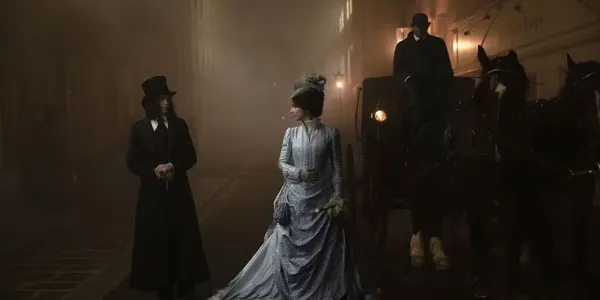

Where did the notion of Dracula as romantic antihero begin? Luc Besson says it’s in the book, but that’s a bold interpretation; one suspects the influence of Frances Ford Coppola’s Bram Stoker’s Dracula, with a shared hairstyle also pointing in that direction. At any rate, this is a tale that has been reinvented any number of times, contributing to its status today as more legend than literature. Besson has never needed a strong story to deliver a captivating film, and he’s able to indulge many of his cinematic passions as he tracks the course of his lonely Wallachian prince across time, seeking out the reincarnation of his lost love.
The production was inspired by its star, Caleb Landry Jones, the two coming up with the idea whilst working on another project. In heavy make-up at times, dropping his voice by an octave and adopting a Romanian accent, Landry Jones is most recognisable for his height, which adds to the character’s imposing presence when he’s properly costumed. He handles himself well in fight scenes where height is often a disadvantage, and proves himself capable as a romantic lead. if there is a sense of disappointment, it’s only because one imagines that, with a more traditional script, he might do something more interesting with the character. He’s expanding his range into a conventional space rather than delivering a refreshingly unconventional take.
This being a Besson film, the great love underlying it is presented in explicitly sexual terms, the film opening with a series of intensely passionate and playful encounters between the prince and his beloved wife Elisabeta (Zoë Bleu, who bears a striking resemblance to the young Isabelle Adjani). Their romantic idyll is that of aristocrats who need pay no attention whatsoever to the daily concerns of ordinary folk, but that changes when war comes to the region and Dracula’s men physically pry them apart to dress him in his armour. This is very much combat du look, with a ludicrously large dragon helmet which takes on a different cast when fire is used on the battlefield, but even as Vlad is victorious, his princess is ambushed, resulting in tragedy and setting him on his fateful course.
Besson does not know much about how swords work, but he can still make a fight look good, as long as you don’t pay too much attention to what’s happening in the background. He doesn’t know how horses work either, so that one key sequence comes across like very gentle fantasy parody of the way such a thing would manifest in real life. Again, we might have had more, but what we get is effective enough. He’s much more at home in the world of royal courts, and it’s by way of these that we see Dracula dance across time. He may have an advantage, borrowing a trick from Poison Ivy or, perhaps, Perfume’s Grenouille, but everyone is gorgeously dressed. The effort put into some costumes just for single shots sums up his foregrounding of visual aesthetic as much as anything in his career.
Music also plays an important role here, with Danny Elfman’s sweetly melodic score, often played out in a minor key, echoing through the ages. Simple though it is, it’s one of the best pieces the composer has delivered for years, and it helps to balance the different periods on which we come to focus, with the prince finally coming to the end of his quest in 18th Century Paris – in the person, of course, of one Mina Murray. She does have a Jonathan (Ewens Abid), but at no point does he really seem adequate for her. It’s possible that the French crew were unaware of how much they were making him look like a Monty Python character, but that aside, he is sadly lacking in presence, even if he does give one of the smartest answers ever to “What is your last request?”
Also in the picture here, stepping up in place of the absent Van Helsing, is Christoph Waltz as a priest who has spent years trying to root out the source of an outbreak of vampirism. The notion that he’s behaving like a detective in a murder mystery is laid on a bit thick, but he brings his usual class to the role. The script is not strong on logic but the characters feel real enough. The chemistry between Landry Jones and Bleu is sizzling, and everything is handsomely framed. If the ending is not entirely satisfying, it has that in common with the novel. In neither case is signing off dramatically really the aim. Two personalities dominate the story, and it’s where they interact that the magic happens.
Horror fans may be a little disappointed here, for all that there’s blood and torment and time spent in an asylum. The gargoyles never succeed in being either creepy or scary as they might have been. There are plenty of other delights for lovers of the Gothic, however, and some will find themselves swooning over the architecture. The film may feel a little like a distillation of romantic Dracula lore to date, but it’s none the worse for that.
Reviewed on: 31 Dec 2025


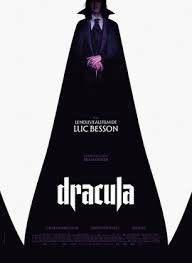
Director: Luc Besson
Writer: Luc Besson, based on the book by Bram Stoker
Starring: Caleb Landry Jones, Christoph Waltz, Zoë Bleu, Guillaume de Tonquédec, Matilda De Angelis, , Ewens Abid, David Shields, Bertrand-Xavier Corbi, Raphael Luce
Year: 2025
Runtime: 129 minutes
Country: France
Festivals:
Search database: