 |
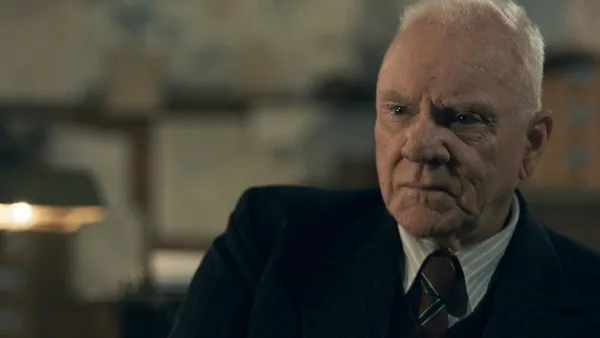
| Malcolm McDowell in The Partisan |
It’s rare that one gets the opportunity to speak with a legendary actor like Malcolm McDowell, a star whose work has spanned more than five decades. Many actors slow down, dispensing with promotional work, whilst others retire and then disappear from public life. In this case, however, it’s more a matter of being too busy – Malcolm has three films coming out this year, with six more currently in post-production, plus a popular series and several projects currently underway. The film we’ve met to talk about is James Marquand’s The Partisan, in which he has a supporting role alongside star Morgane Polanski. It’s a wartime espionage story, and he fits so naturally into his role that it’s bizarre to think that he hasn’t done anything like this before.
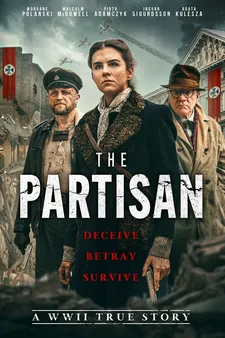 |
| The Partisan poster |
“I've always been fascinated by anything, any documentary about World War II, the phenomena of it all, the whole thing,” he tells me. “And then, of course, the Cold War. The Le Carré books are deep in our sensibilities and I've always been fascinated by it, but I've never been asked to actually play a spy, I don't think. Anyway, I like very much the script and, you know, I was interested to go shoot it in Warsaw because, of course, that's where the Second World War for us started. And I really got on very well with James Marquand, the director, and I knew his father [Richard Marquand], so it was kind of a circle completed for me.
“I knew his dad, I guess, in the Seventies, and his dad did a terrific film called Eye Of The Needle with Donald Sutherland, which was another World War II spy thing, so I think that's why I was drawn to it also. I like the idea of playing a laid back character. And if you're playing a spy, you know, it's like an onion, there's so many things to peel off.”
How did he approach the role as an actor – giving viewers a character they could connect with when the man’s whole life was constructed around layers of secrecy?
“I think it was self evident that I was a spy master,” he says. “Therefore, because of my age, that I was obviously retired from the field but still had a wealth of experience to pass on. And that's the way I played it. He had been there, done that and tried to impart his experience. And yeah, I really enjoyed working with Morgane Polanski. I think she's a lovely actress. Of course, she comes from a very noble family in movies. I don't know how many Academy Awards her dad has won, but he's an amazing film director. But what was beautiful about Morgane is that she's not directing, she's acting. It's a whole different career. And so it was great – I really enjoyed working with her. She's a very talented young lady.”
Does he feel now that he’s in a similar role to that character when working with younger actors, trying to pass something on to them?
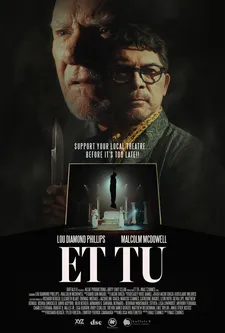 |
| Et Tu poster |
“A little bit, yeah. Been there, done that. But I really did try not to implant any of my opinions unless somebody asked me, because there's nothing worse than a boring old actor complaining ‘Oh, in my day...’ or whatever. No, that's not a good thing. But, you know, I've had a long career. I've been an actor that's been paid for 62 years. I mean, it's crazy. That came up so fast, you know?
“Weirdly, I've started playing leads again in movies. I've got four movies to come out where I played the lead. I mean, as long as the energy's there and I can do it...” He shrugs. “I mean, I wasn't sure. I was offered this western [Last Train To Fortune], and it was the leading part, and it's basically just two people in it. So there's a lot of stuff. I thought ‘Oh God, I hope physically I can do it.’ And I felt fine, and I had lots of physical stuff to do. In fact, at one point, I was knocked to the ground by my fellow actor. There was a fight and I was the one who ended up getting punched. It was a complete accident, of course, but, you know, you don't want to get punched too much when you're over 80.
“It's really weird when you read a script. You know whether you want to do it or not. It's more an emotional thing with me. Who's doing it? Where is it? Who's in it? And if it's a reasonable part – I mean, all parts are really interesting. Let's face it, you're playing somebody else and it's never all in the script. You really come with a load of stuff. I mean, I've just done this weird little movie called Et Tu, and why would I do it? Well, it was a little genre movie and I thought it would be so much fun, and I really had a good time. It seems to have gotten good reviews. But, you know, it's a little film that really didn't cost them very much money.
“I've got this series that I'm shooting three months a year called Son Of A Critch. It's on Netflix in the States. And then I've got this film called Summer House, which I love. It was a great character, an alcoholic. Then Dog & Bull, which I made in England. I haven't made a movie in England for a while, so that was great fun, to come back and work in England. I love that. And that same director, James Marquand.”
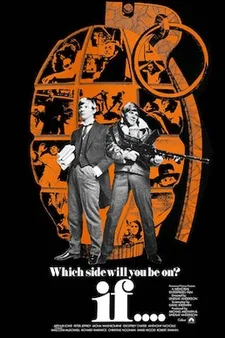 |
| If... poster |
Lindsay Anderson’s If... is the film that I first remember seeing him in, I tell him. He’s done impressive work in lots of different roles, but, perhaps because of A Clockwork Orange coming out so soon afterwards, even after all this time people seem most keen to cast him in villain roles.
“It's the kind of thing that you can't fight against,” he says. “That's what they want. I mean, I don't get offered very many romantic leading parts and I never did. I did one – Time After Time, which I thought was lovely, with David Warner. He was playing the heavy in that one. If that had been a successful movie, I guess I would have had a career in romantic leading parts. But the heavy is always the best part in a movie. You know that. It's always the most fun. And you don't have to be first in, last out, if you understand what I'm saying. You're not there till the death. And usually you have six scenes that are great. They always write good scenes for the villain. So I can't complain. I'm quite happy with the way things have gone.”
There was a film which journalists were once advised never to mention to him in interviews, but recently it has been released in a new version with a very different tone. Caligula. When I raise it, those bright blue eyes of his flash and I wonder for a moment if I have been too bold. He takes a breath.
“The new one I love,” he says, “because it's the movie I thought I made. The one before – all the ones before it – were crap, were just rubbish, put together by this pornographer, Bob Guccione, to make money and that's it. They used us and our talent and just added 40 minutes to an hour of hardcore pornography that was not shot on the same sets, in the same place or in the same year. So I hated it. I was just absolutely disgusted. And in fact, I was really depressed about it.”
There’s a great deal more of his performance in the new version – material that was previously excised.
“Exactly. It didn't make any sense and it was really, you know, of course it had the semblance of what one did, but the new one is incredible. I mean, it's long, but it is incredible. In fact, Helen [Mirren] and I are going to go to a special screening of the movie in Florence at the end of this month. It's sort of exciting to revisit this film as what we thought we made, after hating it – and I mean, really loathing it – for 40 odd years.
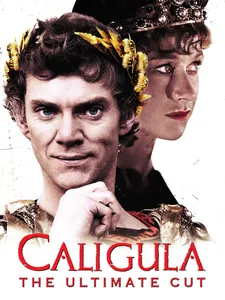 |
| Caligula: The Ultimate Cut poster |
“I really didn't want to see it either. They really had to drag me there kicking and screaming to watch it. But this guy, Thomas Negovan, did an amazing job. The scientific job of putting it all together. There were notes for him to go on. He was really amazing. So I'm really thrilled that at least people will see the film that Tinto [Brass] and myself and Helen made.”
He’s delivered some iconic performances over the course of his career. Which does he think the most of, looking back – or does he believe that his best work is yet to come?
“Well, there you took the words out of my mouth. When I'm asked ‘What's your favourite performance?’ I always say the next one, because in a way, it's true. I never really look back. You know, a lot of these films that I do, to be honest with you, I've never seen. But that doesn't mean to say I don't like them or anything. I just really don't like looking at myself anymore on the screen. You know, it reminds me of the aging process. And of course, I mean, listen, I'm lucky to still be working, so. There are parts for old geezers and somebody has to play them. I'm happy to do it. I love still working.”
The Partisan is in UK cinemas from 3 October and on digital from 27 October.