





Eye For Film >> Movies >> Beyond Silence (2024) Film Review


One of the most powerful things to emnerge from the #MeToo movement has been an awareness of just how commonplace sexual abuse and assault is. There is now less reason than ever for those who suffer it to feel alone. Still, that does not automatically mean that anything is being done about it – and in contexts where it has long been known to be endemic, there is sometimes a culture of silence which is very difficult to change.
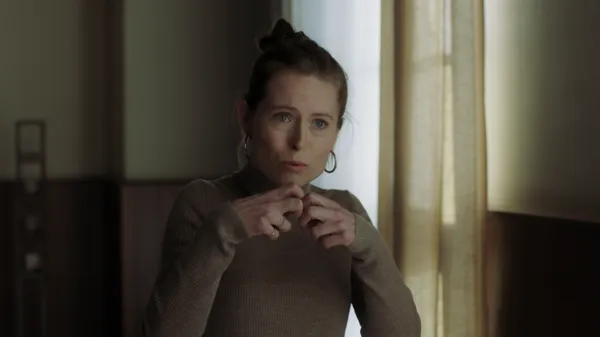
Eva (Henrianne Jansen) wants change. She wants a just response to what has happened to her, and she wants to make sure that it won’t happen to anyone else. She realises, however, that when powerful people have powerful allies, it’s sometimes not as simple as making a report to the police. That’s why she has gone to see her head of faculty, Sandrine (Tamar van den Dop) to seek support. Her sister, Anna (Sigrid ten Napel) has accompanied her both to provide moral support and to translate, so that, as a Deaf person, Eva isn’t limited to expressing herself through written notes.

She has written it all out, a difficult act which survivors are, nonetheless, often encouraged to do as part of the process of recovering their sense of control. As she feared would be the case, however, Sandrine barely skims the first page before recoiling and going on the defensive. A brittle conversation follows. Sandrine believes Eva, at least to an extent, but tries to discourage her from speaking out against the PhD supervisor responsible, warning the younger woman that it could destroy her academic career, explaining how she will find the system stacked against her.
There is more to this than meets the eye. Attentive viewers will note the way that Sandrine tenses up when she reads the letter – natural enough, perhaps, for anyone discovering that they have a fractious matter like this to deal with when they thought they were going to be talking about academic issues – but over time, her body language hints at something else. Then there’s the ashtray full of cigarette butts on the outside window ledge, almost literally concealed stress, and her eyes darting towards it throughout the conversation. Director Marnie Blok keeps the camera close. The quick exchanges trap Sandrine on a temporal as well as a spatial level. Whatever is going on inside her – and many viewers will come to swift conclusions about it – she has no opportunity to process it in the moment, and so becomes almost a spectator herself as it shapes what she has to say.
This is not a film about Deafness, but that still becomes a factor in the narrative. Jansen is herself Deaf, which Blok felt was vital for inclusivity and authenticity. Minoritised women face a greater risk of being targeted for sexual exploitation, but Eva never comes across as lacking agency, even if she is clearly used to her voice being ignored. Anna’s presence complicates the conversation in interesting ways, and we watch the struggle that comes from suppressing her own feelings in order to give voice to Eva’s, whilst Eva is equally frustrated on the occasions that her sister tries to change the narrative.
In asserting her agency, Eva also comes across as speaking for a generation of women who see things very differently from those who went before them. She and Sandrine each need something from the other, but only she can articulate it; and, perhaps, only Sandrine can fully understand what it is. Carefully constructed and ably performed, this Oscar-shortlisted short film has an open ending which invites viewers to speculate on a range of possible next steps for its characters. In doing so, it reminds us that what it is addressing goes to the heart of how we formulate, express and define narratives, and to consider what it takes to reshape them.
Reviewed on: 28 Dec 2025


Director: Marnie Blok
Writer: Marnie Blok
Starring: Henrianne Jansen, Sigrid ten Napel, Tamar van den Dop
Year: 2024
Runtime: 17 minutes
Country: Netherlands
Festivals:
Search database: