 |
| Brigitte Bardot |
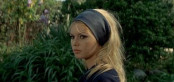
When France’s Fifties and Sixties symbol of sexual liberation Brigitte Bardot whose death has just been announced at the age of 91, chose to renounce her acting and singing career in favour of animal welfare, she announced prosaically “I gave my youth and beauty to men, I now give my wisdom and experience to animals.”
She chose to make the announcement when she was just 39 in 1973, after making almost 50 films, among them the ground-breaking And God Created Woman (her then husband Roger Vadim’s first film), after which she became a global phenomenon. Although she was said to have redefined the image of women ahead of the May 68 student revolution in France, she also courted controversy by espousing far right politics and was criticised for making homophobic slurs and was fined for inciting racial hatred.
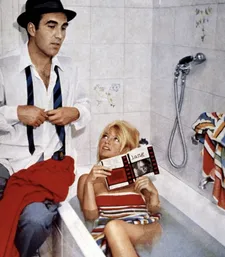 |
| Brigitte Bardot Photo: UniFrance |
Her animal rights charity the Brigitte Bardot Foundation, which was established in 1986, campaigns to protect both wild and domestic animals. It captured the imagination of the public with her fight to save 100,000 stray dogs in Romania, two sick elephants in a French zoo, and famously flying to Edinburgh by private jet to intervene in a court case to save Woofie, a cross-collie bitch who had been sentenced to death for allegedly biting a postman.
Today the foundation has announced on its website “with immense sadness" the death of its founder and president, Madame Brigitte Bardot, who "chose to abandon her prestigious career to dedicate her life and energy to animal welfare and her foundation."
Bardot who became forever known as BB in France, was born in Paris on 28 September 1934 to a bourgeois family of means. She began taking dance classes at the age of seven with the aim of becoming a ballerina. Then she began a modelling career, starting by posing for friends of her mother, who designed hats. Photographs were taken—and she became noticed. In 1950, at the age of 15, she graced the cover of French Elle magazine, which ultimately led, in 1952, to her controversial marriage (against here parents’ wishes) to Vadim when she was 18. That début film And God Created Woman was poorly received in France but caused a sensation in the States and elsewhere, ensuring she was launched on a stellar trajectory.
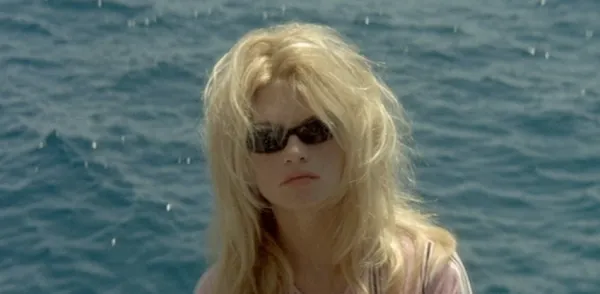
She was sought after by such established directors as Louis Malle for Viva Maria in 1965 opposite Jeanne Moreau (Bardot was nominated for a Bafta Award for Best Foreign Actress); Henri-Georges Clouzot for The Truth in 1960; and Jean-Luc Godard for Contempt, based on Alberto Moravia’s eponymous novel in which she played opposite Michel Piccoli.
Bardot frequently confounded the critics with the quality of her performances. On working with Godard she said memorably: “It’s common knowledge that [Godard] got on my nerves. I thought he looked stupid wearing that hat all the time. We were always having to make up dialogue at the last minute. There was no plot. It was a real free-for-all. Not to mention the hordes of paparazzi following me about. But it turned into a great film, and so much the better.”
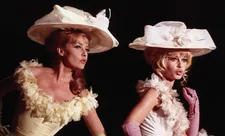 |
| Bardot opposite Jeanne Moreau in Viva Maria |
When director Danielle Thompson wrote to her five years ago to let her know she intended to make a TV drama series about her life, she received a far from enthusiastic response. Thompson said at the time: “She answered with a very long letter, saying that she was always surprised how unbelievably interested people were in her and did not quite understand why she was not left alone for good.” Bardot ended the letter on a note of cautious approval suggesting that if the series was going to be made she was happy enough for Thompson to do it. Bardot had been a friend of Thompson’s parents Gérard Oury, the director and actor Jacqueline Roman.
Thompson regarded Bardot as a pioneer “far more so than other great actresses of her generation. She knew how to shatter taboos and change the image of women in the society of her day.” Simone de Beauvoir dubbed Bardot the “locomotive of women’s history,” presenting her as the first liberated woman of post-war France.
At the point she renounced the silver screen Bardot had had enough. She told one interviewer: “I was really sick of it. Good thing I stopped, because what happened to Marilyn Monroe and Romy Schneider would have happened to me.”
In her later years she cut a forlorn if still striking figure on public outings, despite her various ailments including arthritis. With her grey locks pinned up in a huge bun she strode out defiantly, sometimes walking with the aid of a stick. On her “retirement” she guarded her privacy zealously retreating for much of the year to La Madrague, a secluded property in St Tropez which she owned for more than 50 years and she shared with her husband Bernard d’Ormale, a former businessman who was devoted to her. He was a former adviser to the Front National and at one point Bardot was quoted as saying that the far right icon Marine Le Pen was “the Joan of Arc of the 21st Century.”
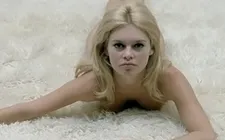 |
| Brigitte Bardot Photo: UniFrance |
To support her causes, Bardot over the years had sold many of her personal effects at auction including her dresses, and jewellery, among the items a diamond ring, ruby bracelets, and a pearl necklace given to her by the German millionaire Gunter Sachs, her third husband.
Bardot was sanguine about the aura of controversy that accompanied her for most of her life. She once said quite simply: “If I upset some notions and went against established rules, that wasn’t part of what I wanted to do. It wasn’t my goal.”