




 |
| Snow Bear |
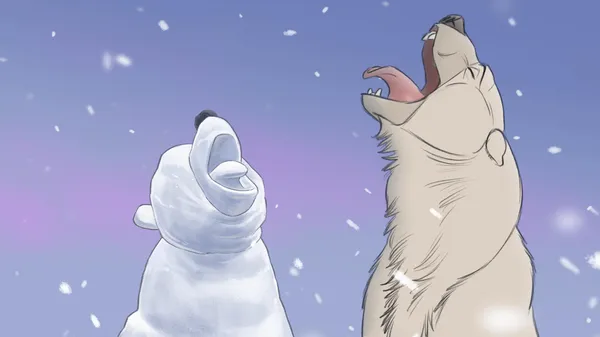
There’s a lot of innovative stuff on this year’s Oscar Best Animated Short shortlist, but sometimes tried and tested methods can still stand out. Directed by longtime Disney animator Aaron Blaise, who has previously contributed to the likes of Aladdin, The Lion King and The Iron Giant, the delightful Snow Bear uses classic techniques to tell the story of a lonely polar bear whose life changes when he realises he can literally make a friend. Having put the film together frame by frame, with minimal assistance, he’s thrilled that people like it so much, and he was happy to share his story with me.
“I've been an animator for 38 years,” he says. “I was with Disney for 21 of those years. I left Disney in 2010 after I lost my wife to breast cancer in 2007, so I was kind of lost. I wanted to redefine myself, just find myself again in general. I left Disney and started this business, creatureartteacher.com, which is my online art education and animation business. It was in the early days of that business that I thought it'd be really cool to create a course on how to create your own animated short, so that's where the first drive to do my own film came from.
“I've always wanted to do my own film. As I dove into it, first of all, I wanted to come up with an idea for a film that I could do as one person, so I could do the whole film myself. So I thought, okay, one character in a simple environment. And that's where the idea of a polar bear in the Arctic came from. The Arctic turned out to be not so simple.” He laughs. “Then, as I delved deeper into the story, it became more about my own journey of loss and finding love again and all of that, and that's when the story really blossomed and became much deeper and more personal. So about four years ago, I started really getting in deep on getting it made. And I sat for three years and made the film and finished it about a year ago, and here we are.”
Was it always going to be about a bear? He has some history with them.
He smiles. “It's so funny. I've done bears so many times. I. First of all, I love animals, so my whole world is the natural world. So it could have been bears, it could have been chipmunks. I don't know. But for some reason, I had an opportunity back in 1997 to create Brother Bear. Disney had a film in development called Bears, and when I found out about that I was like, ‘Oh, I want to work on this film.’ So that's how I got involved with that, and then I made it my film and we did Brother Bear. Then later on, years later, just coincidentally or actually because I made Brother Bear, I had the John Lewis advert in 2013. The Bear And The Hare, they came to me to ask me if I would do that.
“Creating this film, that was just coincidental that it's a polar bear. It could have been something else in another world, but I thought at the time the Arctic would seem really simple, so a polar bear popped into my head.”
All his bears have different styles. Did he spend much time studying polar bears for this one?
“I did,” he says. “I did a lot of study of polar bears. I spent months actually. It was a lot of studying of their anatomy, of their habits, the world that they live in, all of that. I didn't get a chance to go see polar bears in the wild before I made the film. It's funny because I just got back from the Arctic watching polar bears last month, and so it was the film that got me to see real polar bears in the Arctic. So it was interesting, it went a little bit backwards.”
I recall a news story from a few years ago about a group of sled dogs in Churchill, Canada, who received regular visits from polar bears who enjoyed their friendship. Was he inspired by that?
“It wasn't an inspiration,” he says. “I had already started the film when I discovered that story, but I do find it interesting. I think there's another story there. I just haven't figured it out yet. But yeah, I love the footage of these giant bears just sitting with their arms around these dogs,. They place their paws on their heads and it just engulfs them. It's really amazing.” He shrugs. “I've also heard of polar bears coming in and taking some of the dogs in the past. But if there isn't that competition and if they're not too hungry, then, yeah, they can be friends and they sit and they hang out together.”
It's interesting, I suggest, because we assume some animals want to be on their own just because, for practical reasons, they have to be. But Disney has always focused on different kinds of animal friendships, so he must have a lot of experience in depicting such stories.
“Yeah. I mean, telling these stories through the eyes of nature, through the eyes of animals, that's a timeless kind of thing that's been going on since man could tell stories. Native Americans had a lot of transformation myths and would tell these stories through the eyes of the animals. And so they saw them as fellow earthlings, basically, rather than competition. Disney has just picked up the torch and was really good at telling stories in that way. For me it's just, you know, you anthropomorphise the animal to tell humanistic stories, but you do it in animal way.”
I note that as polar bears face habitat loss, they’re starting to find themselves in situations that they wouldn't have done in the past.
He nods. “It's interesting because when I started out telling this story, I wanted to tell a story about loneliness and loss and the want for companionship. That was my drive. I wasn't driving toward trying to make an environmentally themed story. I wanted an emotionally driven story about companionship and loss, so the beats of the story where he ends up on the glacier and all of that came later. And when I was showing it to friends and family, 100% of the time people would say ‘I love the story. But I also love that you're trying to tell this environmental message.’ And I said ‘Well, I'm not. I wasn't intending that.’
“It was in my mind I was telling a story about seasonal changes, but you can't really tell a story with the Arctic that goes through seasonal changes without it having that environmental theme. But because I came at it from a viewpoint of loneliness and loss first, it felt more balanced, I think, because I didn't want it to feel like a public service commercial. I wanted that emotional core first. The benefit of that was the audience falls in love with the character and then you bring the environmental theme into it, and now you have an empathetic character attached to that. It feels more like a story that makes you think a little bit, I guess.”
Going back to what he said about the Arctic not being simple, I observe that there's a lot of wonderful work there with the colours of the Arctic. Was that about seasons and days, or was he just interested in what he could find there?
“It's both,” he says. “I use colour to get across mood and tone and emotion. For instance, when he first makes the snow bear in the first half of the film, it's all very colourful and candy-like. And what's very truthful is that you can find those colors in the Arctic. But I wanted it to be happy colours and vibrant and exciting because he's finally got a friend.
“You know, a lot of people say, ‘Well, how do you make a white bear against snow in a white environment?’ Well, it's not. It's anything but just white. It's every colour in the spectrum. Because it's white, it reflects every colour, so you end up a lot of times with even more vibrant colours. It was a lot of fun to use that and use colour to get across, through the visual storytelling, mood and emotion.”
With that in mind, I enquire about the music for the film.
“I'm glad you brought that up,” he says. “Obviously, Snow Bear is a dialogue-free story. I wanted to tell a story that I didn't have to worry about language barriers or cultural barriers. Everybody in the world, no matter what culture you're from or what language you speak, goes through loneliness, goes through a longing for companionship at some time in life. So that choice to tell the story with no dialogue really puts the weight on the visual storytelling, but also the music. The music is there basically to be the voice of the character and to mimic the emotion that's coming across in the visuals, so I really wanted to lean into the music heavily. And so I wanted somebody that I could trust.
“I had worked with Mark Mancina in the past. I hadn't worked with Marlon [Espino], his partner, but we worked together on Brother Bear. He'd also done Tarzan and Moana too. He did a lot of wonderful Disney films. And so I sent Marlon the story reels before I had done any animation, and they came back and they said ‘Yeah, we want to work on this. This is something we think we can dig our teeth into.’
“They were really excited by the fact that it was all visual storytelling, which means that really the music was going to carry it. And it was just a home run, you know, letting them do what they do best, which is create these emotional landscapes through their music. I couldn't have picked a better composers at all. I'm so happy.”
Does he feel that he has a good shot, presenting a classically animated film like this to the Oscars as they are today?
“It could work against me and it could work for me. It's funny because everyone keeps saying ‘Oh, you went back to the Disney style.’ I see it as my style. I guess it's Disney style. I can't help it. Having been there for 21 years, it rubs off on me. But that's the way I draw, that's the way I paint. It's the way I portray animals in my animation. So for me, it's the Aaron Blaise style, and I hope that it comes across. I hope it gives people a nostalgic feel, you know, this idea of creating something by hand, creating something that's human made, that's not AI. I feel like the world is starving for that a little bit.
“It's been wonderful because that's been the feedback that we've been getting from a lot of people that are seeing the film, that they're so happy to see handmade animation, not AI filmmaking. That's what I'm hoping people will really lean into. I think the style will be one thing, but the fact that I created the entire film by myself over years in my office, I think people will respond to that. So hopefully that'll work in my favour. I don't know, but I'm really happy that people are responding to the fact that it's a handmade piece of film created one drawing after another by one person.”
Finally, we talk about his forthcoming book, Through The Eyes Of An Animator: Drawing Animals The Aaron Blaise Way, which is coming out in May or early June (but with pre-ordering already possible).
“When I started my business, I loved animal drawing so much, and I brought that with me,” he says. “I actually started out before I became an animator. I wanted to be an illustrator for National Geographic, and that was my big goal. I had this opportunity to do an internship with Disney back in the mid-Eighties, and that's when I got involved with animation. But I brought that love of animal drawing with me into my animation career, and the one informed the other. My animation career was shaped by my animal drawing, and my animation career has really shaped the way that I draw animals now as well.
“In this new book that I have out, I wanted to get back to when I started this business that I have now. My first goal is I wanted to be the number one guy that people go to, to learn how to draw animals. That was my goal. Over the years, I've come up with this system of how I look at animals through this animator's eye. So that's what it's called. And it's really just taking my 40 years of experience of drawing animals and boiling it down to the way I see them and the things that I look for and what I put into not just anatomy, but putting life and storytelling into them.”
Does he hope that this can inspire another generation of people doing this kind of animation?
“That's my hope,” he says.