





Eye For Film >> Movies >> Julian Assange And The War On Journalism (2025) Film Review


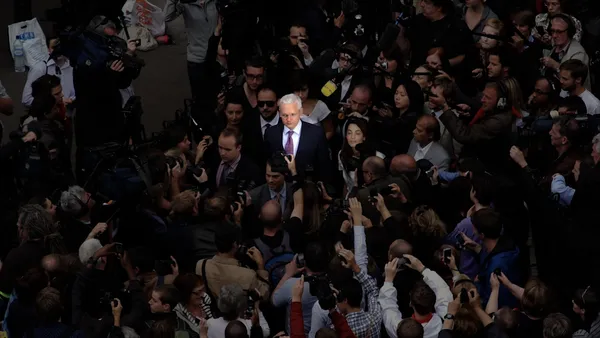

In the Ecuadorean embassy in London, Julian Assange, variously claimed to be a journalist, a hacker, a rapist, a terrorist, a hero and, latterly, a father, sits close to the camera as if about to disclose something urgent directly to the viewer. On this occasion, he says, he’s not here to talk about himself, but to talk about the crises facing journalism and democracy.
He is not, you may be pleased to hear, narrating this whole documentary, which emerges instead from a composite of voices. Amongst their owners are some people with egos almost as big as his own, and although their contributions may seem balanced to begin with, it emerges over time that some are distinctly untrustworthy. This means that, although the film inevitably does end up focusing a lot on Assange – he is too vivid a character to be easily sidelined – it’s still an intriguing piece of work, with layers of mystery beyond what you’re likely to be familiar with already.

The Wikileaks story unfolded quite differently in European and US media, which is probably why the film is screening under a different name there: The Six Billion Dollar Man, a reference to the sum of money reportedly offered to the Ecuadorean government by its US counterpart in exchange for handing over this troublesome man. How did he get into that wacky situation? That’s where the film first reveals itself as a fresh version of the story.
Whichever side of the Atlantic you were on, the early revelations about Wikileaks were so high profile, so dramatic and multifarious, that one might easily get the impression that it was a seasoned professional organisation. In fact, to the extent that it was organised at all, it was a collection of wildly ambitious young people, few of them over 30 – and looking back now, they can see how naïve they were. “When you get into a fight with the Pentagon, it’s only going to end one way,” says Sigurdur Thordarson.
“It will be an encouragement to every other publisher to publish fearlessly,” Assange announced after the group successfully exposed the killing of innocent civilians by US soldiers in Iraq. Looking around the world today – especially if one is oneself a journalist, and aware of what goes on behind the scenes – it’s difficult to call him a prophet. What Wikileaks did back then was important and did make a difference. Briefly, it attracted prestigious allies like Der Spiegel. In the end, it was the fresh faced young Pte. Manning who carried the can, but the Wikileaks team got spooked enough to start looking for somewhere to set up a secure base, which was how Assange came to be in Sweden over one fateful weekend.
It would be impossible to tell the story without addressing this episode, yet doing so is fraught with difficulty, and not just because of what remains uncertain. Director Eugene Jarecki, whose past films’ awards success is testament to his skill, deserves praise for his sensitivity. It is Lisa Longstaff of Women Against Rape who discourses on events, noting that we cannot, of course, know exactly what went on behind closed doors, but saying enough to sustain a variety of interpretations. What does come through clearly is that the two women involved had even less control of what happened in the aftermath of their encounters than they did at the time; and there is no version in which Assange comes out of it looking good
He is, in fact, criticised at multiple points in the film – usually a good indicator that a director has not been beguiled by his subject. The array of celebrities who gathered around Assange during his time in the embassy risk making him look heroic, but sometime collaborators refer to him as paranoid, arrogant, even cruel. He’s not the only person involved with Wikileaks to have been accused of sex offences, and there doesn’t seem to have been much of a filtering process when assessing prospective new members. Still, Jarecki gently steers the film towards a particular point which is most neatly encapsulated by a member of the embassy staff. That is, whether or not an individual is likeable, due process matters.
To become a mover and shaker of world events is to put oneself at risk of having one’s personal destiny shaped by them. over the course of the film, we move on from US activities in Iraq to take in the ‘Arab Spring’; the rise and fall of Bernie Sanders as a potential presidential candidate; the rise of Donald Trump, who allegedly suggested to the CIA that just kill Assange; and the change of government in Ecuador that brought Assange’s time in the embassy to an end. Along the way we hear about a blackmail plot, a police sting operation, admitted embezzlement, alleged poisoning, a secret baby, the strange series of decisions which led to the release of unredacted US military cables, and the political and judicial processes which followed.
We follow Assange to solitary confinement in Belmarsh Prison. “Why was he there?” people ask, given that its focus is on violent offenders and he was accused only of breaking bail conditions. Nobody makes the obvious point that he would be harder to assassinate there, at least without high up UK cooperation. Occasional details like this jar. Elsewhere, a contributor compares Assange to Prometheus and mangles the myth, which doesn’t matter on its own but serves as another reminder that we need to take everything we’re told with a pinch of salt.
Over two hours in length, the film cannot be accused of not being thorough, and yet, upon arriving at the end, one wonders how much has actually been said about threats to journalism. A glimpse of Daniel Ellsberg reminds up that people being punished for telling the truth is far from a new thing. There are brief reflections on the damage done by misinformation, the breaking of trust by political figures and the consequent loss of public faith in traditional media institutions, but there’s nothing that the type of viewer willing to sit through this in the first place is likely to have failed to notice. Assange himself has nothing particularly deep to say on the subject.
This is a consistently interesting film and a good exercise in navigating historical narratives, even if it’s not exactly what its UK title might have viewers expecting. Released in a season when there’s little on offer to those seeking intellectual stimulation, it might do pretty well. To many, its central figure may now seem like yesterday’s man, but many of the adjacent issues it raises are very much alive.
Reviewed on: 18 Dec 2025


Director: Eugene Jarecki
Writer: Eugene Jarecki
Starring: Pamela Anderson, Edward Snowden, Julian Assange, Naomi Klein, Jeremy Scahill, Chris Hedges
Year: 2025
Runtime: 126 minutes
Country: US
Search database: