 |
| Sirât |
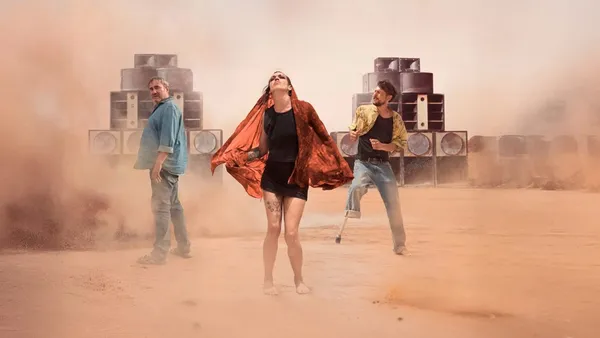
Kangding Ray hasn't had the most traditional route to film composition, if there is such a thing as a traditional path. For Ray, the architect turned film composer, Sirât is only his second feature film. Ray previously scored Hanna Doose's intimate German art house film, Wann Kommst Du Meine Wunden Küssen, about three friends, once members of the Berlin arts scene, who reconnect on a farm in the Black Forest and face the reality of the paths their lives have taken. Collaborating with the French-Spanish filmmaker Oliver Laxe on Sirât, the music itself becomes a prominent character in the story of a father's search for his missing daughter in the North African desert.
In conversation with Eye For Film, Ray discussed the different phases of his creative journey and how new phases are already emerging. He also reflected on his creative process, how music is alive, and the place it occupies within cinema.
The following has been edited for clarity.
Paul Risker: In your own words, how would you describe your creative journey?
Kangding Ray: Well, I'm first an artist, then an electronic music producer. I started out in the experimental and ambient scene, but before that, I was an architect. That's how I came into contact with artists and musicians in Berlin. There's a creative scene in Berlin that really connects a lot of people, and this was especially so in the early 2000s. I was kind of inside this scene and from architecture, I began working with art and then music. But before that, I was also a guitarist. So, if I go back, I come from rock, but I became an architect and then a musician, and that's what I do now.
So, I have always been in a state of constant transformation. I came from experimental towards more techno bass music, and right now I'm mostly busy touring the world doing DJ sets and producing my own music. But three years ago, I started scoring. Sirāt is only the second feature film, and it signals a change towards another phase. I've always been like this, following the flow of where life wants to take me. But all these phases, from architect to experimental artist, dance music artist and DJ, towards film composition now, feels a logical path.
PR: How do you compare the challenges of your two feature films to date and what you've taken from each experience?
KR: The first film I did was a very intimate German art house film. It was a story of three women having an existential crisis. The characters share a history and two of them are sisters. So, it's a mix of family and friendship drama, and there's a little dance music involved because one of the characters is a former DJ, but he doesn't play such a big role. Much of the film is about emotions, and so, it's very soft and tactile.
The work on Sirât was very different because I pushed a lot more for a rawer and visceral sound. It's more radical in a way because the story demands it. But I'm always reacting to whatever framework the director gives me.
PR: From the beginning, Sirât empowers its music to become a character in its own right. Oliver Laxe is essentially emphasising that cinema is as much a musical medium as it is visual.
KR: It is a very important aspect of the film. Some people say it is almost like a character and it evolves. In the beginning, it is there as a sort of celebration of life — it's very lifelike, intense, and euphoric, and, of course, ravey, because it starts at a rave. And then, along the way, as the character himself goes on this journey, in which he loses a lot, the story disintegrates and the soundtrack follows this by becoming more ethereal and more explosive or disintegrated, until it becomes like these ambient filigrain textures.
PR: Can we describe music as being alive if we're going to talk about it in the context of evolving?
KR: The way I approach music is very much like that. I'm neither efficient nor professional, in that I don't know exactly where I'm going. So, I use sound to look for the magic or those other things that come out of the machine. That's why I love analogue hardware that can give me something that's more alive.
The films that stay with me and I can remember a long time after seeing them always have a special score, like Blade Runner, Stalker or Requiem For A Dream. You associate the score with the film, which is a good sign because it becomes its own character — you cannot detach the music from the film.
PR: Picking up on your earlier point about being guided by the music, what loose threads were you trying to pull at on Sirât to inspire the music?
KR: Well, I came onto the project pretty early because Oliver wanted to give a lot of space to the music. We ended up having 62 minutes of music for a film that's not even two hours long. That's an enormous amount and most of it is without dialogue. So, the music becomes like a living character, and each scene has to have the right amount of texture and intensity, the right tone. This was very important for Oliver and me to find, because otherwise the amount of music would create an imbalance and steer the film in a different direction. So, a lot of the work was done in the two years prior to the shoot.
PR: Is there anything that might surprise the audience to know about the score, specifically how the music was being used in a particular scene or moment?
KR: The last scene especially, which starts with a very subtle arpeggio and ends up being like a 10-minute growing theme until the credits, started with a sound that I made five years prior. I'm always recording and collecting sounds that I store on my hard drives. Sometimes I don't know what to do with them, but I was always thinking that one day I would need this one for something, and I would make sense of why I made this sound. However, it was a very particular sound that I could never use on my own albums or records because it didn't feel right.
One day, Oliver and I were struggling a bit with finding the right tone of this one scene and I remembered the sound of this beautiful little arpeggio. I was like, 'Okay, this is going to be a bold choice.' We tried it and the magic happened — it was what we needed. It's an unusual choice for that kind of scene, but we're really happy about how it turned out. It almost has this genuine tragic and comedic feel. It's exactly the right tone and the right direction to take the film, by giving a little light towards its end.
PR: What are your thoughts on the place music occupies in cinema more broadly? What role will music play in helping us to understand what cinema is and can be? And how is the relationship between music and the audience changing with time?
KR: Historically, the purists in European art house or underground cinema saw music as a dangerous and manipulative medium, which is not the case in US cinema. It's less so in British cinema, but let's say French, Spanish or Italian filmmakers have always been cautious about using it because they think that it's bad to manipulate emotions through music. Instead, you should use your cinematography or the story. Now times have changed, and international films are seen a lot more in the US. So, there's more of a conversation, and it's very interesting because a lot more avant-garde scores will travel a long way now.
Before, there was a hegemony of classical composers that would have a monopoly on big films. Now, I see signs that people want to be touched by music, which is a lot more advanced than the typical neoclassical approach. This is both a good sign and a positive change.
Sirât is shortlisted for five categories at the 2026 Academy Awards, including Original Score.