




|
|
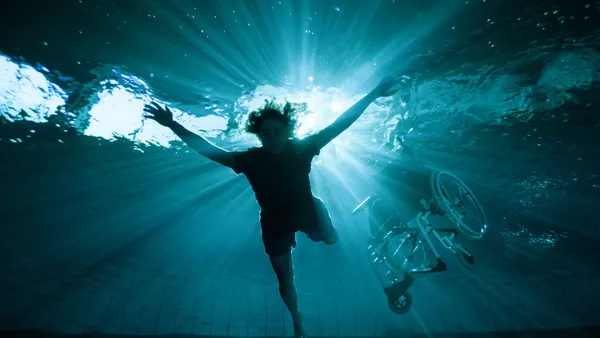
Mari Sanders on star Lucia Zemene, who plays Vera: 'In the end, she was extremely thankful that she could make her disability part of a more universal story'
Photo: Courtesy of Thessaloniki Film Festival
|
Dutch director Mari Sanders’ latest film centres on Vera (impressive newcomer Lucia Zemene), a hedonistic 23-year-old who finds herself navigating an entirely new life after she loses a leg in an accident. It’s a situation that throws her into turmoil as she tries to decide what she wants from her life, while her friends and family also come to terms with the new reality. Sanders, who has cerebral palsy and uses a wheelchair himself, says he’s proud that this is the first film ever, so far as his research goes, to take an actor with a disability and make her able-bodied through camera trickery rather than the common practice of making an able-bodied actor look disabled.
“It was basically fun to make this historical reversal,” he says, and though he says it was a challenge, he adds: “But that's part of the fun of filmmaking, isn't it? To make you believe that what you see is this transformation of somebody with two legs.”
Sanders says that good preparation was key: “I think with my DoP, Sal Kroonenberg, who did an amazing job – we really thought everything through, and Yorgos Mavropsaridis, the editor. We didn't want to overemphasise the fact that she had two legs, so it was a bit of a game. But I think we had fun making a découpage that could work, and also a bit of revenge. Everybody has to make the art they want to make, and of course it's a debate. But I think the time has come to also ask people with disabilities themselves to give life to the story. So it felt really good.”
Stand Up had its world premiere at Tribeca Film Festival and recently picked up the Human Values Award and Alpha Bank Accessibility Award at the Thessaloniki Film Festival, where we sat down to chat with him about it.
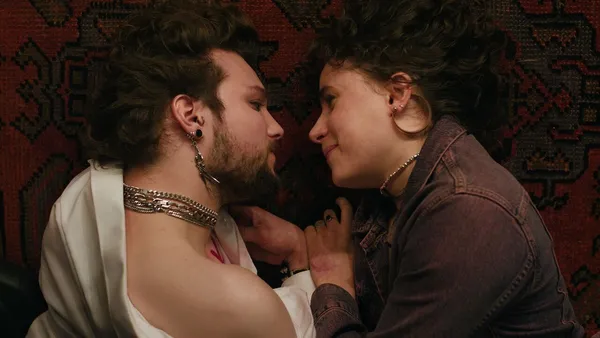
The director – whose previous work includes docfiction hybrid TV show Handicapable and documentary Rolstoel Roadmovie: Over de drempels van Europa – sees his films as an opportunity to collaborate with the actors, including Daan Buringer. He plays Xander, a punk-spirited young man in a wheelchair who Vera enters into a sort of will they/won’t they relationship with, or as Sanders puts it “a situationship”.
Speaking about Buringer, Sanders says he had him in mind when he was writing the film: “I kind of followed his career since he was 16 so I really knew what he was capable of, and I was always wondering how he would look in a punk outfit. So that's how it started.
“Daan is quite an intellectual actor, also Lucia. I was very honoured and thankful that I worked with such intellectual actors in the sense that when all three of you are disabled, you are three of the pillars – of many – of the film.
|
|
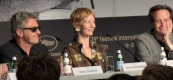
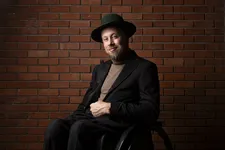
Mari Sanders: 'Even if I spend my whole career talking about disability, I'm pretty sure I will never repeat myself'
Photo: Courtesy of Thessaloniki Film Festival/Studio Aris Rammos
|
“We talked about disability between the three of us. When three disabled people talk about disability, you always get a different kind of conversation. I'm not saying that the conversation with non-disabled people is more or less valid, but it's a different kind of conversation.
“I think at the heart of this film is this conversation between the three of us, and thinking, okay, what happens if we make poetry out of disability. What happens if we really dive deep and try to do some soul-searching to see how much of ourselves is defined by disability?
“I really liked developing the script together with them. I don't like to write scripts and then be the puppet master. I like to be a very collaborative director. I take my actors very seriously. They're artists, and you're making something together. Especially with this film, when it's so much about authenticity and disability, I think it's really important to let their characters also be developed by themselves.”
Sanders says he viewed his film as a playing field that allows his stars to bring their own characters forward. He adds: “I have to coach them, almost like a football trainer, and make sure that I keep an overview, but I also like to stress that Lucia had an accident herself four years ago. So of course, she was able to bring a lot of emotional baggage, but we also immediately said, ‘Yes, but you're still playing a character, so please make use of your personal emotional baggage. You went through everything that the character goes through, but Vera is a completely different character from you’. That was also very important: to make that distinction.”
He says he talked a lot with Lucia as he was alive to the possibility of triggering trauma.
“In the end, she was extremely thankful that she could make her disability part of a more universal story. That it's not an individual thing she has to carry, that she could now use to make art. That purpose was really important to her, and it also gave her a lot of motivation. She always said to me, which I'm very thankful for, ‘Don't be shy. I want to show my emotions. I'm there. Of course, it's hurtful, but it's what I want to do."
One of the key issues the film deals with is ableism as Vera’s friends and family also struggle to cope with her new situation. It is something the writer/director handles empathetically.
He says: “I understand her girl friends, I understand the parents. I know that they want to do good, but there's that saying: the road to hell is paved with good intentions. I think that's often the case with disability, and that's also the more difficult part of it.”
The film shows how both groups of friends – those with a disability and those without continue to prove vital to Vera and can co-exist with one another.
He says: “I'm not saying that everybody should be Xander or one of the friends, but I think everybody with a disability is somehow challenged to find an answer to the big question: how does it define my identity, even if you're saying, ‘I don't want to make it part of my identity at all’. It's a choice, and on Thursday you can make a different choice than on Friday. Acceptance is a road; it's not the end station.
|
|
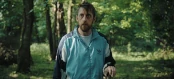
Lucia Zemene and Daan Buringer as Vera and Xander. Director Mari Sanders: 'I think at the heart of this film is this conversation between the three of us, and thinking, okay, what happens if we make poetry out of disability'
Photo: Courtesy of Tribeca Film Festival
|
“Vera, in the end, chooses her own path, and she also needs to learn to understand that her girl friends need time for mourning. She doesn’t carry the disability on her own, it also affects other people.”
In terms of shooting the film, there were logistical challenges and the way that Sanders has embraced them should make it easier for future projects involving disabled actors and crew.
“It was a big challenge,” he says. “One of the challenges was making things accessible in terms of physical accessibility, but also time-wise. Sometimes we had energy disabilities as well that we had to take care of. We really tried to lobby the Dutch Film Fund [Filmfonds] to get extra funding for that accessibility part. I know that at the BFI this is already common practice. In the Netherlands, it wasn't, but after this film, it is, so I'm very proud that the money it costs to make things accessible isn't something that has to be solved in a creative way. I should get the same level playing field as every other filmmaker.”
Despite the victories, the filmmaker is still concerned that there’s a lack of representation at every level, in terms of crew. He says that begins with creating a level playing field but also says that legislation is a vital tool for achieving better accessibility.
Sander says: “I truly believe that. That's also why it was so moving that we had a world premiere in Tribeca, New York. In the city where I could order a taxi and it was there in two minutes, an accessible taxi. I could go into every cafe I wanted, or, even when it wasn't possible, there was a doorbell I could ring. It's a political choice in the end.
“There was an English or American scholar who said something like, ‘We all get disabled as long as we get old enough’. I mean, we're all temporarily able-bodied, if we're lucky. I think one of the most moving parts of making this film was that we had to reinvent production in many ways. It was quite easy to do that because we simply asked questions of everybody, able-bodied, disabled or with hidden disabilities. We asked, ‘What do you need to perform? How can we make the best work environment for you?’
“By starting your production with that question, you have a very happy set. Everybody feels seen and heard. Even the people who don't require time to relax can use that time to work on the grip, improve the lighting, and so on. Everybody goes home on time and has some time with their kids. We’re in a very challenging industry, but let's have some fun together.”
Sanders, who spent eight years making the film, also set up a company Wild Lam to help develop Dutch talent in acting and film creation.
He explains: “When we did this casting, we found that there was amazing disabled talent around that wasn't getting into the professional world. We also decided to start a foundation to support disabled talent in the Netherlands, not only by lobbying for accessible sets, but also, and this is quite new, by training them. We felt there was a lack of training because the theatre schools had a philosophy for a long time that you should be perfectly able-bodied to be an actor. Times are changing, and I think the theatre schools are adapting, but this is still a philosophy we have inherited from the past. It will take a lot of time before there's a level playing field.
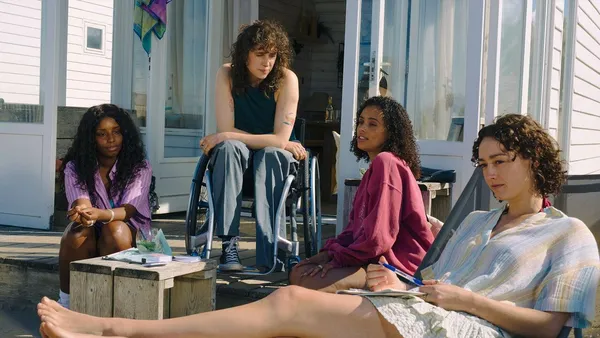
“The best thing we could do, we thought, was make sure that disabled actors have access to training, also to understand how their disability affects their acting capabilities and how they can use it artistically. The results we have are amazing. We’re really trying to make a new generation of disabled actors and artists.”
Given his dedication to improved access and the nurturing of talent, is he ever worried that he might become ghettoised in terms of always being expected to make films about disability?
|
|
Mari Sanders: 'We’re really trying to make a new generation of disabled actors and artists'
Photo: Courtesy of Tribeca Film Festival
|
“I don't want to be known as the disabled director who makes disabled films. Even though, I think we should realise that disability is a wonderful subject,” he says. “It talks about the human condition in many ways. My partner once said to me – she’s also a wonderful writer on disability – and I was saying I was afraid to be put in a box. She said: ‘Why? There are so many Russian directors talking about white Russian alcoholics for their whole careers. Why shouldn't you make films about disability? The theme is so colourful, and there are thousands of stories’. Even if I spend my whole career talking about disability, I'm pretty sure I will never repeat myself because it's such a rich subject. In the end, it's only about the human condition.
“I think a disability makes very universal things visible. That's the great thing about disability. You can question normality. You can question what it is to function and what it is to go through loss and gain. It's actually kind of a nice vehicle, although I think we need to do both things at the same time. We need to normalise disability in television and film by giving disabled actors roles as mothers, lawyers and so on, without talking about their disability. But the theme itself is still very interesting, and there's still an artistic goldmine to be found there.”
Now, while enjoying travelling with Stand Up, the filmmaker is also looking forward to getting some time and space to think about whatever comes next.
He adds: “Of course, disability, even if there are no disabled actors in the film whatsoever, will always define me as a filmmaker.
“I'm always very interested in the human condition and how people relate to their bodies, and to be an outsider. It defines me as a director, but that's a wonderful thing because it gives me a clear point of view towards society.”