




|
|
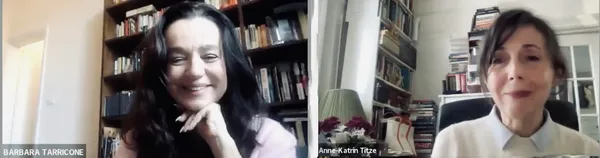
On David Cronenberg’s The Fly (starring Jeff Goldblum), Barbara Tarricone-Hamilton to Anne-Katrin Titze: “That was my seminal intuition that I was watching something extraordinary.”
|
The documentary on and with David Cronenberg, The Flesh And The Soul, co-directed by Barbara Tarricone-Hamilton and Giuseppe Papasso had its world premiere at DOC NYC and is a highlight of the 17th edition.
From Bologna, Italy Barbara Tarricone-Hamilton joined me on Zoom for a conversation on David Cronenberg’s memories of Bambi and Federico Fellini’s La Strada, Coralie Fargeat and Julia Ducournau, Robert Lantos and Howard Shore, his films A Dangerous Method, Maps To The Stars, Dead Ringers, Videodrome, and The Fly.
|
|
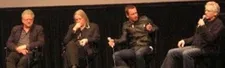
Producer Jeremy Thomas, writer Christopher Hampton, actor Michael Fassbender and director David Cronenberg at the New York Film Festival press conference of A Dangerous Method
Photo: Anne Katrin Titze
|
In the documentary we learn about Cronenberg’s childhood filled with books and music, his early love for science and how he “invented stem cells” in his film Rabid. Social media would make him far too accessible, he states, motorcycles were an early fascination and the different reactions to Crash astonished him. He quotes Freud that “civilisation is repression” and Christopher Hitchens that “death causes religion.” Making a Marvel movie would bore Cronenberg to death, and when George Lucas’s company once called, his honest response made them hang up on him.
Anne-Katrin Titze: Barbara, let's start with David Cronenberg's childhood. I love the story of the two cinemas across the street from each other. And the fact that you have him watching La Strada in one of them in the present. Can you talk a little bit about his beginning with cinema? Bambi and La Strada, the clips you chose, they give great insight into his oeuvre.
Barbara Tarricone-Hamilton: Well, thank you! We really wanted to give access to his mind, his brain and what instilled in him the passion of cinema. And he was extremely generous in sharing with us all his memories and inspirations. He was okay with digging into his childhood. When we started our conversation, we had an entire day ahead of us shooting. We did something you rarely have the time and possibility to do with one of the great filmmakers, which is take our time.
|
|
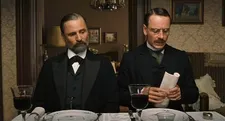
Viggo Mortensen and Michael Fassbender in A Dangerous Method
|
That's when we had the luxury to say: Let's talk from the beginning. How were you as a child? He brought us into this very fascinating trip into what little David Cronenberg's life was like. As a fan of his work, it was especially fascinating, because you see some of those little seeds that developed and blossomed into his opus.
One of them was La Strada, obviously. Surprisingly, because it is a work that apparently is very far from what his filmography is like. But like he said, it gave him the inkling of what the power of cinema is, seeing those adults crying, weeping coming out of the theater. And so we had the luxury to ask him if he was willing to go back to the theater that still exists and to watch the movie for us and we capture his reaction.
AKT: Bambi and La Strada are powerful films. Anybody who doesn't cry watching those two, I don't know if they're human. And also, I love how he then talks about his love of insects. Science is his thing and you show a clip of the kids, the twins from Dead Ringers. At two points during your interview a fly comes by. He calls it his friend. What did you think when that fly came by?
BTH: Thanks for asking that! Because generally speaking, when something like that happens, you say, cut! And you get the fly out of the set. And then shoot again. We did that. Well, we let him talk through it and then just shot the question again. But it was a little detail that talks about his sense of humor. Because his sense of humor as you know is very subtle. And it just was apparent in his interaction with the fly. So we left it there. And it's just a little detail, but people loved it. During the movie premiere in New York people laughed. And got it. And so, that's where the fly came to be. And it's not a paid extra.
|
|
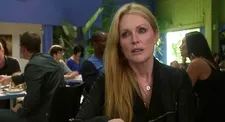
Julianne Moore in Maps To The Stars
|
AKT: Yeah, I did not think you’d come by with a fly and let it out. It was a coincidence, that he doesn't believe in. Another great moment of editing when you show a scene from A Dangerous Method, after Cronenberg talks about coincidences, and then we have the dialogue about Sabina Spielrein. Was it fun choosing the clips to go with the interview?
BTH: It was a lot of fun, and honestly, it was teamwork. We had creative consultants, that are all great Cronenberg fans. And then we put our minds together because we really wanted to have the audience watch Cronenberg talk, for the most part, because it's a conversation, it's an intimate conversation. And we didn’t want to cover it all with B-roll and clips. Our creative consultant Simone Buttazzi especially likes A Dangerous Method and he insisted on using that specific clip that works really well.
AKT: A Dangerous Method is also one of my favourites. For some reason I had forgotten that Viggo Mortensen plays Freud in that film. I blocked that out. Until Cronenberg started talking about casting and how Mortensen plays a gangster and then Freud. I thought it was very revealing what he said about casting. Were you surprised?
BTH: I really appreciated how generous Mr. Cronenberg was in sharing all these practical details. And sort of demystifying the mystique of the maestro having these visions, creating a work of art with no physical constraints, logistics or technical aspects considered. He was very generous doing that. Not a lot of great filmmakers really tell you, listen, I have to think about A, B, and C.
|
|
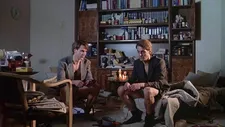
Jeremy Irons as twins in Dead Ringers
|
AKT: Passports!
BTH: Passports, I have to think about passports! I thought that was very special and unique to be willing to share these details.
AKT: I appreciated that you not only left in the fly, but also the beautiful Freudian slip. He says; “In every film I've done, there are elephants of my life.” And then he immediately corrects himself to “elements,” but after watching your film, we see big elephants, big things from his life that made it into his films. How much of little-boy David Cronenberg is in there, and how much connects to him.
BTH: I agree. We set out to offer a master class in filmmaking by David Cronenberg, but also pretty much access to how he operates. And then the question is, how does this originate?
AKT: Absolutely, it's great to just have mainly the interview and hear him talk. You give us time to think along with him. How did it all come about?
BTH: Donato Santeramo, who serves as executive producer, is a close friend of David Cronenberg. He is a philosopher, an intellectual, a professor. They are like-minded in many ways. He shared with us that every week they get together and they prepare liver together.
|
|
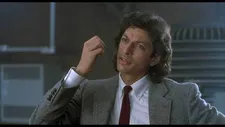
Jeff Goldblum in The Fly
|
AKT: Liver?
BTH: Fegato, some sort of fegato recipe. It has to be something bloody, obviously. So through Donato Santeramo, David Cronenberg was invited to a festival in Italy. As it happens, I was participating in this festival with Giuseppe Papasso, my co-director, and we saw an opportunity. We started a relationship and gained his trust. He taught several masterclasses during that festival and other festivals and basically we asked him if he was willing to replicate this for us. We were honoured and humbled by that.
AKT: Please talk about the title of the film!
BTH: Well, that also stems from our conversation and close collaboration with Donato Santeramo and David Cronenberg. I don't know if you noticed, but at the end of the meeting the flesh and the soul transforms to the flesh is the soul. That is sort of the philosophy, if you want to call it that. I don't think Mr. Cronenberg would appreciate me elaborating too much on the philosophy. It's very practical on how he sees movie-making. But, you know, I think the underlying philosophy of much of his work is that flesh is the soul. And as he says, there’s no soul in terms of an afterlife without our bodies. But there is obviously something in the flesh, in the body, which is what the soul is constituted of.
AKT: The way he rejects as demeaning the label as “master of body horror” makes perfect sense. It’s one of those many shortcuts of genre. He's very right with that critique, don't you think?
BTH: I agree. I agree. So what he says is, I don't think in terms of genre. And if you look at his work, there’s so many different types of movies in there. One of my favourites is Maps To The Stars.
|
|
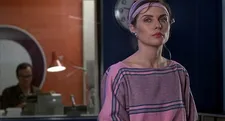
Debbie Harry in Videodrome
|
AKT: Mine too.
BTH: And that is a completely different movie from The Fly or Eastern Promises or The Shrouds. In a lot of his movies, there's no trace of this body horror.
AKT: Right. The two French filmmakers, both women, Coralie Fargeat and Julia Ducournau, who both quote Cronenberg as inspiration, he does accept in a way as his cinematic daughters or granddaughters. I don't think he rejects what they're doing.
BTH: Absolutely not. Absolutely not. Yes, and I think that's also interesting, because it speaks to how a work of art lives on and inspires people over time and the way it is interpreted changes so much. That question stems from the fact that the body horror concept attributed to his filmmaking was often associated with the exploitation of the female body.
The exploitation of the body and the male gaze and the accusation of anti-feminism placed on his work throughout the years in the past. So the way that it's been an inspiration for two very successful female filmmakers I think it's very interesting. Culturally, how a cultural object changes its impact, its relevance in the way it is perceived over time. It also speaks to how a great filmmaker like him can be ahead of his time.
AKT: I never felt the male gaze in particular with his films, compared to other filmmakers! Near the end of the documentary, Cronenberg says he's talking to Robert Lantos about his Consumed [his novel to be turned into a film]. Do you have any update on where that project stands?
|
|
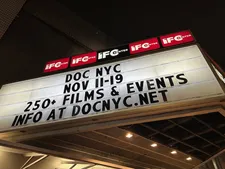
DOC NYC at IFC Center
Photo: Anne Katrin Titze
|
BTH: I don’t.
AKT: I did a post-screening discussion with Robert Lantos and Atom Egoyan a few years ago at the Museum of Tolerance. So I was wondering about news.
BTH: Oh wow. I know, that's an interesting project that I would want to materialize, of course.
AKT: Howard Shore is another one of his longtime collaborators that I spoke to. But let’s get to the ending. “There’s nothing after?” you ask. And Cronenberg responds: “Nothing.” I guess it was not at the end of your discussion and you decided that it’s a perfect ending of the movie?
BTH: We decided. Also, because to tell you the truth, he doesn't really love to elaborate on his past work. But I knew that I wanted to have several things about his main movies in there, because that’s what fans wanted to know. I would want to, and I had fun talking about those things. We first had a very long conversation that was mainly on broader topics.
Then I asked him more specific questions about some of his older movies. I twisted his arm a little bit. He doesn’t see his body of work as a trajectory that has a sense of like one thing after the other in a specific chronological order. Anyway, sometimes we journalists, as you know, have to find a way to ask other questions and then squeeze them in there. So we did have a longer conversation about other topics afterwards. He didn’t stand up and leave after saying there’s nothing after life!
AKT: Were there any revelations for you personally making this documentary that changed the way you see his films?
BTH: I can tell you that, and I can only tell you this retrospectively, when you think about the movies that make you understand how powerful cinema is, for me one of them was The Fly. I watched that movie in grade school. Now we wouldn’t think it appropriate for a child to watch The Fly, but it was a different era. Children were exposed to all sorts of movies. And I was mesmerized by it. Not in a bad way.
I was completely wrapped into the story, and it was one of those early movies that I watched that made me understand what is filmmaking. I couldn't have told you that at ten but then later you go back and wonder, who makes movies like that? Who is this? What am I seeing? That was my seminal intuition that I was watching something extraordinary. By the time I actually watched Videodrome again, for this interview, I was completely amazed how relevant it is. I don't know if you watched it recently?
AKT: No, I watched it a long time ago. I watched it at university, in a horror film seminar, I think. I still remember the video being put in the body.
BTH: It's so relevant to our culture now. You know, what was an idea that was groundbreaking at the time. Now it's not a reality that we are gonna get sucked into TVs physically. But we do live our life completely filtered and mediated by this, by social media, by screens. Yeah, I’d like you to watch it again and then tell me.
AKT: I will! Thank you Barbara!
BTH: Thank you! Thank you for this great interview. I'm glad you enjoyed our work.