





Eye For Film >> Movies >> The Middle Room (2026) Film Review


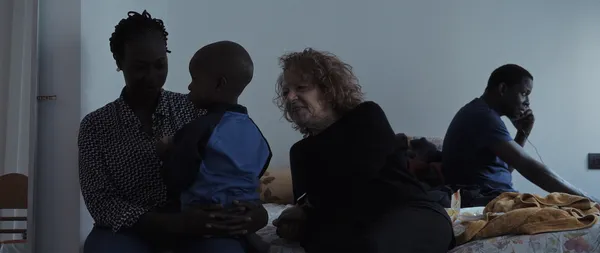

At a time when hostility and prejudice towards immigrants is on the rise throughout Europe, Enrico Maisto’s documentary offers a timely, subtle and intimate portrait of relationships navigating cultural, social and geographical divides – but not always smoothly.
It focuses on Mietta, a retired juvenile court judge from Milan, and “Ibu” a Senegalese immigrant who she first met in Sardinia 20 years ago, when he was living there illegally and selling watches on the beach. She helped to regularise his status; he became a friend of the family and relocated to Milan.

The action opens in 2017, when Ibu asks her to help bring his pregnant wife, Bousso, to live with him. Mietta, who has no husband or children of her own, decides the best solution is to buy a larger apartment to share with the couple. Maisto is invited in, too, and over the course of several years records the developing relationships as baby Khadim grows into a chatty, clever little boy. But one who sees himself as Italian rather than Senegalese.
What could have been a simple, feelgood tale of an unusual but loving family group – reinforcing comfortable ideas of shared humanity overcoming bureaucracy and prejudice – is a knottier study of power dynamics, cultural expectations and conflicting senses of “identity”.
Mietta is a fascinating mixture of successful legal professional and bohemian free spirit, who cheerfully discusses the lovers she has “lost count” of and the “official fiancé” who left her the day before their wedding. As imperious, witty and acerbic as a matriarch in an Elena Ferrante novel, she clearly adores Ibu and his family, but there’s a definite sense of her enjoying her “white saviour” role, expecting a certain amount of deference in return for her generosity.
Ibu is a much more relaxed, genial persona. But he too expects his relationship with his wife and children to follow conventional lines even in an unusual setting. Bousso is initially unhappy and unsettled, finding it hard to adjust to a life which contrasts starkly with the extended family and community she has left behind. But as Ibu’s breadwinner status means he spends much of his time at work she finds herself bonding more and more with Mietta.
The “homemaker” and the retired high-flier develop a touching, complex relationship, united by a shared indulgent exasperation with the “boys” in the family.
Maisto himself is a character in the drama, observing with a sensitive and perceptive lens, and asking pertinent off-camera questions of all his protagonists regarding how they see their futures unfolding. He has the good documentarian’s gift of melting into the background to the extent that you forget all these intimate scenes of family life are played out with cameras only feet away. And when Mietta is taken ill, Ibu keeps him as well informed of her progress as a close relative.
Ironically, Maisto’s success in this respect throws the film’s flaws into sharper relief. Although we get to feel as though we’ve shared the apartment for the best part of a decade too, there’s a frustrating lack of detail about these people’s wider lives.
We never get to know how Mietta and Ibu became so close in the first place, or their connection with Maisto. There’s no mention of Mietta’s wider family and friends in Milan (though a young Italian boy, Alex, regularly comes round to play with Khadim). We get very little sense of Ibu’s working life and (beyond a few scenes of them visiting the mosque) how the family interacts with the local community.
And, though the timescale of the film coincides with the rise of the populist right and the election of Giorgia Meloni as prime minister on an anti-migrant platform, there’s no indication of how this has impacted on the family’s lives. The only mention of politics is when presidential elections are held in Senegal.
Ibu and Bousso are both supporters of the victorious candidate, who pledges to “mobilise Senegalese both here and in the diaspora”. This leads Ibu to start thinking of the possibility of returning to his home country – and the impact this might have on Mietta…
More on the backstories of the protagonists, and the political background to their experiences, would have made for a more rounded and satisfying film. It’s still a fascinating portrait of a set of people who, for all their flaws and differences, are decent and kind and who want the same things we all do; love, stability and hope for the future. But for all its virtues, Maisto’s film never quite tells the full story.
Reviewed on: 27 Nov 2026