




|
|
Aroma. Xue Ma: 'I'm a director first. I write a script just from images. My logic of film language is image logic'
Photo: Courtesy of POFF
|
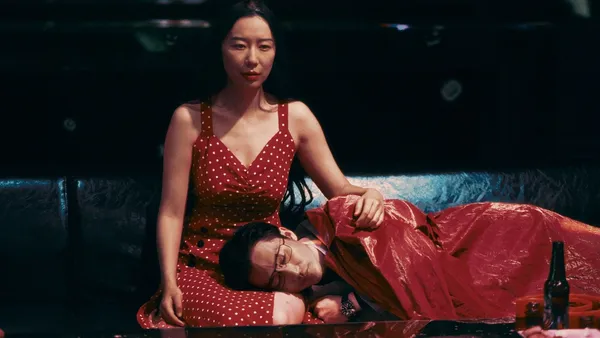
Aroma, the latest film from Chinese director Ma Xue (White River, Sonata Of Wave), puts the sensory experience of its protagonist Yang (Jiali Zhao) to the fore. Yang has an acute sense of smell which, with the exception of lemons and disinfectant, makes her recoil from the world, until the day she encounters a man whose jacket smells irresistible to her. It turns out the wearer is not the owner, which sends Yang on a detective mission into the life of Fang (Weihao Xu), who she discovers is lying in a coma. Becoming his nurse, she believes she can connect with him, taking us into a realm of fantasies, which also become the dreamspace of Fang himself, as his childhood, life with his wife and pursuit of a mystery woman in red all come into play. The film had its world premiere in the Rebels With A Cause section of the Tallinn Black Nights Film Festival, where we caught up with Xue to talk about her working process.
Tell me about why you chose scent as the starting point for this film as it’s not the most obvious choice.
Ma Xue: I think it's interesting and challenging. I love something I haven't known. I had no idea how I could make a film about scent, so I wanted to try. I also want to explore topics or things I have no idea about, but which I'm curious about. I don't need to find the answers; I just want to observe and discover. So that is why I make films.
So filmmaking for you is like a process of discovery?
MX: Yes, discovering something I'm curious about. I'm curious about the world and about people. If I have an idea or some questions about the world, or perhaps about people, I'll try to make a film to explore them.
Did you do a lot of research into scent and smell?
MX: No, it was just like my first step in filmmaking, when I shot an erotic film [White River]. Everyone thought it was very ridiculous and nonsense. I had no experience watching erotic films – so that’s why I wanted to do it. I didn't want to learn from everyone else and simply repeat what they had done. But because I have no experience, I wanted to start to explore it. I got the idea for this film from thinking that perhaps someone could be unique and special and couldn't tolerate smell. Could that be a story? I wanted to challenge myself.
I'm interested that you chose to have a male narrator for this film, which is quite surprising because a lot of it is to do with the female experience. But then you have the male narration. I wondered why you decided to do that.
|
|
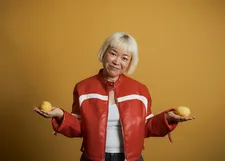
Ma Xue: 'The lemon I chose is something very simple that everyone can connect with'
Photo: Courtesy of POFF
|
MX: I'm a director first. I write a script just from images. My logic of film language is image logic. I don't rely on dialogue or the language of people talking because I think language is tricky. My major was language so I think language is understood according to everyone’s own experience of the world. When you hear the words, you have already given up your imagination of the images, in my opinion.
So when I’m shooting on set there is very little dialogue, almost none, because I believe the atmosphere of the space and the relationships and subtle emotions created can already feel very real and inspire the audience to have more imagination about these pictures. I don't need the audience to have the same answer about the situation. Maybe everyone has a variety of different experiences, and that's greater than everyone coming to the same conclusion.
As for the narration, I think the girl is very lonely, completely alone. So the narration is like an older voice comforting her in that moment. The perspective isn't about not letting her be so alone because the man is absent from her life. I think its function is to give her company, like there’s a Cupid or someone beside her. It's not using narration to explain the story.
Do you have that narration written when you're shooting the film, or does it come afterwards?
MX: It comes afterwards. For me, these are separate stages of the creative process. I want to have creative fun. I don't want the film to feel like homework or a study report, that’s so boring.
I was very excited on set during the shooting. It was very alive and lively. After that, I finished that part of the creation, but we still had to organise all the clips into something around 90 or 100 minutes, so that it could be called a feature film.
Then we have the second stage, which is editing. Editing is another creative process. After editing, I review my work and experience new feelings inspired by the pictures. I'm inspired by my own work again, and then I have new ideas for sound, music and other elements I can use to create another artwork. I make decisions quickly but deciding in the edit is a long process.
How do you work with your cast when you're doing something like that? Perhaps you're not giving them the full shape of the film because you don't even know what that full shape will be in the end.
MX: I think I have a very clear story, and the characters are strong enough for the actors to imagine how he or she will be. For them, these are challenging new characters. I think these kinds of characters aren't very easy to come across in an acting career. Acting like a coma patient, or acting like someone who cannot tolerate a particular smell, is very unusual.
What they say isn't important. Some lines I gave them on set, but I'd say, "I'll just give you this topic. Speak randomly." I think that, in that atmosphere, almost anything they say is right. No matter what they say, the important thing is the relationship in that space. I believe in the space, the right location, the atmosphere, the character's image and the character's condition. The actors need to believe that the character exists. Maybe we haven't seen this kind of person before, but we can believe that this kind of person exists somewhere. If they have that open-minded worldview, they can really enjoy my project and it will be good.
It's a film that's at least partially about loneliness and connection, and this lack of connection. Is that something you feel is a very important topic in the modern world?
MX: Yes. I don't think we need to approach every serious topic in a very heavy or serious way. I would rather take a lighter approach, using particular ways to confront or sit alongside difficult and heavy topics, or forbidden subjects.
How did you approach colour in the film? It's quite important, particularly with your mysterious woman, who appears later in the film wearing red. Why did you specifically choose red?
XM: Some of the elements I chose came from my personal interests. I paint as well, so I'm very sensitive to colours. I believe colour is one of the senses of human beings, like smell.
The lemon I chose is something very simple that everyone can connect with. Everyone knows a lemon, and the yellow round shape is very cute and simple to accept.
And then there's the lady in red. I wanted to introduce her as the red lady. I feel that, in a dream, perhaps there's a very strong, singular memory that can be dangerous and subtle.
You cannot decide whether red is a good thing or a bad thing, but it's very obvious. It cannot be hidden. He hid his secrets for a long time, but this colour comes out and pushes him, as if to say that there's a secret you cannot hide any more. Red is also very opposite to his personality.
When you're working with your cast, do you rehearse a lot beforehand?
MX: No. For the acting details, I never do rehearsals. I catch moments very randomly on set. I want to keep the fresh feeling and have the actors reflect off each other in a very real way at that moment. Actually, I just want to take one or two shots. But we do have rehearsals beforehand to get a feel for the space. As I mentioned, space is very important to me. For each of my films – I've made three feature films now – I take my DOP and all the cast and crew to the locations where we're going to shoot, so they can feel the space and understand what happens there in relation to the storytelling. We rehearse the routes they’ll take, but not the acting. They have to believe the space belongs to them.