




|
|
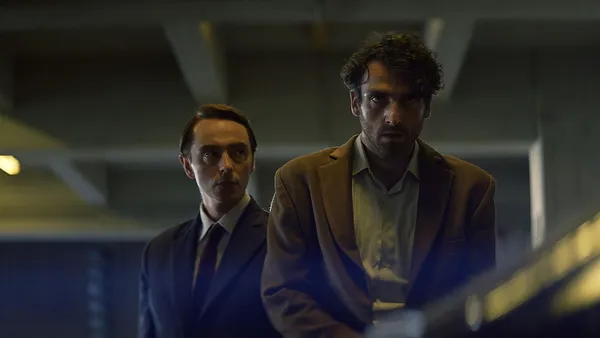
David Dawson as the Interregator and Arthur McBain as the Suspect in The Flaw. Director Theophilos Papastylianos: 'There is a height difference between Arthur and David. So, when you're going to frame, it is a challenge'
Photo: Courtesy of POFF
|
Dystopian thriller The Flaw, Antonis Samarakis’ novel of the same name, takes us into the world of the Regime, which sees a stark dividing line between those who are for it or against it. When a man, who will become referred to only as the Suspect (Arthur McBain), has what he claims is a chance encounter with a "dissident" at an art gallery, he finds himself under interrogation. After protesting his innocence, he is to be transported elsewhere, with the Regime tasking an Interrogator (David Dawson) with proving his guilt through a ruse that sees the pair of them make an unexpected trip to the beach and a funfair. Shot with precision by Greek debut director Theophilos Papastylianos, making the most of the brutalist architecture of Latvia, the film also stars Ralph Little in a much more serious role than normal, as one of the Regime’s operatives. The film premiered at Thessaloniki Film Festival in Greece before screening in the Baltic Cinema Competition at Tallinn Black Nights, where we caught up with the director to talk about symmetry, casting and colour.
Tell me about the symmetry in this film as it’s obviously something you were keen to employ right the way through it. It must have been quite challenging sometimes to maintain that.
TP: The most difficult part was the hotel room because we were shooting different scenes inside, so it's always a challenge because you don't want to repeat yourself in terms of shots, because it’s a limited space. For me and our DoP, that was the most challenging part. How can we frame and have interesting images and frames inside the hotel room that don't look the same? Actually, we were able to succeed in that.
Didn't you say in the Q&A at Thessaloniki Film Festival that the height difference between the two guys was sometimes tricky?
|
|
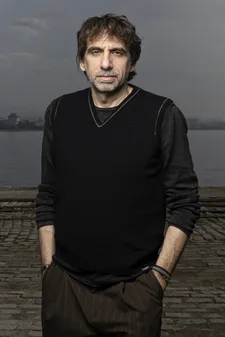
Theophilos Papastylianos: 'I believe that we make conscious choices that affect the subconscious of people'
Photo: Courtesy of Thessaloniki Film Festival/Studio Aris Rammos
|
It was a challenge, actually, because before finalising the cast, that went through my mind. There is a height difference between Arthur and David. So, when you're going to frame, it is a challenge. But the interesting thing for myself was, I thought, okay, so David, who's the Interrogator, and is this person of power and strength, is shorter than Arthur. And I said to myself, that would be so great. Work with him in such a way energy-wise, that we're going to make him taller, then get Arthur on the other side and just try to suppress his energy and make him shorter – and these two guys are going to meet in the middle.
That was an amazing process for me, bringing them down to a similar level, different energy, and then starting to play around with that.
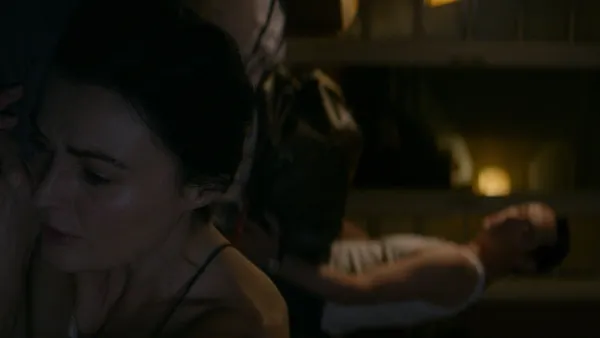
There's one shot in the film where you basically use what I can only describe as an extreme Dutch angle. I don't know what you want to call it, where the Interrogator’s wife is in bed and he is out of bed in their apartment. The whole thing is completely tilted by, I guess, 90 degrees.
TP: That was the plan about right from the start. When I was writing the scene, I knew I would shoot it like that because it has to do with the way I shoot and the way I like to work with films and my approach. I believe that we make conscious choices that affect the subconscious of people.
For me, having that shift in terms of framing creates a weird sensation for the audience. Right from the start, you have this crooked feeling, and it's actually the Interrogator's wife's perception of the relationship – that something is not working. And the camera is completely locked. So, this is her shot, but actually at the interrogation of the Suspect where he's actually looking at the camera again. It's exactly the same shot, and the camera is locked. The suspect is looking at the camera, like he's just talking to us, because both of them are prisoners in their own lives.
I suppose everybody is almost a prisoner in this world. You read the source book by Antonis Samarakis when you were quite you and it’s well-known book book in Greece. So, at what point did you start thinking, I'd really like to adapt it?Especially because it's well known, it’s tricky in terms of how much do you stick to the book and how much do you do your own thing?
TP: I think when I read the book again, after already being a director and a scriptwriter and working on different projects, I started to have a whole new perspective on the book that I couldn't have known as a teenager.
|
|
There is a height difference between Arthur and David. Theophilos Papastylianos: 'For me, having that shift in terms of framing creates a weird sensation for the audience. Right from the start, you have this crooked feeling'
Photo: Courtesy of POFF
|
The question for me is always, when you have an idea and you say, “I want to turn this thing into a film”, at the time you actually have this idea, it looks amazing and you're like, “Wow, this is a great idea”. But the question always is: after seven years, because that's how long it's going to take to reach theatres, is it still going to be up to date?
My instinct told me that, looking at the way the whole world is progressing and how society is moving, this book is going to become more and more up to date as the years go by. So that's how I ended up working on the book and making that decision to go forward.
I guess dictatorship and oppression is an evergreen subject, unfortunately, in the world.
TP: There is an oppression around us, even if it's happening on a subconscious level. For me, that's the most tricky part. When somebody is imposing a dictatorship on you through guns and curfews, you realise at a conscious level what has happened. So, after one year or two or three years, you're going to start to react to that.
But when everything is slowly getting into you and working on a subconscious level, and they're building a whole manifesto of how we should appear, how we should act, how we should live our lives, they actually affect us in a sense that we can't realise.
They're creating all these problems for us that have to do with survival. Sometimes you don't have the time to be political or to take a social stand against everything that is happening to you. We have digital fascism in a sense.
The whole Regime thing works actually as an allegory to my mind, to my soul, because each one of us, if you think about it, we're kind of like small regimes by ourselves.
The way we perceive the world is very biased, so we're blinded by our emotions, by what we think is good or bad. We don't leave space for other people to come into our lives. We judge them from the back.
Tell me about the casting. I think it’s particularly interesting that you cast Ralph Little, because in the UK he’s very associated with comedy and being a good guy?
TP: So now we're flipping the coin on Ralph, also. The way I cast, I really don't care about if somebody is categorised as a comedian or if the public and the audience know him for a specific type of character or portrait. For me, it's all about the casting process and the interview and casting session we do and he really nailed it.
And David Dawson, he seems to be rising to prominence more and more, probably even since you cast him?
TP: Yeah, that was a good call, huh? I hope he does great!
So, did you just basically have those traditional casting sessions for them? You didn't have anybody in mind when you were casting?
TP: We got in touch with Jeremy Zimmerman, the casting director in the UK. I sent him this script. He really loved that he wanted to work on it. We talked about it, and we started working on the descriptions that I had, and a few notes that I'd send him.
In this film, I actually sent him portraits from paintings, from Modigliani, for each character. I sent one that is for David, one that is for Ralph and one for the Interrogator’s writer. I didn’t use Modigliani for the Suspect, I can’t remember the name but it was another painter. I truly believe that painters, when they do a portrait, there’s a specific It's a combination of perception, paintings and descriptions and then I flew to the UK to get to meet the guys in person and I did a casting with them.
|
|
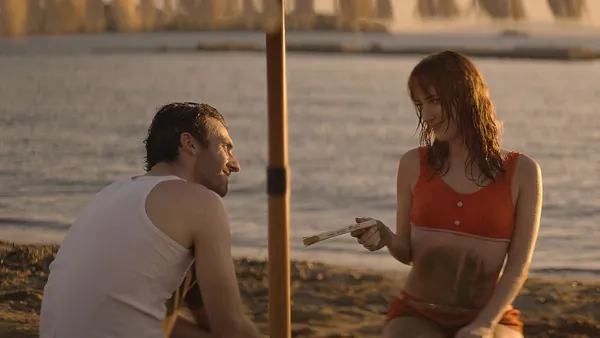
Arthur McBain and Georgia Small in The Flaw. Theophilos Papastylianos: 'She's the only character in the film that has nothing to do with the regime'
|
A funny story is, when I did a casting session with David about the Interrogator. I go to him, “David, do you mind if you do a scene as the suspect?"
He was like, "What? I worked on the part of the Interrogator" I said: "Yes, but one is the alter ego of the other and I would love to see you in a scene of the Suspect.”
He was like, “Okay”, and he nailed it. Right from the start, he nailed it. I was like, okay, so he can play the Interrogator but also he can play the Suspect. But it was a test for me because you need to see the qualities of the Suspect in the Interrogator. So the moment he nailed both of them, I thought, “Okay, this guy is fucking brilliant.” Arthur was great also – he had a great self-tape and then we met in person.
Let’s talk about the use of colour in the film. There isn’t a lot but then, on the beach, all of a sudden there’s this flood of colour. Also, it’s the one part where you have more than one female character at the same time.
TP: I love the fact that you actually mentioned it, because not a lot of people see it. What we did is, and this was my take on it, there's no red colour throughout the film. There's a reddish-orange tone in the scenes at the hotel at the end, with the neon lights and the rain.
But we stripped the film of the clear red colour because I wanted to have this red momentum in the film only through one of the girls on the bus. She's a redhead, her bathing suit is red – Georgia Small plays the part. She's the only character in the film that has nothing to do with the regime. All of a sudden, you see this persona here, full of red colours, and you're like, “Okay”.
Even the fairground is a little bit muted in terms of colour, although the energy is more chaotic
TP: It wasn't an easy choice, actually, to keep the aesthetics at a level that we were always happy with. It's a challenge to find the right locations because everything is changing so fast, and everything is becoming more colourful in our lives.
The brutalist architecture of Latvia helps a lot
TP: We had a great team in Riga in Latvia that really helped us out. But for me, it's all about the collaborations. It's so important to get people to work with you who can share the same vision with you and put their input towards that direction. Music was such a case for me. It was so important how the score would be built and how we would actually progress throughout the film. I was lucky enough because I got this guy, Dimitris Fessas, who wrote the music. This started years ago, because I was at this concert of a band called Citizen Jim. I met their lead singer and guitar player, who is Dimitris Fessas, and I had a short discussion with him and I really liked his energy.
So, when I was doing the film, I said, “Okay, let me get a script to this guy”. This was his first time writing a score, so it was a challenge for him. He started working on different pieces and presenting different pieces. I think he nailed it right from the start.
Watch the trailer below: