




|
|
Agnès
|
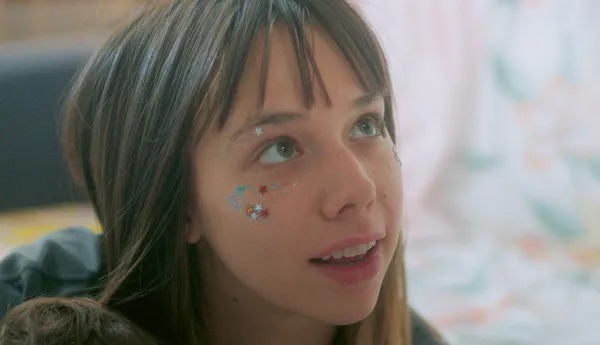
Agnès (Kim Higelin) is a child minder. She’s a French immigrant in the US, a terrible cook, a shy person just on the brink of attempting a more outgoing life, but at risk of losing it all when she gets caught up in a moment of random violence. Her story is a slice of life at a moment when everything hangs in the balance – and just before, as ordinary events pass by, destined to be etched in memory in spite of their individual smallness. It’s one of the finest short films in the running for the 2027 Oscars.
Surprisingly, Agnès is a début film. Nora Arnezeder has a well-established career as an actor but this is the first time she has sat in the director’s chair. After the film’ release, she embarked on a hectic festival tour at the same time as caring for a baby. I was delighted that we were able to find a spot in our schedules when we could meet to discuss the film, its myriad meanings and its origins.
“It was in 2014,” she begins. “I've been living in Los Angeles for 15 years, and I was preparing a party at my home, and I asked a friend of mine if she could stop at a grocery store to get some wine before heading to my place. On her way to the grocery store, there was a shooting in our local supermarket. I called my friend, and she said to me that she was literally five minutes away from the supermarket. It left me with such a weird, deep feeling that, you know, any decision you make can alter your life forever.
“When the terrorist attack at the Bataclan happened, my sister, she had a reservation at a restaurant, and she had to cancel because she had a toothache. The terrorists shot [in] the restaurant as well, and if she hadn't had her toothache, she would have been gone. So I really needed at that time to tell a story about how a decision can alter your life forever. It came from a feeling of fear as well. At that time, I was very scared to leave my home because of any attack that could happen, like a trauma.
“I do love to write things to heal myself, which is what I did. It took me some time to write the script, maybe six years, and then Caitlin Keats, my co writer, came on board, and the producers came on board, and we got it all together and we shot it.”
There are spoilers in this interview because it just isn’t possible to discuss it in depth any other way, but one of the things that I like about the film, I tell her, is that its opening scenes give us no clue as to what’s coming. It might go on to unfold in any number of ways.
“Yeah, yeah. That was very important. I could have told the story in very different ways. Five seconds or one minute in the house and then 15 minutes in the supermarket. But it was important for me to tell a mundane day in the life of a youngster. To me, it's the decision she makes before heading to the supermarket. that was interesting. What do you do? You wake up. It's like when I read on the news [about] people talking about their day before the massacre or the attack. I'm very touched, moved by those little details before the attack happened.
“So they wake up. What time do they wake up? Who do they call? Their last phone call. Are they having a coffee? Are they having a tea? At what time do they have their shower? And what time did they decide to go to this place where their life will change forever, or end? It was very important for me to tell that specific story about how mundane decisions can alter your life forever.”
I like how much we learn about who she is as well in that time, though, because the way she's looking after the children, she has to be able to cope with panicky situations. She has to be calm, she has to be organized. And so we learn all those important things about her early on. And then you have the little wraparound device with the star later on.
She nods. “Details are absolutely important in every movie, I feel. Details. Detail is what's making a movie, as well as the story. But these little details, like the ants, the star, these are something that we found last minute. I felt that there was a bigger picture, there was something to be told. The story is about gun violence, but there's also layers that needed to be told. The ants, for example. I needed ants. I woke up one morning. I didn't know why I needed them, but I felt it in my body, I felt it was needed for the story. It's very important to believe your instinct is always right, even though you don't know how to explain why.
“So we filmed. We got ants on set, during rehearsal. Like, my DP was there, and Kim, my wonderful actress, during rehearsal, she saw that some ants were drowning in the milk, and so she saved them, and I asked my DP to film that. That was a beautiful moment that we used in the short. And then the little star at the end – I didn't feel I had my ending. I felt that ending the short in the cold room with the massacre off screen was strong. Obviously it was. But I felt I had more stuff to tell, you know what I mean?
“I thought about it for days and days and days, and I was like, ‘I need to find another layer to my ending.’ And one day I woke up and I was like, ‘The little star!’ There's a link between the beginning and the end, and I think that link was important and the star meant something. What I love with messages that you don't need to come up with one message. You don't need to tell the audience how to think. This is not how I want to make my art. I want to. I want to tell several messages and I want the audience to decide for themselves. I don't know what you thought when you saw the little star at the end, what it meant to you, and I'd be interested to know, actually.”
I explain that as a critic I always have multiple interpretations in mind, because much like her, I don’t like to tell my readers what to think. To me personally, the star felt a little bit magical, and it revealed Agnès’ openness because when she agrees to let a child put it on her face, she shows us that she's ready to accept a bit of chaos and cope with whatever happens.
“I'm still thinking about what it meant, to be honest,” says Nora. “That's the beauty of making movies. You don't need to come up with it. You have several ideas, but there's no one answer. I love your thoughts on it. To me, it could mean different things, but it also, to me, it has a link to the ants, the star, which means that we're everything and nothing at the same time. We're the ants, we're the star. We're very small amongst the universe. The star means ‘Am I going to be a star?’ or ‘Am I just a star?’ Am I just very small and huge at the same time? It brings us back to our condition, I feel.”
I tell her that I liked the fact that when the ant is put outside on the railing, it meets another ant and it obviously recognizes the other ant or recognises its smell. This seems to talk about being an individual, but part of a larger community as well.”
“I love that,” she says. “That's really smart. Yeah, totally.”
In the earlier part of the film, we see Agnès making a cake, and everything is going wrong. That seems suggest that the film could spin off into a comedy.
“Life is a comedy,” Nora says. “Life is a comedy and a drama at the same time. I just wanted to film life the way it is. You know what I mean? I love, for example, the movie Life is Beautiful from Roberto Bellini, because it's not just black or white. It's not just drama or comedy. Within the drama you have moments of comedy, but it doesn't mean it's not deep. You know what I mean? It doesn't mean it's not tragic. So I just love life as it is. Life is very rich, and I love when movies mirror life.”
We talk about the film’s minor characters and how detailed and rounded they feel, though we see some of them for less than a minute.
“It was important for me to film these people as individual and being in the wrong place at the wrong time,” she explains, “but meeting my actors made me want to film them even more. In the beginning I wanted to stay in the POV of Agnes, but then my lens changed a little bit. So you're not always in the POV of Agnes. Sometimes you stay on people. That's something that I found when shooting. I was very inspired to film these beautiful faces that had so much to say in the eyes.
“Everyone has their story. We don't need to tell their story order to understand the feeling of their story, like the blonde girl at the cashier, and the cashier herself. I was very moved by them when I met them, and they inspired me.”
There's a moment when Agnès has left her flat, and then she realises the television is still on and just goes back to turn it off. I tell Nora that I thought that was a very strong character moment. She’s pleased and say that no-one else has mentioned it.
“This detail was very important for me. I'm an actress as well as a director, and these moments are so important to me because it's life, you know, it's life. As an actor, I love to get off frame and then come back into frame when you least expect it, because I forgot something. The messiness of life is what I want to see on screen. And for Agnès, the messiness of her life was important that we see on screen. But also maybe if she hadn't switched off the TV, maybe she would have gone to the supermarket earlier. Who knows what would have happened? Every second counts in your destiny, I feel, so that's basically what I wanted to tell.”
Having broken into directing, she already has more projects on the go.
“I'm writing a movie with my sister Léa Arnezeder and Ahmed Badawy, and Nolita Film is going to produce it. It’s a French movie set in Cannes, in the south of France, and it's a movie that's very personal and dear to my heart, inspired by the women from my family. And then I have another movie that I wrote in Los Angeles, a love story that's also very dear to my heart.”
In the meantime, there is the Oscar race to think about.
“It's wonderful.” She exhales, and her eyes sparkle. “It's wonderful. The fact that we won Santa Barbara is already incredible, and all the buzz around the short is really beautiful. I get to meet amazing people, very interesting people from different backgrounds. You know, we showed the film to a school, then we showed the film to inmates in prison and then we met people in the business who saw the short as well. I love having these conversations with people and I love meeting people that come from different backgrounds. The fact that Agnès is in the Oscar run gives you the opportunity to meet these people and it's wonderful. I love it. I could show Agnes for another year or two. I love, I love, I love this short and I love how people respond to it.”