




|
|
The Last Temptation Of Becky
|
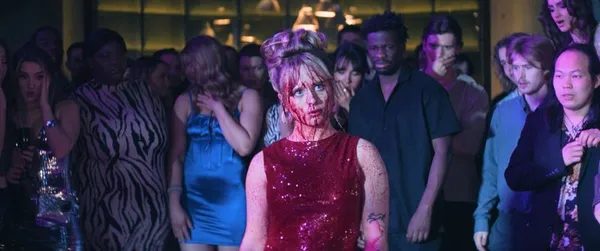
American producer and filmmaker Jenn Wexler takes the reins of The Last Temptation Of Becky, the third film in the series. Written by Matt Angel from a story he developed with Suzanne Coote, this latest film opens up the world from what has traditionally sat within the home invasion sub-genre in Becky and The Wrath Of Becky. Decidedly bigger in scope, The Last Temptation Of Becky mixes together the international spy thriller and revenge sub-genres.
18-year-old Becky Hooper (Lulu Wilson), the youngest CIA field agent, is tasked with infiltrating a family who run an inn on the site of Adolf Hitler's fabled bunker, The Wolf's Lair. There she discovers that Wilhelm Russ (Neil Patrick Harris), alongside his wife Helga (Catherine Walker) and their two children, Luisa (Aoife Hughes) and Otto (Noah Leggott), are plotting to raise the Fourth Reich. But as Becky sets about derailing their monstrous scheme, she discovers the true horror at its heart.
The Last Temptation Of Becky is the third feature Wexler has directed, following The Ranger, that blends a kids in the woods slasher with the art of Lisa Frank, and the 1970s boarding school, festive-set horror The Sacrifice Game. Wexler has also produced Mickey Keating’s Darling and Psychopaths, Robert Mockler’s Like Me, and Larry Fessenden's Depraved.
In conversation with Eye For Film, Wexler discussed her intense imagination and yoyoing between her introverted and extroverted personalities. She also reflected on the spiritual alignment of her directorial work, getting to be wild with The Last Temptation Of Becky, and having a hole carved in her skull — metaphorically speaking.
This interview contains minor spoilers.
Paul Risker: How would you describe your relationship to cinema, not necessarily on a professional level but on a personal one?
Jenn Wexler: I started having an intense relationship with stories in film and on TV when I was very young, especially horror. It goes back to when I was four or five years old, and to the TV show Are You Afraid of the Dark? In the US it was a Nickelodeon TV show. I became obsessed with it and that was my entry point into the genre.
Then in my pre-teen years I moved schools. I was in this new town, I didn't know anybody and I had a lot of social anxiety. So, horror movies became like a best friend.
From there I just became obsessed with film in general, but specifically horror. There was something about the feeling that if the ‘final girl’ can survive all the attacks by the serial killer who has killed all her friends, and she's able to take him down, then I can go back to school tomorrow. Horror became an inspiration.
PR: Imagination can help to steer us through some of our darkest days. It can allow us to build worlds inside our minds to escape to or project ourselves. This forms an unbreakable bond with cinema.
JW: I had an intense imagination when I was young, which I continue to have. I think it's beneficial to me now as a filmmaker, but when I was young, after the movies ended, I'd keep imagining that I was in them.
Narrative is so influential to us and given that it can have such an effect on our psyches, especially a young person's, it's important to consider what stories are being told and what we are sharing with the next generation.
PR: Being a creatively driven person, is storytelling and filmmaking as natural to you as breathing?
JW: Yes, I instinctively think in those terms most of the time. If I go somewhere on vacation, my brain will still be asking: ‘How could this be a movie?’ And I have had moments where, because it can be hard to get movies made, for just a second, I might think, ‘Well, maybe I'll just stop or pause.’ But then it’s immediately like, ‘No, this is who you are. You’re most happy when you're making stuff.’
PR: Would you class yourself as an introvert or an extrovert, and how does that nature fit with the different parts of the filmmaking process?
JW: I'm a mix of an introvert and extrovert. When I spend too much time alone, I crave being around people. When I get too much of one, I want the other. So, it goes back and forth, which is one of the reasons why I love filmmaking – it’s a mix of both.
When you're writing a script, you're very introverted, and because directing is all about constant communication, when you're in prep and in production, you have to be extroverted. Then, when you’re editing, you’re back to being an introvert. Then during the film festival circuit and the release, you go back to being an extrovert. So, it all works pretty naturally with my personality cycle.
PR: Speaking with producer Thomas Bond, he told me: "… For any first-time filmmaker, one thing that I can't recommend enough is to hire an editor. If you are a first-time director, do everything you can to avoid editing it yourself. You need that second pair of fresh eyes — someone who doesn't come to the movie with these preconceived notions of what they think it is based on the script. And you will find so many new avenues to tell the story in the best way possible." As someone that has produced, written, directed, and edited, I'd be curious to ask for your thoughts on the pros and cons of a director editing their own film?
JW: I think there are things about directing you can only learn by editing. On The Ranger, I had produced several features before I directed, and I thought I knew what directing was all about. I got into the edit, and it was just me and my footage, and I had to face it and make a movie out of it. And the process of being by myself, working through it over a couple of months, taught me even more about filmmaking. I would not have had the experience of that education had I immediately started working with an editor.
Then, when I felt I'd gotten The Ranger to a pretty good place, I wanted a more experienced editor to come in at that point. My friend Abbey Killheffer, a commercial editor (who also was our key grip on The Ranger) came on as co-editor. It was really nice to say to Abbey, "Here's the cut; we're on our way, but we're not there yet." Having her eye to really finesse the cut was invaluable, but the initial experience of cutting it together and facing what I had done on the film made me a stronger filmmaker. And I brought all that experience to my second film, The Sacrifice Game.
With every movie I make, whether I'm producing or directing, I feel like someone's carved a hole in my skull and poured more knowledge into it. On The Sacrifice Game, I worked with editors Arthur Tarnowski and Mathieu Bérubé, and learnt so much from them, which I then brought to The Last Temptation Of Becky. Then, working with Janna Emig, our editor on Becky, I learnt so much about her process.
PR: To bring the conversation around to The Last Temptation Of Becky, can you remember your impressions when you saw the first film? And what were your feelings about taking the reins for the third instalment?
JW: Becky came out during the pandemic and played drive-in movie theatres, as indoor theatres weren’t an option. I don't live near a drive-in, but I remember at the time people were talking about it, and I was able to watch it when it later hit streaming. When I first saw it, I thought it was a really cool and fun Home Alone-like twist on classic home invasion movies. And I like that it feels a little gritty and serious with these deeply emotional moments.
Lulu as Becky was amazing. She had to play a huge range of emotions, and she was only 13 years old. Kevin James was excellent too and very scary. It was cool to see him in that kind of role.
This is an established franchise, and coming onto Last Temptation, I wanted to do justice as much as possible to what's come before to help deliver it home, which is obviously a different approach than when you write a new story from scratch.
The Last Temptation Of Becky is playing with a couple of different genres: an international spy thriller, but also a revenge movie. This is really cool because we have a lot of revenge movies that are from the perspective of a middle-aged man, but we don't often get to see it from a young female perspective. And I've always been interested in young female characters who find the courage to stand up to darker forces.
PR: Is that a thread running through The Ranger, The Sacrifice Game, and now, The Last Temptation Of Becky?
JW: I think they're all spiritually aligned in that way. It was cool that the Becky producers, Chadd Harbold and Russ Posternak, recognised that thread in my first two films and thought to bring me onto this.
PR: Becky is clearly a character that is traumatised by the loss of her parents and the violence that has intruded on her adolescence. She's almost a child stuck in an adult body in this film. These darker tones, however, are juxtaposed with a strong sense of humour.
JW: Her normal teen-hood experience was stolen from her when she was 13 years old, and she’s stuck in that moment, replaying it over and over again. Yes, she's “the youngest agent in the CIA", but she's also missed out on the fun of adolescence — she didn't get to go to prom, go on a date or have her first romantic relationship. We don't really get to see her with friends her own age. Instead, she has been pushed into these extreme situations, and so, what does that do to a person?
Of course, there's the fun of the movie that we want everybody to experience — humour, wild fights, big deaths — but on a character level, some of what Lulu and I talked about were things like how Becky deeply wants connection and a family. I like to think of her CIA colleagues at the beginning of the movie as being a pseudo-family. Then she starts to discover some of them aren't exactly who she thought they were. I also like to think about Luisa, the daughter of Wilhelm and Helga, whom she has the sword fight with, as a sort of 'Dark Becky'. She has everything that Becky doesn't have – a stable family (even though they happen to be Nazis threatening to launch The Fourth Reich.) During the sword fight when Becky takes her out, it's not just because Luisa is this bad Nazi character, but Becky also resents her for having everything she has lost.
PR: Becky is a character who keeps everything bottled up, and the theme of trauma is very much present. She has obviously put up these walls to protect herself, which she reveals when she says she's never really tried to make friends. Of course, we know she's deceiving herself, which comes from a place of vulnerability and fear.
JW: The beautiful stuff we're playing with here, that we get to dig into, is the conflicting energy inside of her. She wants connection but doesn't want to admit it. She justifies everything because of what happened to her and her family.
PR: One of the fun things about genre cinema is mixing humour in with the more serious tones. This can make the serious tones more relatable and accessible, and it's a complement to throw the word 'bonkers' at the film.
JW: Well, even if you're being silly, or you're tonally having a lot of fun, my favourite movies are the ones that have a darker subtext underneath that the characters are grappling with.
Sometimes you have to approach a serious topic through humour. And the premise of this film and where it goes is bonkers. And that was really fun for all of us because it meant we got to be wild with it.
PR: And perhaps the film is a response to the wild reality of the world right now. If we're honest, we might have laughed had someone twenty years ago described what we're now living through.
JW: It's the sad and absurd horror of our times.
PR: Do you see The Last Temptation Of Becky as a political film?
JW: I think all movies are political. Even if you watch a movie and it does not seem at all political, only pure escapism, that in itself is political.
PR: I can't recall who it was who said to me that if you give actors a good script, it empowers them to do a lot of the work for you. And the cast in The Last Temptation Of Becky know how to layer the different tones of the movie with nuance, while being bigger than life and feeding the escapist tones.
JW: Well, something that's fun about all the Becky movies is that each one has a cool ensemble cast, especially in terms of the ensemble of bad guys. And then for this film, we really lucked out. The cast is stacked, everybody is so talented and they’re all bringing their A-game.
PR: I'm thinking about how Billy Wilder's sets were run, where the actors couldn't change a word or a line of dialogue. And I've heard filmmakers say filmmaking is not a democracy. You choose to lean into the collaborative nature of the process and remain fluid, allowing different ideas to shape the film. So, the culture on the set of each film is a conscious choice, led by you, the director.
JW: I love filmmaking because it really feels like a bunch of people all come together and lend their individual superpowers to the endeavour. As a director, my job is to make sure we're all making the same movie. I have different techniques for how I do that in terms of the references I mention or the lookbooks I create to get everybody on the same page. But once we're all going in the same direction, it's beautiful to hear everybody's ideas. After all, we're so different, we each have our own individual experiences, and you just don't know what amazing magic is going to come from where. Watching talented artists, in front of and behind the camera, take an idea and turn it into something great, that’s such a joy.
The Last Temptation Of Becky screened at the 2026 editions of Fantasia and London FrightFest. It is released theatrically in the US on 4 November, with a UK release to follow in 2027 courtesy of Signature Entertainment.