




|
|
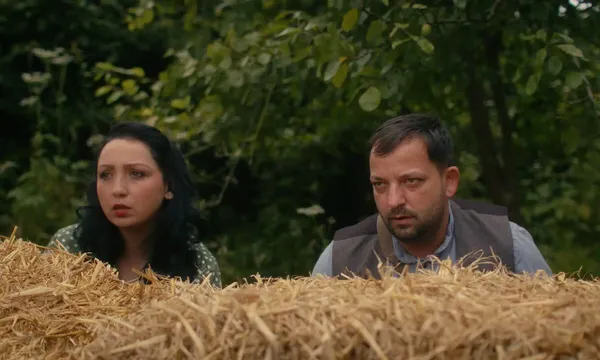
Katarina Kokenyova and Ladislav Billo in Rozkvet
|
A World War Two set drama following the story of a Roma translator captured by the Nazis, Rozkvet is screening at this year’s Belfast Film Festival. It was originally written by the city’s own Andrew McNeill, who also stars in it as interrogator Engel, whilst Katarina Kokenyova plays the heroine, Erika, and Thomas Pollack directs. Shortly before the festival began, all three joined me for a conversation about the project and about the urgency of telling Roma stories after 80 years in which they have been treated as a footnote.
“It goes back even further than that,” says Andrew, when I ask him about the play. “It was originally a short film script that I'd written. It's only about 15 pages long, really. Just the central scene of the interrogation. I put it away for a bit, but then we resurrected it for the first time that we were doing it as a theatre company. It actually worked quite well because a lot of it is just set in one room. That was around about 50 minutes long. We did that in the summer of 2023.
“I was very happy with it. I had no intention of doing it as a film. That was Thomas, and our producer Larry [Cowan]. They came along to see the play, which was just the three central characters, and they said ‘You know what? We think this would actually work really well as a film.’ I just gave it a go. It all fell together very nicely, actually. I definitely think the film was the right way to go with it as a story. I just had to do so much more with it, to flesh it out a lot.”
I ask Thomas how he went about making it cinematic again.
“Obviously, with the play, it was very contained. Some things that work well in theatre might not necessarily work in film, so the challenge there was making sure it doesn't look too theatrical. I think that carries through with really strong performances, being clever with the angles. But I think once Andrew fleshed the film out, it was not as noticeable. Even when you are in the room for a certain amount of time, it's never boring. I think my approach to that was just making sure things didn't look repetitive, didn't look flat, so for me the challenge was keeping that engaging from a film standpoint.
“Obviously we’re working at the lower budget end of stuff. We kept that in mind when writing it as well. Nothing too big, no mad explosions and tanks coming into stuff, but at the same time keeping it character focused. But we didn't compromise on the quality of what's in front of the frame in terms of production and the sets. We know that it's a unique story to begin with, but we didn't just want to make it like a typical low budget war drama. I think that comes across, just being very smart with some of the set pieces, like we filmed in the Ulster American Folk Park, for instance.
“I think we made full use of what we had there, and I think putting our stamp on it really came down to paying homage to Seventies Soviet cinema, which is one of my influences. I'm going for a bit of an old fashioned style of filmmaking. You know, it's not super rapid cuts and stuff. I went for something a little bit more old fashioned and cinematic, but not boring.”
I ask Andrew if the story of the Roma experience was close to his heart when he was writing.
“Definitely, yeah,” he says. “I remember being back in school studying about this time period and they only ever got a one line mention in the textbook. Just as a throwaway that the Nazis also oppressed – and it just listed out all of the other different groups of people, so the Roma, the homosexuals, Jehovah's witnesses, socialists, communists. That was it. That was all I ever knew about it until Katarina. I'm just getting to learn more about her family. They’re people who've been through this.
“I thought, no-one knows about this, and the Roma are still so oppressed throughout Europe. You know, we see it here in Belfast and Northern Ireland. Where I live, for instance, we've seen that a couple years in a row. So that stuff's still going. I think it's really important to delve into the historical context of this. These people have gone through terrible persecution and I think it's about time that they get to tell their story.
“I would never have tried to do this on my own. It was only through having that connection with Katarina, her family and all. I was always able to come back and ask questions and say ‘Is this alright? Can you give me a little bit of cultural knowledge here?’ I mean, certain sorts of beliefs and opinions that these people would have held at that time.”
Katarina had a lot to carry on her shoulders, representing so many people who have been denied the opportunity to express themselves.
“It was scary,” she says. “I'm not going to lie. I was very scared. But also I feel very honoured that I was able to bring this story to life and, finally, to tell a story about us from us. Not just other people telling our stories and misrepresenting us. It's actually us that are in the driving seat, and are able to tell the story the way we want to tell it.”
I ask if she feels comfortable discussing her personal background and how it relates to this. She says yes, but hesitates for a moment, unsure where to start.
“It's a lot, basically, as I grew up in Slovakia and, yeah, since I was young, I came across so much segregation and racism. When you're a little child, you don't really understand why you're different or why people are looking at you differently. In my eyes, you know, I went to the same school as my non-Roma friends. I wore the same clothes my friends were wearing. We lived in the same apartment complex as my classmates, but then still I was singled out many times. It happened with so many of my Roma family and friends.
“When you start school, when you're at such a young age, you do not understand, because obviously your parents will try to shield you as much as they can – but for instance, there were teachers who were saying ‘All the Roma students, stand up, ‘ and you had to stand up, and you saw all the other children just looking at you. And they were instances when they said ‘Oh, I'm not going to sit on that chair because the gypsies sat there.’ But not all of the people around me were like that. I had some incredible teachers in my life who really helped me come out of my shell.
“You carry this kind of born shame in you. That's what the world made me personally feel: that I need to be ashamed of who I am. It's like you have to just hide and be in a corner. But I had some really great teachers who really brought me out of my shell and encouraged me to step up.
“First of all, I approached Erika just as a human being. If you strip everything away, at the end of the day she is just a mother who wants to protect her child, and I think that's why this story is so beautiful, because it's not so heavily historical or like a typical war movie. It's really very character driven. You get to see and meet so many different characters throughout this story, and every single one was brought up in different circumstances, with different belief systems. I think the film explores it so cleverly because you get to see how they think so differently. And then some of them get challenged and you get to see if they have the courage to actually change their beliefs and step up, or just stay in those old beliefs that they were brought up in.”
How was it for Andrew, getting into a character that he'd written?
“Yeah, a Nazi, no less, as well,” he says. “To me as an actor, when I was writing the short play to begin with, it was just an exercise to try and understand what would attract everyday people to this. Because you talk about approaching that, even a character like that as an actor, you have to approach that as he doesn't know what he's doing. Terrible as he might be, as awful as the things he believes and does are, I need to see the word through his eyes here and just try and do this justice.
“That, to me, is much scarier. The fact is that a lot of these people did these terrible things and continue to do them in many places throughout the world. They are just people, they're people with families. People in Germany, they were very respected citizens in their local communities and just seemed like absolute stand up people. And then they go off to parts of Eastern Europe or France or wherever it was and just do these absolutely terrible things because they genuinely believed that these things needed to be done for their Reich or their people and families to survive. That's the poison of fascism and Nazism.
“The truth of it actually terrified me more than I thought it ever would, to be honest with you. But I'm very glad of that. The thing I love about being an actor is getting to see the world through other eyes and understand certain things that you may not have otherwise been able to.”
Without going into spoiler territory, he’s a character who has had a tragic experience of his own.
“Yeah, it makes you understand why he does the things he does, but it doesn't justify them. You know what I mean? He justifies this to himself, but without spoiling anything, I think when you're referring to there's a point in his life prior to the events of the film which he could have turned his back on what he believes and he could have went against it. He could have stood up and maybe done something to try and redeem himself, to try and make things better. But he actually I've seen this many times as well in life where he's like, ‘No, I've gone too far. I have to double down. Some of these bad things that happen, they have to be worth it. I cannot change what has happened, so I have to just keep following the course and make it worthwhile. That's what gives him that real single minded determination to follow orders and achieve his mission and win the war. That's his goal.”
It’s a film heavily focused on the performances. Thomas explains that he didn’t feel he needed to do much in that regard.
“Andrew, Katarina and Richard [McFerran], who are all in the film, they all did that on stage, so they had already been in that mindspace, which was very helpful. These guys understand their characters better than I could, especially Katarina. I wanted her ideas. I like to be quite hands off with things like that and let them develop that. And then obviously with some of the other actors, who were non-actors – and honestly you would never know – obviously they were given a bit more guidance that was more about just making them comfortable on set, and then just letting it play.”
Katarina hopes that the film will help to change attitudes towards Roma people.
“I think there's still such little awareness, and kind of a prejudice towards the Roma people,” she says. “If you look in the media, even to this day, whenever you see Roma representation it's either a caricature or just showing these people in the worst light possible. Everybody seems to think that Roma people are illiterate or they're criminals or dirty, you know? So I just really hope that they are going to see us just as human beings, and just the same as any of them.
She would like to see more films set in the present day tackling these issues as well, she adds.
“I think it's starting to pick up. I haven't had the chance to see all the films, but I mean, there is one that was even in the Venice Film Festival. It was done by a Romanian Roma actress and director. It's called I Matter and I just really hope I will get the chance to see it someday.”
“I'm very excited for the festival at the minute,” says Thomas. “I'm developing stuff to try and shoot locally, and then a few other films. One's actually set in Romania as well. That’s what I'm developing at the minute with Larry. There's one we want to do about two former boxers who had a feud during the Nineties. It's a revenge thriller, basically. I can't wait to see all the other independent films at the festival. We actually did a little launch last week with all the filmmakers in that category and it went really well.”
“I'm working on a couple of plays at the minute,” says Andrew. “I'm well in the development of a one man show, and I've done a 15 minute version of development of the longer play. It's centred in the First World War this time around, but it's based on a true story about a young fellow from Belfast who was put in front of a firing squad under dubious circumstances. It's about working class exploitation during wartime, and the power of resistance against evil really.
“Then we are hoping to do a play at some point about what it's like for some people in other countries from a Roma background. That'll also hopefully be sent in the past as well. I like setting stuff in the past because I think it's a great way to discuss contemporary issues in a less sort of on the nose way. You know, ironically, being so specific about a time and place can actually make a more universal story, I think. So once I finish writing, we hope to get stuck into that one.”