 |
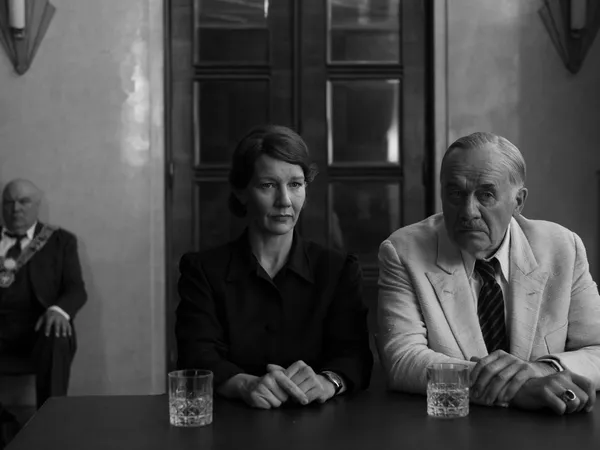
| Sandra Hüller and Hanns Zischler in Fatherland Photo: Courtesy of Cannes Film Festival/MUBI |
The relationship between the German writer Thomas Mann (Hanns Zischler) and his daughter Erika (Sandra Hüller) is elegantly and movingly explored in Paweł Pawlikowski's Cannes Best Director winner. The pair embark on a journey across both the Allied-controlled West Germany and Soviet-run East of the country, with Thomas to receive Goethe accolades in both places. It may have a running time of less than 90 minutes - something of a rarity these days - but it is constructed like a precision timepiece, from the meticulous black and white mise en scene that emphasises the pair amid the post-war framework to the magnetic performances from Zischler and Hüller. There are many fleeting pleasures too, including Cold War star Joanna Kulig in a memorable jazz singer cameo.
Beth de Araújo takes us inside the anatomy of childhood trauma in her gripping drama. A regular run in the park for eight-year-old Josephine (Mason Reeves) and her dad Damien (Channing Tatum) ends in the little girl witnessing a brutal rape by a male stranger. De Araújo shows how near-impossible it is for Josephine to process what she has seen, given that she doesn't even know what the term "rape" means. While she may not be able to verbally articulate the trauma, we see it manifest in other ways, including the spectre of the rapist, which we see simply intruding into her every day life, by sitting on her bed or just hanging out in the same space as her - a device that is isn't played in traditional horror fashion and is all the more chilling because of that. A carefully exercise in shifting perspective that was a deserving winner of Sundance's US Dramatic Competition Grand Jury prize.
Jennie Kermode writes: In the eyes of the general public, there is nothing more monstrous a woman can do than fail to love her child. Hanna Bergholm's Nightborn, whose star Seidi Haarla deservedly won the Cheval Noir for Best Actress at Fantasia this year, mingles themes of postpartum psychosis and ancient folklore in the story of a Finnish woman and her English husband whose lives begin to fall apart after their son is born. It deals in blunt, unsentimental terms with the aftermath of pregnancy, contrasting society's sunny ideals with the bloody reality of what protagonist Saga is going through. Increasingly feeling like an outcast, and increasingly isolated as her relationship with her husband disintegrates, she must confront not only her terrors about the baby but also a long dormant side of herself. Set in a charming little house in the forest and shot like a fairy tale, this is by turns beguiling and difficult to watch; it's also a film which many women will feel relieved to see.
Edin Custo writes: To Hold a Mountain relies on a careful balance between the political and the personal. On one side is Gara’s fight against a NATO base being built on Sinjajevina, a pristine Montenegrin mountain of untouched pastures where people still live tethered to the customs of their ancestors. On the other is the family trauma that has shaped Gara and her 13-year-old daughter Nada, revealed as they return each year to their ancestral pastures at 2,000 meters once the snow thaws. With beautiful cinematography of the mountain Gara refers to as Mother, the documentary feels both comforting and new, framing its heroes as ordinary people who bear the evidence of hard lives lived in the wrinkles on their faces.
Julian
I'd put money on this vibrant animation from Louise Bagnall making a strong showing this awards season. Her heartwarming debut expands on the book Julián Is A Mermaid by Jessica Love to follow a few weeks in summer that Julián spends with his Dominican Abuela in Brooklyn. Julian's approach to life is extrovert and creative, something his gran isn't too sure about at the start. Soon he's finding new friends and becoming part of “Team Mer”, as he plans a mermaid costume for a big event. Along the way a little blue sprite called Luna helps Julian to express himself and unlock his feelings, while his Abuela also starts to find her life transformed. A film all about having the confidence to be yourself, Bagnall told us: "He's not thinking about any labels, he's just thinking, ‘Oh, I love this thing, and I'd love to try that, I wonder what that is over there’. So I think it’s more of an authentic and more organic exploration."
I See Buildings Fall Like Lightning
Oli's (Jay Lycurgo), Rian (Joe Cole), Patrick (Anthony Boyle), Conor (Daryle McCormack) and Shiv (Lola Petticrew) are long-time friends from a working-class neighbourhood in Birmingham who are all hitting their thirties. We can immediately see how tight their are in the kinetic opening of Clio Barnard's latest, which thrusts us into the middle of a birthday party as they sing along to The Streets’ Don't Mug Yourself. The buildings of the title, were demolished when they were kids but the hope promised afterwards hasn't materialised. Barnard's gripping drama charts the group's stories, from the one who got out (sort of) to the one dealing drugs and others raising a family. A film about keeping going and keeping your friends going too.
Surely one of the most distinctive films you'll see in terms of style at this year's festival with Rafael Manuel using locked off and highly choreographed shots to create something rich and strange. His pitch black comedy tracks teenager Isabel (Jorrybell Agoto), who is a new hire at a sprawling golf club. The film draws its battle lines between the elite who play their golf there and who are living in a sort of rarefied continual present, where food is always out to eat and water spritzers are never turned off. The plot, such as it is, revolves around Isabel trying to deliver a golf club to the president Dr Palanca (Teroy Guzman) but its the satire of this type of existence that drives the film.