 |
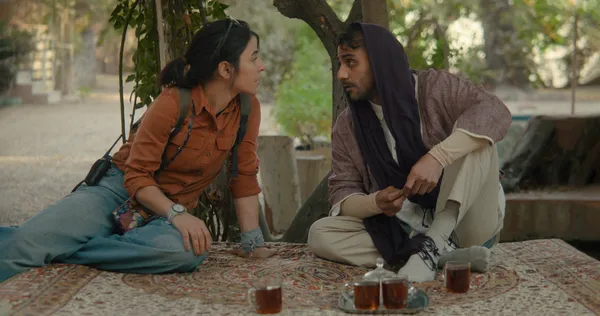
| Gender roles are flipped in Head To Head Photo: Courtesy of TIFF |
When one (Naderi) starts to rebel, and the shoot goes south, Golmakani is able to explore ideas around the corrupting effect of power, and revenge and solidarity. The writer/director, who is currently based in Germany, says she was partially inspired by her film studies in France to tackle the subject.
“During the analysis I was doing for my studies, I was bothered was seen during this analysis, by a lot of misogynistic scenes in the films, and this is not something which is imposed on us by government or whatever. It is the choice of a filmmaker and [I thought] why are actors playing in these scenes and why women are not saying anything about that.
“First of all I had a kind of feeling of [wanting] revenge about that and I thought, how can I invite them to put themselves in women's shoes? And, for sure, the easiest way is to ask them to dress like women. Because it's difficult, it's complex, and it makes them understand a lot of things. I thought to make it on a film shoot because this idea came out of films themselves.”
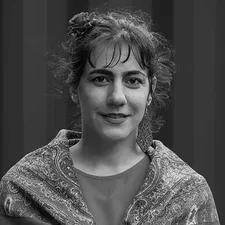 |
| Ghasideh Golmakani: 'I love making films in Iran, because when I get out of my apartment into the street, I walk only ten minutes and I am inspired' Photo: Courtesy of TIFF |
“It's a bit like children when they are small, and they are beaten by their parents,” says Golmakani, “When they are older, they are searching again for partners who beat them. I wanted to show that this power game is reproducing itself, and at some point, someone should break it and stop it. That's why, the film finishes as it does, otherwise, there would be an imbalance between them [the two main characters].
Another thing Head To Head has in common with Just An Accident is cinematographer Amin Jafari, whose CV also includes Panahi’s film-within-a-film drama No Bears and Panah Panahi’s Hit The Road. Within the film, he adopts two shooting styles, a straightforward one for Golmakani’s film and, for the embedded film, handheld camera.
Golmakani says: “I was very lucky to work with him already on two of my short films, and it was great because we have the same taste for images and compositions. He is a great master of low budget films in Iran, and he has a good eye, but he is also very human to work with.”
She praises him for being able to work without a lot of lights and in lower scale productions, adding: “We worked together on the script. First, we decided we should have two different textures – one handheld, one on the tripod. It went very fast because we have the same taste, and we are talking on the same level, but I owe him really a big thank you, because I think what we see now on the screen is a big part due to his professionalism and experience.”
Golmakani also incorporates snippets from other films within Head To Head, often to illustrate the restrictions placed on women she is skewering. She says it was easy to choose the selection because of her PhD studies.
Referring to dancing scenes in which the men move but the women, she says they occur frequently in Iranian domestic cinema, even if we don’t tend to see those films internationally. She adds: “They are mostly in films for an Iranian audience, like popcorn comedies and suchlike, so I was trying to find the most obvious one to make the audience understand what I want to say exactly.”
One film that is directly referenced is Asghar Farhadi’s About Elly.
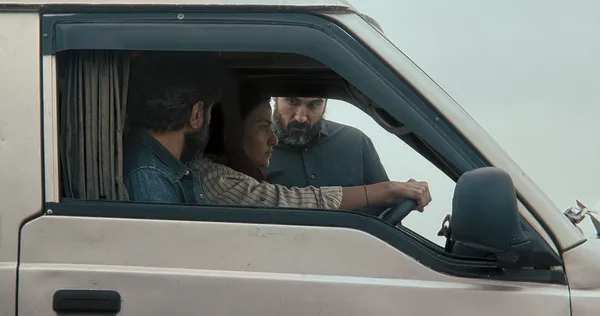 |
| Head To Head. Ghasideh Golmakani said making men wear head scarves is 'complex, and it makes them understand a lot of things' Photo: Arsam Zamani |
She adds: “That's why we have this scene in the film that has a woman in water. They are completely dressed. For a long time, we also didn't show naked men in the Iranian films, but lately, they are starting to show it. But I'm asking myself why male actors are accepting to play such films? I am asking this question of our colleagues.”
The film was shot in Tehran and in the desert not far from the Iranian capital.
Golmakani says: “I would have liked to go somewhere a bit further, in the central part of Iran, but production-wise was not possible for me because it's a completely self-funded film, so I have very little amount of money.”
The filmmaker says she has no problem travelling too and from Iran. She adds: “For the moment I don’t have any problems, I go very often there and back. Film shooting everywhere is complex and in Iran it is more complex, but I was lucky to have a great cast and crew who were a very small group. So we didn't make much noise. We just did our work, and then when I finished, I just left the country. It went smoothly with not many problems, to be honest.”
As Golmakani describes the casting of the male actors, it sounds as though the auditions process was quite an eye-opener for them.
“It was very funny,” she recalls “Actually, the casting process itself could become a film because when they were sitting in front of me, the first thing I did was give them a scarf and ask them to wear it, and we were filming it. It was very interesting to see how they handled this headscarf. Most of them didn't know how to put it on, and it was funny because they all have sisters, mothers, wives, and I mean they are living in this society. So already, taking the scarf in their hands was showing how much they don't have an understanding about women's conditions. Then during the whole rehearsal. Yeah, I asked them to keep their scarf on their head.
“At the beginning, they were very uncomfortable. It was warm. They didn't know how to do it and everything, but at some point, it became part of them. I think they were interested to play this role because it's kind of different from most of the Iranian films we are used to seeing, and I think actors are interested in challenges.”
Another key member of the cast is Lili Farhadpour, who found international acclaim with My Favourite Cake, and who has a small but significant cameo.
“I worked with her in another short film of mine previously and I love how easy going she is in general as an actress,” says the director. “Initially, she's a journalist and a writer. While I was writing, I had her in my mind somehow. I wrote this for her hoping that she would accept to play it because I heard that she's not playing any more for the moment because she's writing her new book. Then I met her and I asked, and she said, ‘I will do it for you’. I was just lucky, I can say, because I wrote it for her.
The filmmaker doesn’t want to be drawn on the current situation in Iran, noting the situation is “very complicated” but adding that as she doesn’t live there at the moment she can’t comment on it. “I'm not the right person to talk about it to be honest,” she says.
Looking to her future films she says: “I love making films in Iran, because when I get out of my apartment into the street, I walk only ten minutes and I am inspired and can have ten ideas for films, because it’s a funny country and funny people.
“But my next project is happening in Hamburg. It’s about a German Iranian couple. It's also a dark comedy showing the clash of different cultural differences between couples, because we have a lot of Iranian immigrants who are living with other nations. I think in any case I will, no matter where – Germany, Iran, America – continue with comedy because I think nowadays life is so harsh and I would be happy to offer a bit of love to the audience.”