





|
|
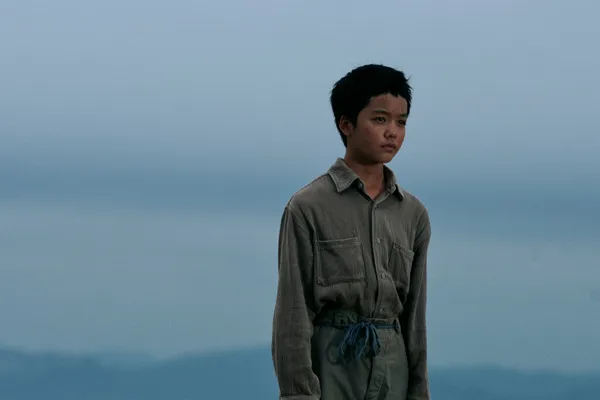
Kotoko (Ami Koyae) poses as a boy in Children Untold. On casting Koyae, director Miwa Nishikawa says: 'The reason why I chose her is that she had this really strong will'
Photo: K2 Pictures
|
The latest film from Japanese filmmaker Miwa Nishikawa follows the turbulent life of a 12-year-old girl, Kotoko (Ami Koyae), who is orphaned during the Second World War. Children Untold charts what happens next as she finds herself on the street, first shining shoes for money before realising her best chance of survival is to pose as a boy. After cutting her hair, she falls in with a group of fellow street kids who are under the wing of a local yakuza. That just marks the start of Kotoko’s battle against what life throws at her.
In a subplot, Nishikawa also charts what happens to Kotoko’s former teacher (Fumi Nikaidô), who finds herself struggling to get by with a newborn after her fiancé is killed in the war.
Nishikawa latest film opened the Platform competition at Toronto Film Festival and we caught with the director to chat about it.

|
|
Miwa Nishikawa
|
What research did you do for this project?
Miwa Nishikawa: Research on the war orphans is quite scarce because not many people came out to talk about their experience. But after the year 2000 a few books and pieces of research became available. I also met a few women and had some research with them as well.
Your film notes there were 120,000 children in Japan orphaned by war, is this something of a forgotten history? And why do you think it has been forgotten?
MN: I’m with you, I was always wondering why it’s forgotten. The number 120, 000 isn't really right, actually. It's probably over 200,000 including the orphans from the Okinawa War and the orphans who came back from China, so it’s not a very accurate number. I guess there are so many reasons for it being forgotten, the first being that it was quite a turbulent time in Japan in that period. Then those orphans didn’t have any way to tell people what they were suffering so I think that’s one of the big reasons we don’t know much about it. Not all the children who lost their parents became street orphans, some went to live with relatives so the number includes all of them not just the street orphans.
The costume design is notable, especially the bright clothes we see Kotoko in initially. How did you decide on that colour palette and how you wanted to use it?
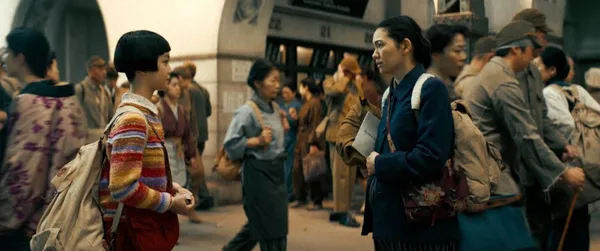
MN: It was a really poor era in Japan after the war and most of the directors who have made films about that time use quite a lot of tamed colour. I really wanted to reach a wider audience including all ages. So if I depict it with a dark colour and a gloomy atmosphere, that won’t work and I probably won’t reach a wider audience. So with the DoP and the lighting, I tried to make it brighter so I’m pleased that you could see that. In Martin Scorsese’s Hugo, I really like the use of colour there. So I chose to use quite bright colours intentionally in this film but 90 years ago, before the war broke out, I’m sure they were wearing something a lot brighter in in Japan as well. But when the war happened, wearing bright coloured clothing was frowned upon so maybe they hid these clothes and wore dark clothing about that time.
|
|
Kotoko (Ami Koyae) and her teacher (Fumi Nikaidô) in Children Untold. 'I really wanted to reach a wider audience including all ages'
Photo: K2 Pictures
|
This is a big ensemble cast and many of them are children, which no doubt presents challenges in terms of casting and how you prepared them for the film. Can you tell me about that?
First of all, because it's been over 80 years since the war ended none of the children had any knowledge of the war. So they didn’t have any knowledge of the circumstances they were going to be playing – the children really didn’t get the background of the characters they were going to play. So we took them to the memorial places and we held a workshop to educate them a little bit. There was another thing. It wasn’t a really big thing but the young people these days are always talking in slang and the slang they were using at the time the movie is set was completely different to what they’re using today. So I had to write all the slang included in the script so that they could learn the slang of that time too, so they couldn’t do any ad libs.
Especially with Kotoko, I found it so hard to find the right person and it took me a long time to cast the central character. She’d never acted before, as well as the other two child actors, they were all newcomers. The reason why I chose her is that she had this really strong will. She had a strong presence. I also really liked her singing, when she is singing a lullaby in the film, that is her own voice, I was really mesmerised by that.