 |
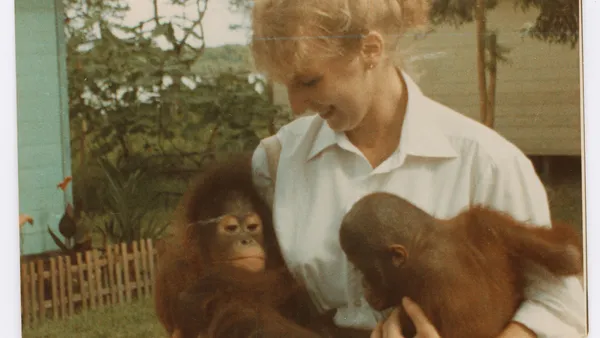
| Dr Lisa Jones-Engel early in her career. Tony Jones: 'I think her transition from scientist to activist is really interesting' Photo: Courtesy of Sundance Institute |
In the second part of our chat, we discussed the shocking hidden footage which forms a major part of his film. Shot in a lab in an undisclosed location in England, it shows what happens to the monkeys on their journey from arrival to mortuary, including testimony – some on camera and some anonymous – from workers.
It’s footage that required considerable safeguarding in terms of its handling, but it also requires trust on the part of those who shot it even to hand it over in the first place, so we began by talking about how Jones came across the film in the first place.
“I give enormous credit here to the Growing Kindness foundation, which funded a lot of the film and gave us complete editorial independence to make the film while they gave us their you know the initial funding to actually make it,” he says.
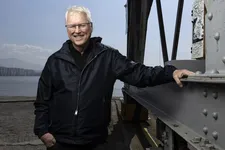 |
| Tony Jones: 'It was part of our ethos in making the film that we were never going to make it an out and out activist film' Photo: Courtesy of Thessaloniki Film Festival/Studio Aris Rammos |
“The people who did that – one of them, Jamie, agrees to go on camera – other people doing the filming wanted to remain anonymous for a variety of very good reasons. I don't think anyone's seen undercover footage quite like this before. It seems to have a very high professional quality – some people ask us, ‘How did you get a documentary crew inside those facilities? It looks like it’s been filmed like a documentary team would’. There's instinct involved, there's artistry involved. The methods of filming were very sophisticated.”
Speaking about safeguarding, he adds: “There’s tremendous risk for the people who are doing this and so we've tried as much as we possibly can to protect their identity and even to protect the identity of the people they're filming for a variety of reasons. Also we haven’t named the facility so that gives an extra layer of protection.”
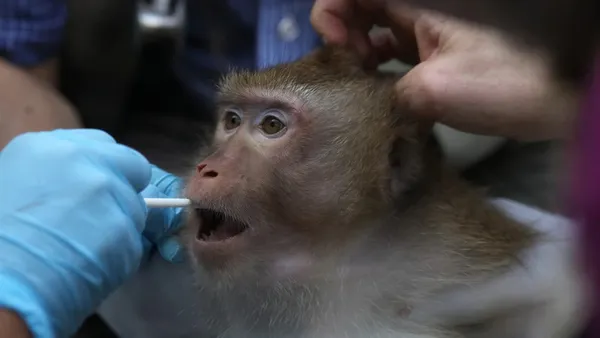
Jones’ films shows the tenderness developed between the animals and their handlers even as they are putting the animals through painful situations. What to show, in terms of animal suffering, was also something Jones considered carefully.
“There’s lots of editorial decisions you have to take,” he says. “To what degree you show the monkeys in pain. It was very tricky. I think if you've seen undercover footage from time to time online, it puts people off because it can be violent and ugly and what we wanted to do was to show the deep distress of the animals without actually necessarily showing the absolute horrors. We don't, for example, show the autopsies, the necropsies as they call them, although all of that was filmed.
“Frederick Wiseman made a film called Primate in the Seventies. It’s a black and white film and he showed literally everything back in those days, including taking the brains out of monkeys that were killed and those sorts of things. We made some concrete decisions not to expose people to the absolute horror but to expose them to or let them see and feel what the experience is like for the monkeys right up to the moment of their deaths.
“That was the hardest thing, to make those choices. But in the end, I think those are some of the most powerful scenes in the film. We won’t go into too much detail but to take these animals from the moment they arrive in these facilities through the ordeal they are put through. You see them clinging together and you see, you feel the emotions of the actual animals and the people who are dealing with them.”
He adds: “It was part of our ethos in making the film that we were never going to make it an out and out activist film. But our judgement here is that you let people see what's really happening and, in effect, the third act of the film, which is what happens inside these testing laboratories.
“You let people see what's happening and it makes its own argument, you don't have to, stand up and say, ‘This has got to change, this has got to stop’. People can make their own minds up. People are smart, audiences are really clever, and their emotions are engaged at quite a deep level. I've seen audiences struck dumb at the end of the film and many people in tears. That's kind of risky for a filmmaker because what you want is people jumping up and applauding your film in the classic way that they might do with a polemical film.
“But we want people to go away and think about this and have some quiet time to contemplate it. I would like people to get their kids to watch it actually in the same way that children watch films about climate change. There are so many things going on in the world which ought to change so that we could be living in a better world. This is one of them.”
There were other editorial choices too, including a nod to the changes that Robert F Kennedy Jnr – the current US Secretary of Health and Human Services – has brought in terms of moves to end animal testing.
Jones says: “One of the more controversial aspects of that film when we showed it in the US was very precisely that we have Robert Kennedy, an anti-vaccine nutter who, at the same time, is against testing on animals. It was a hard one because some people said to us, ‘If you put him in any way, shape, or form, it's going to turn off a lot of your audience’. I said, ‘Yes, but it happens to be a fact and that fact is actually changing things quite quickly’.
 |
| Tony Jones: There’s lots of editorial decisions you have to take. To what degree you show the monkeys in pain. It was very tricky' Photo: Courtesy of Sundance Institute |
Jones is pleased he was able to retain complexity with the film, bringing in factors including a history of testing, while also tracking the farming element of the monkeys that has grown up around the lab industry. He’s pragmatic though and knows, if the film makes it to the small screen, that it probably won’t be able to run at the same length.
“We're going to have to think very carefully about how we cut the film down, if we do, for that kind of marketplace. I want to do that without losing the qualities that you're talking about. I do think they're very important journalistically and in other ways. I would love the film to have a proper theatrical release, and in Australia, we look like we're going to be able to do that.”
He hopes that, in Australia, he’ll be able to go on tour with the film for a series of Q&As, and some festivals have already had him share panel discussions with scientists. As for those scientists featured in the film, nearly all of them were at the premiere in Sundance.
Tony says: “Primarily what they say is, ‘Wow, you know, you have actually presented this fairly. We can't make a complaint. We don't like the fact that you've got Lisa Jones-Engel as a key character, because she's now a member of an activist organisation that campaigns against us’.
“But I think Lisa's emotional response to her lifetime of doing this and the moment where she kind of has a light bulb come on of, ‘Well, I can't do this any more’ is also a very meaningful and quite an emotional point in the film. I think her transition from scientist to activist is really interesting. But if you're one of the fellow scientists who work with her for many years you're thinking, ‘Oh no, I disagree with what you’ve become’. They’re never going to love the fact that she's a key character in the film, but then they are key characters in the film.”
Looking to the future, the 70-year-old has no intention of slowing down.
“I will take every opportunity I can to make more films,” he says. “It's something I wanted to do from my first days as a journalist working on a Panorama-type programme. My first experience in television was working on a program called Four Corners, where I would make mini films which were 45 minutes to an hour long. That was my very first experience of doing any television at all. I moved away from that and became an on-air compere/presenter but I was also a foreign correspondent for six or seven years of my life as well. In that time you're basically making mini films.I would love to keep doing this kind of work.
“I won't go into any details but we have a documentary series with the Australian Broadcasting Corporation that we believe will be green lit fairly soon. I can't really tell you much about that for various reasons but I'm hopefully going to be able to segue into that project, you know, halfway through this year.
“Whatever you do, try to make it as cinematic as possible. But if you were to ask me if I would like to just keep making feature documentaries, that would be the absolute apex of what I could do at this end of my career. I’d love to do that for as long as possible but, as you know, and as everyone making films knows, getting the money to make these films is incredibly difficult. We were very lucky with Sentient. At least the critical success of the film would maybe suggest we’ll get another crack at doing things like this.”
- Read what Tony Jones said on scientific balance>/li>