 |
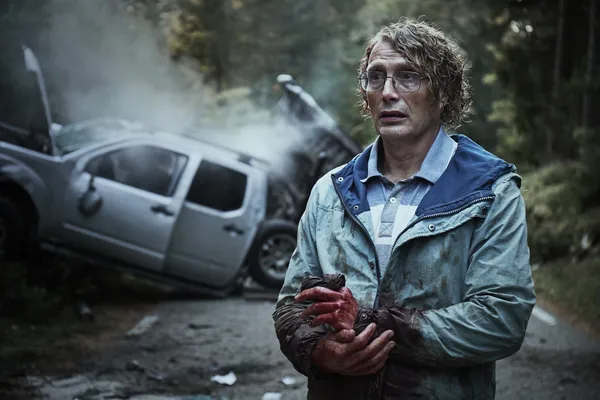
| Mads Mikkelsen in The Last Viking |
Fans of Mads Mikkelsen may be surprised by his turn in new comedy The Last Viking. It sees him reunited with fellow Dane Anders Thomas Jensen, but playing a very different character from anything he’s taken on recently. Socially awkward Manfred, who has always been a little different, is telling everybody that he’s really John Lennon. It’s a bit overwhelming for his brother Anker (Nikolaj Lie Kaas, best known internationally for his work in The Killing alongside Sophie Gråbøl, who also appears here) – especially as Anker has just completed a prison sentence for robbery and is hoping to retrieve loot which Manfred was charged with hiding. A dark comedy, the film nevertheless makes room for Mads to play his character straight.
“I think that anything I do with Anders Thomas Jensen is a different character,” he tells me when we meet to discuss the film. “It's always a challenge. It's a specific universe. I'm not drawn to do different things in the sense of like ‘Oh, here's a different character.’ I am drawn to work with Anders Thomas, and I'm drawn to obviously do different things in the sense of storytelling. And if that also includes a different character, it's even better.”
Do they have a particular way of working together?
“Yeah. I mean, it's hard put a finger on what it is. We've known each other for many years now, and exactly what it is – it's not one thing. I think it's evolved throughout our years together. Nikolaj, who's playing the lead here, has obviously been part of that journey as well. I think we've just grown older. We approach it differently, but we always try to push the envelope in the sense of ‘How far can we go with this? When do we lose ourselves and when do we lose the audience?’ We're never really sure if we did the right thing.”
I tell him that I think this is interesting because usually when we see characters like Manfred, they’re there to be the inspiration for the main character, and they don't really get an arc of their own. This is a very developed character who sometimes feels like he's a co lead more than a supporting character. Is that how Mads sees him?
“I think it is. I never really played the lead in any of these films, but it never felt like that because I played a character that, as you said, has an arc and is super important for the lead character.”
Did he approach this role as playing one person all the time, or was he sometimes Manfred and sometimes John?
“I was never John,” he says. “Manfred was not aware of who John was at all. Very early in his life, he figured out that his father loved John. Everybody loved John. And if that was the case, then maybe that would be a chance of his brother loving him, if he turned into John. It was as simple as that. I play him as somebody who's five, six, seven-years-old, who has not moved on from there. For him, the essential thing in life is that his brother comes back to him, the only one who's been backing him up and supporting him his entire life. So out of desperation, he turns to becoming John. It's dogmatic for him. What he really wants to be is a Viking, of course, but John comes in handy in terms of being loved.
“I didn't go deep down in personality disorder. It's opening up a can of worms, so you'll never satisfy everyone completely, because having a very straightforward diagnosis on a character is a different film in my world. I just wanted him to stop his development when he was six-years-old. He's just in an adult body, but he's behaving like a six-year-old, with all the loveliness that comes with that but also all the annoying stuff. So he's a mix of the two.”
Often when there is a diagnosis attached to a character like that, people just play the diagnosis and they stop playing the individual, I say. And he's a very rich individual in who he is as a person.
“I agree, I agree. And that's also like, you will bump into professional people who say ‘No, that's not the way it is.’ I wasn't interested [in that]. It's not a diagnosis film. It's a story about family. It's a story about love and how you are eternally connected to each other, no matter what you feel about it. And so that's the story we wanted to tell.
It’s something he can relate to on a personal level, he says.
“We never choose our families. It's what we are given. And sometimes it's a walk in the park, sometimes it's not, but it's always family. People have been dealt some cards and they have to figure out how to play them.”
The other thing I like about the character is the way that his intelligence and dignity come across. That's something we don't always see with someone with that kind of difficulty.
“No. True,” he says. “We've been in that universe before where some of the characters have been, in one way behaving quite childishly, and in another way being sophisticatedly intelligent in other spectrums of life. This guy maybe not so much, but he's definitely very honest, whatever he does. There's other characters I've done who would have been conscious about manipulating their brother in certain ways. This guy is not. He's just very intuitive and it goes directly into his feelings.”
That combination of sophistication and childish behaviour makes me think of Another Round, I venture, and he says that yes, alcohol provided the impetus for it there. It’s quite a contrast, I note with the tightly restrained performance he delivered in another film scripted by Jensen, The Promised Land.
“Yeah, that's a very stoic character in the Promised Land,” he agrees. “Not only because he is himself, but also because at the time stoicism was sort of, well, everybody was, if he were a male character. I mean, we had to filter out a lot of contemporary emotions, or maybe not the emotions, but at least actions. You know, the way you hug each other, the way you [are] constantly asking each other ‘How are you? Okay? Is this fine?’ Blah, blah. Those things were not present in the 1700s. So, yes, it becomes quite stoic. But he's obviously a man of morals, and so I get the chance to see him soften up later on in the film.
“This is also a film about a very stoic character in Anders Thomas’ world. Here when he's directing [for] himself, there is an enormous liberty because it's not a secret that there's also a comedy layer to the film. He's a very poetic man. He tells very poetic stories, but it is wrapped insanity. And there's a certain freedom of throwing yourself out of windows.”
And stealing dogs, I point out.
“Yeah, stealing dogs, of course. Who cannot relate to that?”
It’s wonderful being on set with the same people, he says.
“It is coming back home, there's always a risk of us pulling out the same drawer because we are so comfortable with each other. But I think that we have achieved – at least we're trying to achieve – that we will push each other a little further because we feel safe in each other's hands. So if we do fall, there will be somebody to lift us up again. So that's another reason why it's fantastic to come back to your favourite colleagues.”
He got a European Film Award nomination for this film. He’s had quite a few awards in recent years. Does that change the way he looks at the work?
“No, it does not. It is the icing on the cake. We start by trying to make something that we would love to watch ourselves and tell stories that we would love to spread out to whoever wants to see it. And then if that accumulates at the end as an award nomination, that's just the icing on the cake. But it can never be what we set out to do.”
It does lead to more varied offers of work, he acknowledges, but that’s not something he really concerns himself with.
“I think the work itself is doing it. I think that if people watch the films and they pay attention and they also happen to like it, that will do the trick. Obviously, if people haven't noticed you and you keep getting nominated, then they might become curious about watching your stuff.”
Americans tend to think of him primarily as a villain. Is that limiting or is it something that's fun in its own way?
“Well, it's obviously limiting in America, but the alternative is worse – that I'm not working there at all. I'm not going to complain. I mean, I get fulfilled in a lot of different ways back home and in Europe. And if the Americans want to see a bad guy, I'm here. But I've also been lucky to do other things in America. In Autumn, I'm going to shoot a very beautiful drama, cinematic film. So things are changing a little.”
Is there any one thing that he’d particularly like to do in his career now that he hasn't had the chance to so far?
“Not in terms of a specific character. I mean, certain specific characters also belong to theatre, if you say that, but I don't have a little Hamlet inside. I think Hamlet's been done so many times, and done to perfection multiple times. My dream character lands on my table if I get offered something that I really like, and then it becomes my dream character, and then I seclude myself with the director for six months, and then it's over.”