 |
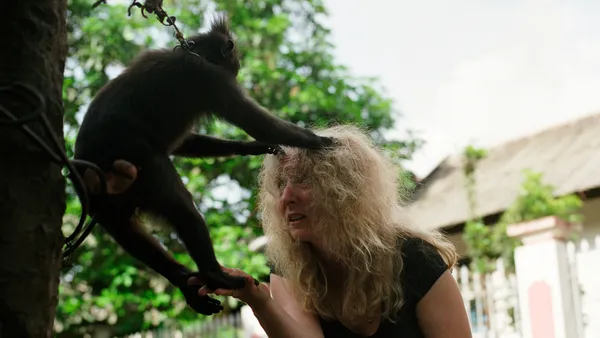
| Lisa Jones-Engel in Sentient. Tony Jones says finding her 'pushed us towards a kind of big narrative film' Photo: Courtesy of Sundance Institute/Lynn Johnson |
Now, at 70, he has made his feature directorial debut with Sentient, a film that digs into the thorny question of laboratory testing on animals. Built around testimony from scientist-turned-activist Dr Lisa Engels-Jones, it also includes interviews with scientists who argue for the continued need to use monkeys – and, specifically, macaques – in medical research. Through the course of the film, Jones tracks the monkeys from industrial scale farming to US labs, while the film also features disturbing undercover footage shot at a lab in an undisclosed English location. His even-handed film, which premiered at Sundance and recently showed at Thessaloniki Documentary Film Festival (where it won an audience award) and Docville in Belgium, considers not just the impact on the animals themselves but on the scientists who experiment on them, showing a legacy of reflected trauma.
When I catch up with him for a chat in Thessaloniki, Jones says the kernel of the idea for his film sprang from his work on television.
He explains: “There is a bit of a backstory because the notion of doing something on the sentience of animals came up when I was doing a programme called Q&A in Australia, which is our version of Question Time. So it was very similar and I was moderating and sitting next to Peter Singer, the author of Animal Liberation, the ur text on animal rights and animal liberation. Someone asked a very general question about animal rights, effectively, and he said this very controversial statement: ‘I think that in years to come, we're going to look back at how we treat animals now in the way we now think about slavery in the 17th and 18th centuries’. As I've said many times, the audience took a bit of a breath because you don't want to be comparing human slaves with captive animals. But nonetheless, it caused me to think about this idea and I started researching the new science of animal sentience.
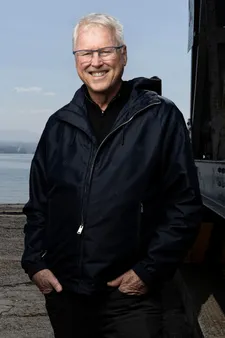 |
| Tony Jones in Thessaloniki: 'We wanted our film to be empathetic' Photo: Courtesy of Thessaloniki Film Festival/Studio Aris Rammos |
It’s a tricky proposition, given that Jones-Engels now works with activist organisation the People for the Ethical Treatment of Animals (PETA), who are not exactly popular with scientists who work with lab animals.
“This was a balancing act because we didn’t advertise to either of them that we were talking to the other side,” says Jones. “We came across Lisa first and started filming with her some years before we actually got access to the laboratory where she had spent many, many years working. And the reason we went to Seattle University of Washington Primates Centre is because a bunch of their scientists opened up in a science magazine article called Suffering In Silence, where they started talking about the consequences for them psychologically of the work they do with animals and, in particular, with primates, with monkeys.
“It was that that got us into that laboratory. They had decided it's time to start talking about this, to be open about it and to let the public know that, you know, ‘We're actually not these kind of heartless robots that people think we are. We care about the animals that we're in, the end, experimenting on, ultimately, in many cases hurting and ultimately killing’. You have to make a big distinction here between testing and laboratory research. That's how we actually got through the front door.”
Jones takes a nuanced approach to the debate, not least because he has Type 2 diabetes, which he takes medicine for.
He adds: “I know those medicines have been tested on animals and I haven’t made an in principle decision not to take medicine. I don't think any of us do. I’ve got a family, a bunch of boys, and we obviously would not have refused them medicines. But I think the important thing here is to consider how quickly you could get out of this spiral of hurting animals in order to test drugs and so on.”
One of the areas Sentient digs into is a sort of “medical industrial complex” that has grown up around the macaque monkeys, which are bred in Asia at huge scale for shipping to labs in the west.
“It is almost like a secret world, isn't it?” says Jones. “I like the phrase medical industrial complex because it is exactly that. Billions and billions of dollars have been invested by the pharmaceutical industry and its component parts to create a system beginning, as we see in that film, with the breeding farms, many of which are in Southeast Asia. They’re breeding farms for monkeys, monkeys being the key animal at the top level now you can't use apes and chimpanzees any more, at least in the western countries. But you can use monkeys.
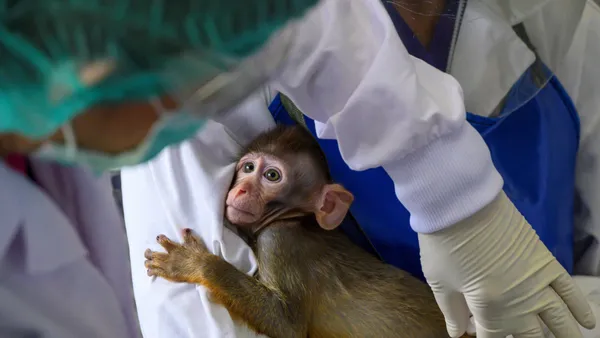 |
| Tony Jones on the monkeys: 'You don't want to say they're like humans but they are human-like' Photo: Courtesy of Thessaloniki Film Festival |
That human-like element is strongly brought home by a wall of paw prints, which the scientists in the lab keep in remembrance of the monkeys that have been part of their experiments. It’s almost like an array that you might see in a play school or kindergarten class and it brings home the cognitive dissonance experienced by the scientists between caring for and killing the animals..
“It's astonishing, isn't it?” says Jones. “The wall of paintings of the paw prints of animals were done just prior to them being dispatched into eternity. So animals that people have come to know and love, and in many cases feel quite deeply about, are then killed as part of the process. They call it reaching the end point of the experiment – they rarely ever say the word ‘kill’. In fact, there's a vet that makes that point. He says: ‘Let's not mince words, we're killing these animals’. But the idea that you feel so attached to the animals that you want to remember them so you actually dip their paws in paint and put their paw prints on bits of paper and write their names down and the dates of their death, it's very weirdly moving.
“I think that phrase ‘cognitive dissonance’ is spot on. The idea that you're experimenting on animals, you're hurting the animals. At the same time you, you may have them in these little translucent boxes where they've been drugged and they're not very well and you can see the little paws coming out of the holes in the side of the box so that they can actually have some contact with another being. And, in this case, it's the human that's actually effectively torturing them. So you're touching the hand that's torturing you just so you have some contact with another sentient being, I mean, it's quite moving.”
One of the most striking elements of the film is how visibly affected the scientists are when they talk about their memories of working with the animals, showing the lasting impact upon them, even in the case of mice. One man comes to the brink of tears as he recalls an incident involving one mouse in the tens of thousands he killed for his work, where things went wrong
Jones says: “We put that in deliberately because most of the film is about monkeys and you can identify with monkeys because, as I said before, they have human-like qualities. Mice are from another planet, in a way, they don't seem like that – but if you spend a lot of time with them, that's not the case, you kind of get to like them as well. But at the same time, in the case of many, many scientists, they're killing hundreds if not thousands of these animals each week. He was doing it and he shows the technique by which he was doing it and it just got to him after a while. You can tell he had one terrible accident and that has haunted him and he's in tears when he's describing the story about what happened years before.
“I was surprised. It's the only time that you actually hear my voice in the whole film. I said, ‘So why do you feel like this after so many years?’ And he said, ‘Because it suffered.’ I think that’s, in a way, the whole point.
Jones adds: “What did that mean for us as filmmakers? Well I've often described it in this way. We wanted our film to be empathetic. We wanted to have empathy for the animals and empathy for the people who are hurting the animals, and at the same time, hurting themselves. Part of the reason for that is very simple, there's very little empathy in the world at the moment. If you were approaching this as activists, we’d have a different kind of way of dealing with this. You would think of those people, probably as being monsters and you'd be unforgiving towards them and so forth.
“But I think when you see that people are suffering and animals are suffering, you probably want to give equal weight to it. I'm sure that there'll be those that say we’re too sympathetic to the scientists. But I get back to my earlier point that I'm not anti-science, I'm not anti-medicine – absolutely the opposite – I just think we need to get to a point as quickly as we can, and this means a massive retooling of these industries at great cost, to get away from using animals in this way. We now know and we have a glimpse of it in the film, that the technology is there to be able to do this more quickly.”
Sentient, which is being repped for world sales by Dogwoof, is currently continuing its festival run, screening at Movies That Matter in the Hague in the past week. Look out for the second part of our interview, in which we talk about the hidden footage in the film, safeguarding those involved and the participants’ reaction to Sentient when they saw it.