




 |
| Christophe Réveille: 'We were starting to think how we could put the audience into the skin of those people' |
Réveille has been living and breathing this remarkable chapter of the tale for more than two decades, since he first met Benigno, one of Che’s men who went on to become an exile in Paris. After hitting it off initially, Réveille – whose regular job is actually as an acting coach – went on to help the former revolutionary to write his autobiography Benigno: Che’s Last Companion, and some years later a graphic novel, Benigno: Memoirs Of One Of Che’s Guerrillas. This became the jumping off point for what would be a whole raft of additional interviews with key players, which culminated in his documentary, which screened Out Of Competition in the Cannes Special Screenings section this month.
In addition to interviews with Benigno, Révielle also spoke to his fellow fighters Urbano and Pombo. “My survivors didn’t know the huge amount of history they were carrying on their shoulders,” he says.
Catching up with him after the film’s premiere at the festival, he acknowledges that after two decades and interviews that also included CIA agent Félix Rodríguez, Bolivian army captain Gary Prado and French journalist and Guevara supporter Régis Debray, he had “a huge amount of material”.
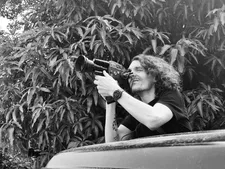 |
| Christophe Réveille: 'I thought, if I tell this story I can help the teenager I was' Photo: Julien Schickel |
The director says this approach provided him with a jumping off point to travel back in time with the men to the start of their associations with Guevara.
“When you lose someone important, like Che was for them, I think the first night when they were walking in the forest by themselves, just the six of them, I'm pretty sure that they were rewinding how they met him. So there is a door to talk about the beginning after 10 minutes. I wanted to do that for teenagers, because I lost someone important when I was a teenager and this story gave me a reason to keep going. I know it sounds like it's not true but it's true because I was anorexic under cocaine. Thirty years ago nobody was going to bet on me. Even I would say, ‘This guy is not going to live a long time’. Then I found this story, and I thought they lived through something worse than me and they kept going and I fight for the others. Who are you to kill yourself with anorexia? I thought, if I tell this story I can help the teenager I was. So I started with one of them and it took 20 years to get all of them.“
From that point on, Réveille asks us to walk a couple of thousand miles in the men’s shoes, interweaving their first person testimony – in which, despite their ideological differences they corroborate one another’s accounts – with animation and footage from the often harsh terrain they moved through. In fact, the director also took risks, heading into one ravine, which had poisonous snakes, while forgetting to take the antivenom from his jeep.
Still, the veracity of it was important to him: “We really went to all the places they went. We did the same trip. For me, that’s precious.”
He collaborated on the animated sequences with Simon Géliot, who co-wrote the graphic novel.
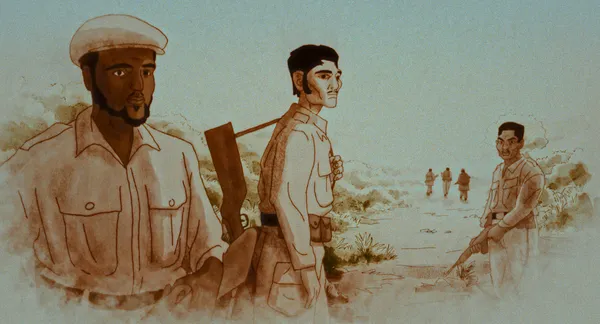
“We were starting to think how we could put the audience into the skin of those people,” he says. “There is the memory road – the trip they did, where it happens. Then I was, like, ‘Yes, but we’re still missing something.’ For me, it's really interesting just to hear them talking, but to put the audience in their shoes, we miss the action.
“Then we were, like, why not use animation? I was like, ‘It's expensive, blah, blah blah’. So, I called a friend of mine. I said, ‘Do you know people from animation? And she was like, yes, I have a friend and he's the producer Baptiste Salvan. He was just supposed to give me advice. We were supposed to spend 20 minutes with the coffee and then after two and a half hours, he was like, ‘I have to go but I'm just a young producer with my partner Gaëtan Trigot, but maybe we can do something’. I said, ‘Let’s try’. After six months we went into production together.
“I call them my lucky charms because as soon as they ask for money we get some.”
The film also features narration from French star Vincent Lindon, who Réveille says brought a lot to the project. He’s also keen to point out that the most important thing for him was to tell the truth, an honesty that he says helped him to get such a range of disparate voices on board with the project.
“Because I told the truth, they all accepted being part of it,” he says. “I didn’t betray anyone in the movie. I really let them say what they wanted to say. Even the military guy who said, ‘It's our obligation to protect our country from the enemy who's coming with arms’, I was like this is important. If I was just pro-Guevara, I would say, this is an arsehole and would cut it but I wanted him to tell his truth.”
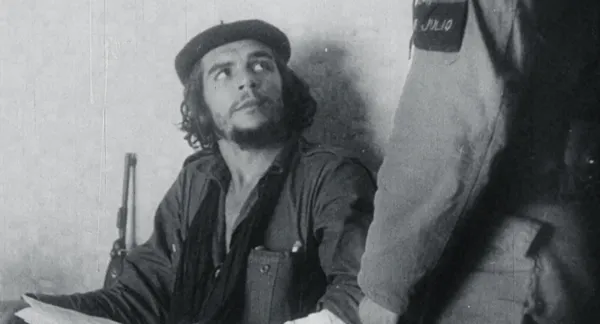 |
| Christophe Réveille on Che Guevara: 'What I want the younger generation to realise is that Che Guevara was not alone when he did that' |
As for Guevara himself, he muses: “When you die young, you avoid disappointing people. Like if Castro died 45 years before and he just spent 15 years in Cuba, it would be easy for him. With Che Guevara, for us, our generation, we know him. What I want the younger generation to realise is that Che Guevara was not alone when he did that.
“How he decided to change the world by using violence, I still question that myself. I’m scared about my own violence. I realised 10 years ago that the people who are in charge of the world are all using violence. I don't like that, but it works. Should I say we have to be violent? No. But I’m not violent because I’m a bourgeois privileged person. But if politics touches what’s most important for me, which means my daughter, I think I can kill for my daughter, so I'm scared about that. So I try to prevent that and say maybe we can talk before resorting to violence.
“I think it was too late for Che. He touched the violence and it worked for him the first time in Cuba.”
Looking to the future, he’s planning another documentary featuring Swann Arlaud and Regis Débray.
“I said to Swan and Regis, ‘If you meet and it doesn’t work, I let you go’. Then they came and they appreciated one another. Now I have to go back to Paris and my editor who makes me cry and who is going to co-direct this one with me because he’s a genius.”
The other thing he plans to do when he gets back to Paris is something special for Begnino, who died in 2016.
“I bought a little Palme d’Or brooch and I’m going to put that on his grave. I promised him in 2004 that I would do something, and I did it.”
Watch a clip from the film below: